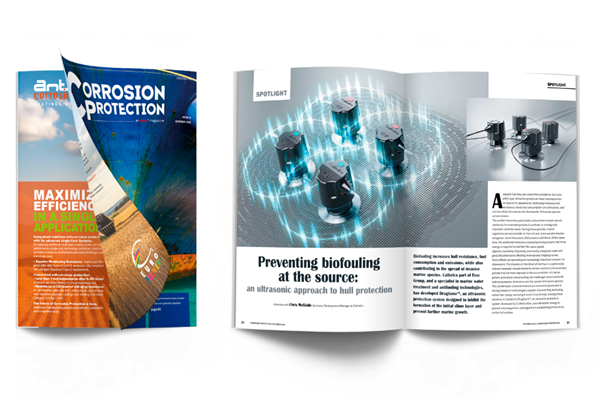
Read the latest issue of the magazine dedicated to corrosion prediction, prevention, protection and mitigation!
Corrosion protection should never be treated as a step to be addressed only after a project is complete, but rather as a strategic element to be incorporated from the earliest design stages. Whether it involves organic coatings, inorganic treatments, cathodic protection systems, or antifouling treatments, the choice of the right solutions should take into account the operating conditions, the exposure environment, the expected service life, and the performance requirements of the structure or component to be protected.
An integrated design approach enables the prior assessment of compatibility among materials, protective technologies, and operating conditions, thereby avoiding late, costly, and potentially ineffective corrective measures.
Surface preparation plays a crucial role in this regard: the removal of contaminants and the achievement of the required surface profile are essential to ensure the adhesion and durability of subsequently applied coatings.
Similarly, maintenance planning should be defined at the design stage. Regular inspections, performance checks, and preventive maintenance enable the early detection of signs of degradation and help to extend the service life of structures.
Corrosion protection can thus be viewed as a process comprising three closely interlinked stages: surface preparation, protective system design and application, and long-term monitoring and maintenance. Only by taking a holistic view can costs be optimised over the life cycle, reliability increased, and the sustainability of industrial investments ensured.
That is one of the key concepts addressed in the numerous articles featured in this issue of Corrosion Protection, which focuses on technologies for the marine and offshore sectors.
The other recurring theme is the automation and robotisation of surface preparation. The use of automated platforms and robotic systems is one of the most promising avenues for the evolution of this process stage: these technologies enable operations to be managed with controlled, repeatable parameters, reducing the variability associated with manual intervention.
As well as promoting process standardisation, these solutions help to improve operator safety by limiting exposure to harsh environments, dust, and potentially hazardous substances, and by reducing the need to work underwater or at height. Process data collection also enables the documentation of operating conditions, verification of compliance with specifications, and prompt identification of any anomalies.
Underwater robots, remotely operated vehicles, and autonomous systems take on even greater importance in applications where inspections and manual interventions are particularly complex, costly, or risky. This is the case with pipelines, offshore structures, and the submerged sections of ship hulls, where limited accessibility and environmental conditions make both surface preparation and treatment quality control difficult.
A further advantage is the ability to integrate sensors and monitoring instruments to collect data on surface conditions and document the work carried out. This information helps to make maintenance planning more effective and to identify any signs of degradation promptly.
All these topics, together with the impact of the crisis in the Middle East and the challenges associated with the Strait of Hormuz, will be central themes at ADIPEC, one of the leading international events for the energy sector, taking place in Abu Dhabi from 2 to 5 November. Corrosion Protection will be there with its own stand (#16008), distributing this issue to visitors.
READ THE MAGAZINE!