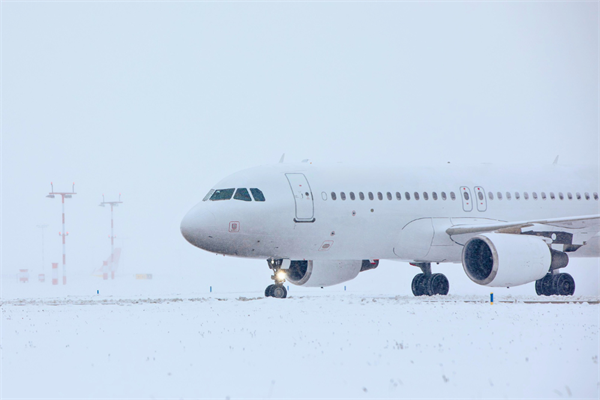
This research project, co-funded by the Spanish Ministry of Science, Innovation and Universities and ERDF funds, addresses a critical challenge within the aviation sector: ice formation and its severe operational consequences.
A pioneering collaboration between OMAR Coatings, the AIMPLAS Plastics Technology Centre, and the National Institute of Aerospace Technology (INTA) is developing an energy-efficient heated coating to improve aviation safety against icing.
Ice accumulation during flight remains one of the most significant obstacles to aviation safety and operational efficiency. The presence of a thin layer of ice on wings can reduce lift by up to 30% and increase aerodynamic drag by 40%, severely compromising aircraft performance. Furthermore, aircraft are exposed to icing conditions for approximately 15% of their service life, a factor that exacerbates impacts on fuel consumption, structural stability, and maintenance requirements.
To mitigate these risks, the COAT-IPS project has developed an anti-icing protection system based on a Joule-heating coating. Formulated as a technical paint, this innovation offers low energy consumption and acts in both anti-icing and de-icing modes, providing a rapid and efficient response to challenging weather conditions.
“In a sector moving towards more efficient and sustainable mobility, it is essential to develop solutions that reduce energy impact without compromising safety. The solution we are presenting represents a significant innovation in the aeronautical field, as it allows for direct application onto the aircraft’s surface and adapts easily to areas with complex geometries,” has stated Blai López, a researcher in Coatings, Adhesives and Converting at AIMPLAS.
He noted the limitations of current anti-icing technologies, such as engine bleed air, pneumatic boots, and electrothermal systems, which are often hindered by high energy consumption, added weight, control difficulties, risks of overheating, and limited efficiency under specific conditions.
In addition to its energy efficiency, the coating is compatible with standard aircraft paints, is lightweight due to the lack of auxiliary systems or transformers, and is fully repairable. This allows for on-site repairs at the point of damage, eliminating the need to discard or replace entire systems. Consequently, COAT-IPS offers an optimised formulation tailored for structural manufacturers, unmanned vehicle producers, and the broader coatings industry.
The development of COAT-IPS leverages the distinct expertise of its three partners to take the coating from formulation through to real-world validation:
- AIMPLAS: Provides the original development of the heatable formulation and expertise in advanced polymer technologies.
- OMAR Coatings: Manages industrial development, optimising the coating and application process to ensure scalability and suitability for on-site repair.
- INTA: Defines the technical requirements and conducts characterisation and validation tests in environments representative of end-use, ensuring the system’s performance under real operating conditions.
“COAT-IPS provides a direct response to the aeronautical sector’s need for lighter, more efficient and sustainable technologies that enable reduced fuel consumption and improved flight safety,” has concluded the AIMPLAS researcher.