The shift towards fully digitised surface finishing marks a major milestone in the creation of smart factory environments. Digital production processes enable not only more efficient and economical manufacturing but also greater precision. Through digital simulation modules, intelligent data exchange systems, and advanced process monitoring software, Rösler equips its customers with tools to transform industrial challenges into opportunities.
Rising demand, a shortage of skilled personnel, and mounting cost pressures are presenting significant challenges for manufacturers of orthopaedic implants. At the same time, advances in implant materials and highly intensive finishing methods are opening new opportunities in joint replacement production. With its digitised surf finishing technology, Rösler offers a solution that combines high precision with process stability and cost efficiency. Notably, the system can handle extremely hard materials such as ceramics, bringing the industry a step closer to a smart factory environment.
Globally, joint replacement surgeries are increasing rapidly. Experts predict that by 2030, around 3.5 million artificial knees will be implanted in the United States alone – a sharp rise from approximately 600,000 knee implants in 2020. Despite this surge, many orthopaedic implants still receive their final surface finish through manual processes, which are time-consuming, labour-intensive, and prone to significant quality fluctuations.
“The implant industry faces a huge challenge, namely, to produce ever increasing implant quantities in a cost-efficient manner and in a consistently high quality. At the same time, the demands for a longer usable life and compatibility with the human body are continuously increasing. The manufacturers react to these challenges by making the artificial joints from materials like titanium, ceramics or ceramic-like coatings. However, the latter, because of their hardness, no longer allow manual surface finishing,” has explained Michael Striebe, Global Sales and Process Expert for medical engineering at Rösler Oberflächentechnik GmbH.
Rösler’s surf finishing technology offers an especially efficient method for treating orthopaedic implants, even those made from extremely hard materials. Compared with conventional vibratory machines, surf finishing is up to 40 times more intensive – the most intensive mass finishing method currently available on the market.
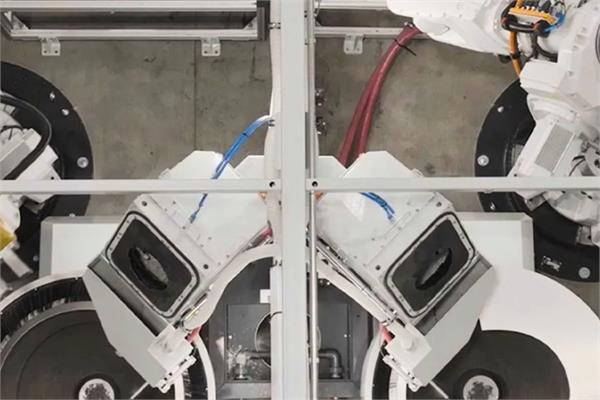
Surf finishing machines feature a carousel with multiple rotating workstations, each equipped with spindles onto which workpieces are mounted. The carousel is then lowered into a rotating processing bowl filled with grinding or polishing media. Depending on the design, up to 16 workpieces can be treated simultaneously. The exposure of workpieces to the media stream, combined with precise spindle motion, allows targeted treatment of specific surface areas, making the technology ideal for components with complex geometries. For instance, the “joint box” on femoral knee components can be mechanically finished without any manual post-polishing. Rösler surf finish machines even enable the processing of aluminium oxide ceramic implants to a world-class finish.
The digitisation of the entire finishing process represents another breakthrough. Special simulation software enables full evaluation of mass finishing processes using 3D models, allowing process parameters such as immersion depth, treatment angle, and potential shadowing to be assessed during planning. This accelerates process development and reduces costs. Up to 90 per cent of the process can be defined digitally, with the remaining 10 per cent verified through essential trials under real operating conditions.
Digitisation also enables direct data exchange between CNC machining centres and surf finishers. By supplying machines with 3D workpiece dimensions and tolerances, processing times can be automatically adjusted, increasing throughput and reducing media and compound consumption. Linking machines digitally across different process stages enhances the efficiency of the entire value chain, while also elevating the quality of orthopaedic implants.
Rösler’s patented software module, Rösler Smart Solutions (RSS) Comfort, ensures comprehensive process documentation and operational stability. The software monitors process water quality from a cleaning and recycling centrifuge connected to the mass finishing equipment, allowing realistic assessment of surface finish quality.
“We even go one step further. In the near future we will collect and analyse the consumption of all consumable items (media, compound, etc.) with the RSS module. This will then allow our customers to review and control the costs of their finishing process,” has added Michael Striebe.
At the heart of this software expansion is continuous information exchange between the centrifuge, mass finishing machine(s), and software. Key process data – such as process water contamination, pH value, and electrical conductivity, is automatically measured and recorded. In the event of deviations from preset values, the system automatically adjusts the dosing of cleaning additives, maintaining high-quality process water without operator intervention. All process adjustments are fully documented and traceable. Rösler is currently the only company offering this unique digital control system.