As we reach the midpoint of 2026, with the global chemical supply chain continuing to be reshaped by geopolitical tensions, regionalization strategies, and evolving economic conditions, taking stock of the current landscape is more important than ever. With this objective in mind, George R. Pilcher, Vice President of The ChemQuest Group, Inc., presents this insightful analysis, offering a clear perspective on a market that remains in constant evolution. A consulting firm specializing in business strategy and technology development for the specialty chemicals, advanced materials, and formulated products industries, The ChemQuest Group has been collaborating with the ipcm® magazines for many years, providing analyses that help readers interpret the dynamics of the global chemical industry through a practical, business-oriented perspective. In this latest contribution, Pilcher reviews the events that have transformed global supply chains over the past few years and assesses their most recent developments, offering readers an up-to-date overview of the challenges and opportunities facing the industry today.
The global supply chain disruptions of 2020-2022 that lingered, in certain cases, through the end of 2023 caused unprecedented misery throughout the entire global specialty chemicals market space, and the paint and coatings industry suffered mightily as a result. Supply chain disruptions of this magnitude had never previously been experienced on a global basis, and there was a tendency, beginning in late 2023/early 2024 to talk about “The Great Supply Chain Crisis” in the past tense, which—as a specific historical event—was accurate. From the more perceptive survivors of that period, however, there emerged the feeling that there was every likelihood that, far from being a “once in a blue moon” event, major supply chain disruptions would be likely to recur periodically in the future, especially as nations of the world are ruled by increasingly polarized and paranoid governments. Two years later, there seems to be little doubt that they were right. Looking out at the state of global affairs in mid-2026, we have no choice but to ask, "What effects are we going to see down the road as a result of the prolonged crisis in the Strait of Hormuz and the resulting disruption to traffic through this strategic shipping route, which carries roughly 20% of the world's crude oil on its way to destinations east, south, and west?"
One could argue, of course, that very little of this crude is headed directly to the Western Hemisphere, and the European Union (EU) receives only about 4% of it. China and other countries in the Asia-Pacific region (APAC), however, receive the lion’s share, and the disruptions to their supply chains affect the entire globe, given the amounts of specialty chemicals, derived from crude oil, which are shipped from the APAC region to the rest of the world. The International Monetary Fund (IMF) estimates that disruptions caused by the conflict with Iran could push global headline inflation (including food and energy) to 4.7% in a scenario of gradual restoration of full operational capacity in the Strait of Hormuz. In the “adverse scenario” outlined by the institution – which implies a prolonged phase of instability and significant restrictions to traffic along this route – the rate could instead rise to as high as 5.4%.
Probability of global supply chain disruptions
Although not a subject for blissful contemplation, the truth is that supply chain disruptions are likely to become a periodic occurrence in the years ahead—there are sure to be ongoing tensions with Iran that can trigger additional incidents in the Strait of Hormuz; the persistent political instability in oil-producing nations like Libya, Venezuela, and Nigeria threatens sudden, unexpected drops in local production, exacerbating global supply chain friction; and the Houthis are still capable of causing chaos in the Red Sea. While it is true that the oil-producing countries of the Middle East are allocating billions of dollars to create alternate pathways for their crude to bypass the Strait of Hormuz on its way to market, these measures, while significant, can only deal with current known threats. “What we don’t know that we don’t know” will always be lurking around the corner to create the next supply chain interruption, so it doesn’t make sense to build the new pipelines and ports and then breathe a sigh of relief… this would not be a realistic view of the world in which we currently live and isn’t going to improve in any substantive fashion tomorrow or the next day.
The entire global economy depends to a shockingly high degree upon a fragile foundation of crude oil, the commodity and specialty chemicals derived from it, and the vast array of products in all areas of life that are produced from those specialty chemicals. Specifically for the paint and coatings market space, of the components in the cost of goods sold (COGS) equation, global raw material input costs remain the most challenging. The industry average COGS in mid-2026 is approximately 50%, which is higher than what the industry is used to, and it is presenting a series of challenges that formulators have faced on occasion in the past but not in such a concentrated manner as is now the case. Moreover, raw material prices are facing a renewed wave of volatility—it is reasonable to say that the relative stability in raw material pricing following the post-pandemic period of inflation is being disrupted by geopolitical disruptions that are wreaking havoc with the industry’s earlier expectations of long-term price moderation. Instability in energy supply and pricing are, more than any other single factor, impacting logistical chokepoints and chemical feedstocks and resulting in a structurally elevated cost basis for paints and coatings producers. This is leading to renewed interest in concepts that should have become second nature to all manufacturers in 2022-2023, but which only particularly astute producers put into practice in any meaningful way:
- Near-shoring, ally-shoring, friend-shoring, onshoring, and favored nation-shoring
- Domestic production contractors to assure sufficient supplies of critical raw materials
- Multiple-sourcing strategies.
This is a sobering thought, indeed, and one that should be prepared for by all industries and individual manufacturers that either produce or use specialty chemicals. Historically, in the paint and coatings industry, raw material suppliers and coatings manufacturers were in a genuinely codependent relationship in which what was good for one was good for the other—and in which what was bad for one was bad for both. Today’s reality suggests that raw material suppliers seem to understand this, but it is not at all clear that their paint and coatings customers either understand or appreciate the critical nature of this relationship, as well as the range of potential effects, both positive and negative, that are likely to arise as a result of how they treat this relationship. The industry needs to return to its roots and redevelop those cooperative ties between coatings producers and raw materials suppliers—and the sooner, the better. This should be a cardinal article of every serious strategic plan created by both coatings’ producers and raw material vendors.
 © AdobeStock / Corona Borealis
The glimmer of light at the end of the tunnel
It is possible that we are finally beginning to see a hint of this approach being taken in 2026—quite recently, an acquaintance in the distribution arm of the paint and coatings industry indicated that coatings companies seem to be becoming more curious about “what’s new in the world of raw materials” and are relaxing some of their restrictions of the past 10-15 years with regard to the amount of pre-work that the raw material suppliers need to undertake before the coatings companies will take a look at their new products. If this turns out to be a nascent trend, it will be cause for kudos all around and will be guaranteed to produce positive results for whichever coatings producers are involved. It is no secret that there has been, over the past 10-15 years, a deep-seated belief among producers in the coatings industry that “there is nothing new from the raw material suppliers,” and it hasn’t helped anyone in the industry—neither the coatings companies nor their suppliers have benefitted as a result of this uncooperative and, consequently, very non-productive attitude. Why? Because this comment has been uttered in stark contradiction to the continual flow of new raw materials from those selfsame suppliers. A change in attitude about this topic is likely to be the single greatest boon to future coatings growth and successful development of new, value-added products… That the tide may be turning is hopeful news, indeed, but it will not represent full-fledged “good news” unless it continues into the future. The great paint and coatings developments of the past—latex paint, powder coatings, cathodic electrodeposition, coil coatings, energy-curing coatings, polyurethane dispersions, and several other notable innovations—were only possible as a result of high-level cooperation between raw material suppliers and paint and coatings producers. In the year 2026, nothing has changed—major developments going forward will only be possible with the resumption of increased cooperation between coatings producers and their raw material suppliers.
Opportunities for innovation abound—using both new and underused raw materials
Strolling aisles of the American Coatings Show 2026 afforded attendees an impressive opportunity to see how many new raw material products were being introduced, but at least for one attendee (the author) it was also a somewhat bittersweet experience, insofar as it was a reminder of some of the exciting materials introduced over the course of the past two decades that have still not received the level of interest and usage that they clearly deserve. One understands, of course, that some new raw materials that are of interest to one person may not necessarily be of interest to another, but sometimes the neglect is simply the result of lack of proper evaluation time, ineffective sales/distribution efforts/channels, poor marketing, and/or protocols by the paint and coatings producers that put handcuffs on the scientists/technologists who are responsible for new product development. Particularly discomfiting are those cases where a new product is truly unique and made by a single supplier, which tends to evoke terror from the hearts of supply chain managers whose heads might easily be on the chopping block if they are unable to secure appropriate supplies of a critical raw material. Examples of the latter include items that might be uniquely valuable to the coatings industry if given the chance. For example, Astro-Cooler’s insulated blankets and quilts protect truckload quantities of wines, carbonated beverages, and pharmaceutical items from winter temperatures, and they would presumably be able to prevent waterborne paint from freezing almost as well as wine or carbonated beverages, at a fraction of the cost of temperature-controlled trucks—but no one will know until more companies shipping waterborne paints and coatings evaluate them. Likewise, many formulators over the past decade have indicated what a remarkable job FP Pigments do maintaining opacity while reducing titanium dioxide loading, for primers and a variety of topcoats, especially in waterborne systems. When queried if they have incorporated these pigments into their products, however, the answer is typically some version of “no—we weren’t allowed.” Why are raves coming from technical people but evincing blank stares from production people, who clearly are not working with them? Whatever the reasons, we should allow for the possibility that it may have little or nothing to do with the value of the materials but rather the willingness to forego potential product improvements for fear of “rocking the boat.” To be a dynamic competitor in a relatively mature industry, no coatings producer can afford to allow fear of change to prevent it from planning, and then executing upon, a forward strategy that will maintain it as a market leader or propel it into a market leadership position.
What lies ahead?
Clearly, there are events on the horizon that may or may not happen, but even the absence of any given event will create a degree of global speculation that is going to affect both the markets and the manufacturing businesses themselves, as everyone scrambles to read the tea leaves and plan accordingly. No matter how one looks at it, this is not a pleasant scenario to contemplate…
What is pleasant to contemplate, however, is the following list of new raw materials that has come to my attention during the past year or so, which meet the criteria that I have used in past years for inclusion in my articles:
- That have been introduced into general commerce within the past 24 months
- That their producers affirm are not just “tweaks” on existing products
- That definitely hold the potential to create properties in certain paint and coatings systems that do not currently exist or significantly improve properties in materials that do.
CAVEAT: the author sees many such materials every year, and—without endorsing or recommending any of them, either on behalf of himself, The ChemQuest Group, or ipcm® International Paint and Coatings Magazine—is including some of them in the table 1 on the following pages because these products, while chosen both randomly and arbitrarily, are likely to make sense for paint, coatings, adhesive, and sealant formulators (and perhaps other specialty chemical producers, as well) to evaluate, especially if the descriptions of the new materials (provided by their manufacturers) in the table appear to address any properties that would be helpful in creating new commercial formulated products.
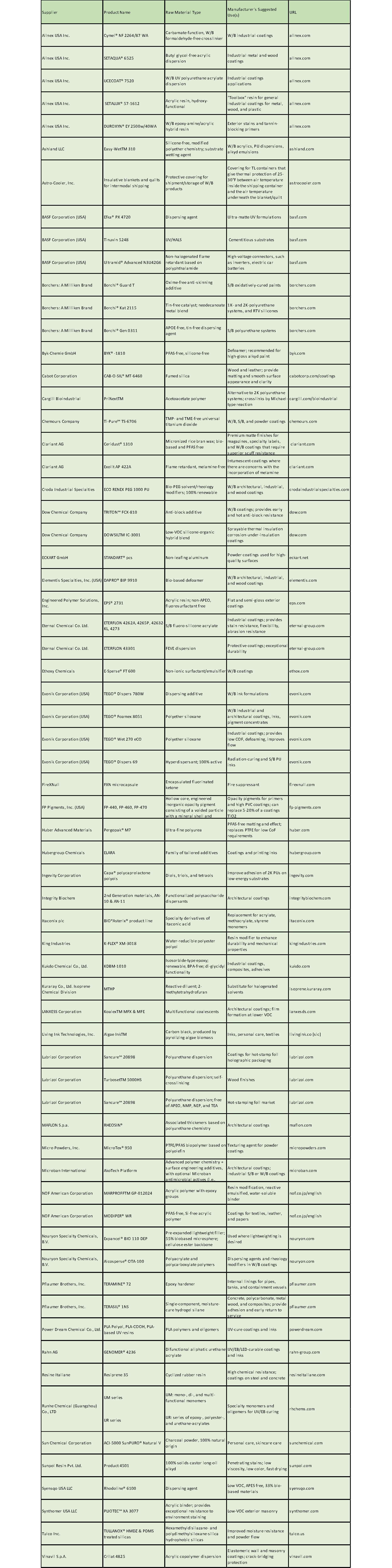 Table 1 - Products selected by the author that may be of interest to formulators of paints, coatings, adhesives, and sealants, as well as to other specialty chemical manufacturers.
Going forward
Historically, raw material suppliers and their paint and coatings producer customers worked together to produce new and improved products in “win-win” collaborations, but that has not been the case for at least the past 10-15 years, perhaps longer. Continuation of that trend does not bode well for the long term, and we all need to hope that common sense will once again prevail and reverse its course. Raw material suppliers need to be incentivized to develop new products that will generate sufficient sales and margins to justify their investment in R&D; it is pretty much as simple as that.
Moreover, The Great Supply Chain Crisis of 2020-2022 was not a unique event—it was just the first in what will be a series of difficult events, but the only way in which paint and coatings producers can deal with future supply chain disruptions is to learn the profound, although painful, lessons learned during the 2020-2022 and apply them to their current and future business practices. Those that did are in good shape today as they head into an uncertain future. Those that did not are already gone or are on shaky ground heading into the second half of 2026 and beyond. Survival is a tricky business during supply chain disruptions, and actually flourishing during such periods depends upon doing just about everything right, including making sure that R&D laboratories are appropriately staffed to take care of the inevitable “supply chain issues” while at the same time maintaining their focus on both tactical product development and strategic research and development on the new platforms of the future.
Taking advantage of raw material breakthroughs is key to being able to do this. Although they may not be effective in all systems or at all levels, new raw materials are being developed. Many of these new materials are sufficiently unique, however, that they are unlikely to produce optimal results when simply “dropped in” for an existing material—but it is quite likely that they will add value to certain products, at certain levels, and this is known as having “a competitive edge.” It is a balancing act, but it can be done—and those companies that learned their lessons from the Great Supply Chain Crisis of 2020-2022 are doing it. What is stopping you?
To learn more, reach out to the author at gpilcher@chemquest.com or visit https://chemquest.com
 © AdobeStock/ enanuchit