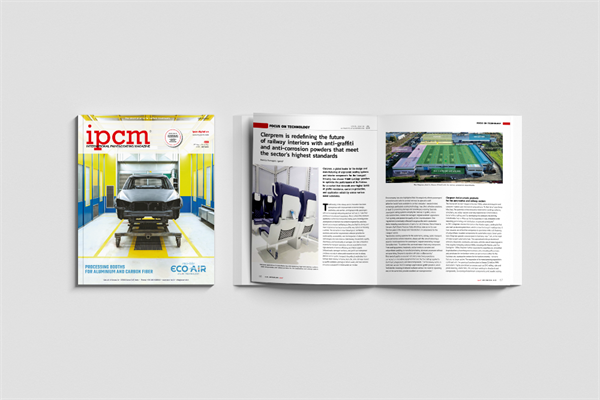
Read the latest issue of the magazine dedicated to surface treatments and organic and inorganic finishes: special issue on Automotive & Transportation!
Are cars still aspirational goods, emblematic of a desired lifestyle, or is their symbolic and emotional value gradually diminishing?
Back in the 1980s, a Golf GTI was enough to make 18-year-olds across half of Europe dream; today, most young people consider the car an uneconomical, unsustainable, and unsafe commodity: something to be intimidated by rather than attracted to, a threat to the planet and a drain on the wallet. More of a burden than an essential asset.
I found myself reflecting on this shift in perspective as we prepared our annual focus on the automotive and transport sectors for this issue of ipcm®, especially after reading an Instagram post that praised the decision by the majority of Gen Zers not to get their driving licence at 18, or not to get one at all, and to rely instead on public transport or alternative forms of mobility.
Setting aside any sociological or behavioural considerations, which would be of little relevance here, I have pondered the potential implications of this shift in attitude amongst a significant market segment for an industry that has been the backbone of many countries’ economies, particularly Germany and the United States, for decades, employing many people, setting technological trends, and guiding and accelerating R&D thanks to the vast investments made by car manufacturers.
Today, in Europe, the debate about the crisis in the automotive industry centres on the consequences of an early, poorly planned transition to electric mobility. However, I believe that, alongside industrial and geopolitical challenges, a deeper cultural shift is also emerging: for some members of the younger generation, cars are no longer a symbol of independence, self-fulfilment, and aspiration, as they have been for decades.
Meanwhile, China is dominating the transition to e-mobility, reshaping the tastes, needs, and desires of a market that was once the domain of European OEMs. Only supercar brands seem to have emerged unscathed from this scenario, still capable of retaining a strong emotional and identity-defining appeal.
The shift towards other modes of transport has undoubtedly driven technological innovation across their related industries in terms of design, manufacturing, and finishing techniques: from high-performance e-bikes with ‘aerodynamic’ finishes to high-speed trains fitted with seats highly resistant to corrosion and graffiti, right through to aircraft designed with ultra-lightweight materials and liveries to boost operational efficiency. Yet the automotive industry remains the testing ground for the most cutting-edge technologies, particularly in the coating, sealing, and assembly phases.
This is demonstrated by the content of the special feature in this issue of ipcm®, which covers new state-of-the-art OEM plants, an innovative on-demand coating system designed to efficiently manage special colours even in extremely small volumes, an optimised powder coating process for alloy wheels, and technological innovations that can guide manufacturers towards greater performance in terms of flexibility, service, and sustainability.
As always, the content of ipcm® extends beyond this issue’s focus: on the following pages, we explore disruptive innovations in powder coating curing, cutting-edge methods for recycling industrial coating waste, and the evolution of biological treatments for industrial waste water. Finally, there are numerous case studies on the industrial applications of different finishing technologies, from anodic oxidation to fluidised bed plastic coating, right through to pretreatment nanotechnology.
And so we continue our journey towards issue number 100!
READ THE MAGAZINE!