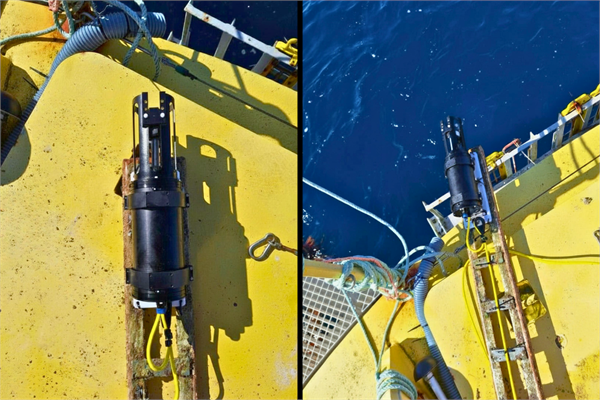
Designed to significantly enhance the safety, reliability, and service life of floating platforms—such as offshore wind farms—the technology marks a decisive shift from theoretical modelling to real-time asset management.
In a major breakthrough for the offshore and naval sectors, Vicinay Marine and the applied research centre Tecnalia have jointly developed a pioneering sensor for the remote monitoring of corrosion on mooring lines. The patented system is set to be officially unveiled at Navalia, Europe’s leading shipbuilding exhibition held in Galicia, where Tecnalia will showcase the technology alongside the Basque Maritime Cluster.
Corrosion poses a severe threat to the integrity of underwater chains and connectors. The harsh marine environment, extreme thermal variability, and decades of continuous operation mean traditional wear-and-tear models often fall short. To solve this, the new sensor measures electrical resistance to precisely quantify link section loss in real time. This allows operators to accurately model degradation and predict the remaining lifespan of mooring lines.
"To date, we have relied on theoretical models and inspections. This sensor enables a decisive step towards continuous, accurate monitoring. It will improve our knowledge of actual in-service behaviour, optimise component design, and support more efficient maintenance and cost management,” has stated Aintzane Expósito, Head of the Materials Department at Vicinay Marine Innovación.
The technology has already been validated at HarshLab, Europe’s unique floating laboratory located 1.6 nautical miles off the coast of Armintza (Bizkaia), which tests equipment under genuine, severe open-ocean conditions.
“Tecnalia has been developing advanced solutions to combat marine corrosion for decades. This joint effort shows how innovation can address critical issues in strategic sectors, utilising our expertise to solve a highly significant industrial challenge,” has added Raúl Caracena, Head of Materials for Extreme Conditions at Tecnalia.
Beyond mooring lines, the sensor boasts massive commercial potential for offshore wind power, port facilities, and any submerged metallic infrastructure. Key advantages include:
- Continuous remote monitoring, drastically reducing the need for costly physical inspections.
- Accurate predictive data to forecast the future performance of vulnerable components.
- Optimised maintenance schedules, allowing operators to plan interventions efficiently.
- Enhanced operational safety, catching degradation long before it reaches critical levels.