Robotics is not always used to speed up production: in the case of Modine CIS Italy, which has specialised in thermal management solutions for over a century, the integration of two coating robots supplied by CMA Robotics was driven by the need to ensure greater uniformity, repeatability, and control over the application of a UV top coat on heat exchangers with highly complex geometries and stringent performance requirements, which are treated using the patented ElectroFin® process.
Heat exchangers are essential for temperature control across a wide range of industrial, commercial, and domestic applications. Designed to transfer thermal energy between two fluids at different temperatures without allowing them to mix, these systems, whose size can vary considerably depending on the end application, optimise heating, cooling, and refrigeration processes, improve energy efficiency, and reduce energy consumption. Heat transfer generally occurs via a metal surface that keeps the fluids separate while promoting thermal contact between them, ensuring a controlled and continuous exchange.
From a design perspective, these elements are characterised by geometries that are often highly complex, developed to maximise the heat transfer surface area and enhance thermal performance. Fins, microchannels, manifolds, and pipes must operate under particularly demanding conditions, especially when components are exposed to corrosive environments, atmospheric agents, salt spray, or ultraviolet radiation. In these cases, the system’s durability depends not only on heat transfer efficiency but also on the surfaces’ ability to withstand inevitable degradation over time.
The surface protection of heat exchangers is no less complex than their design and manufacture. Uniformly coating structures with dense fin networks and internal cavities requires highly specialised processes to ensure that not only the most accessible surfaces are covered, but also that the treatment penetrates even the most critical areas. This need gave rise to ElectroFin®, a technology developed by Modine Manufacturing Company, a firm founded in 1916 and specialising in thermal management solutions, to enhance the corrosion resistance of heat exchangers designed for demanding applications. To support this, the Modine Group’s Italian plant has recently integrated a robotic coating system developed in collaboration with CMA Robotics, a company specialising in the design, manufacture, and installation of articulated robots and industrial coating systems, and capable of providing complete turnkey solutions. This investment was driven not only by production efficiency requirements but, above all, by the need to ensure the repeatability of a particularly complex application, in which the coating’s thickness, spray angle, and penetration capacity directly affect the performance of the final product.
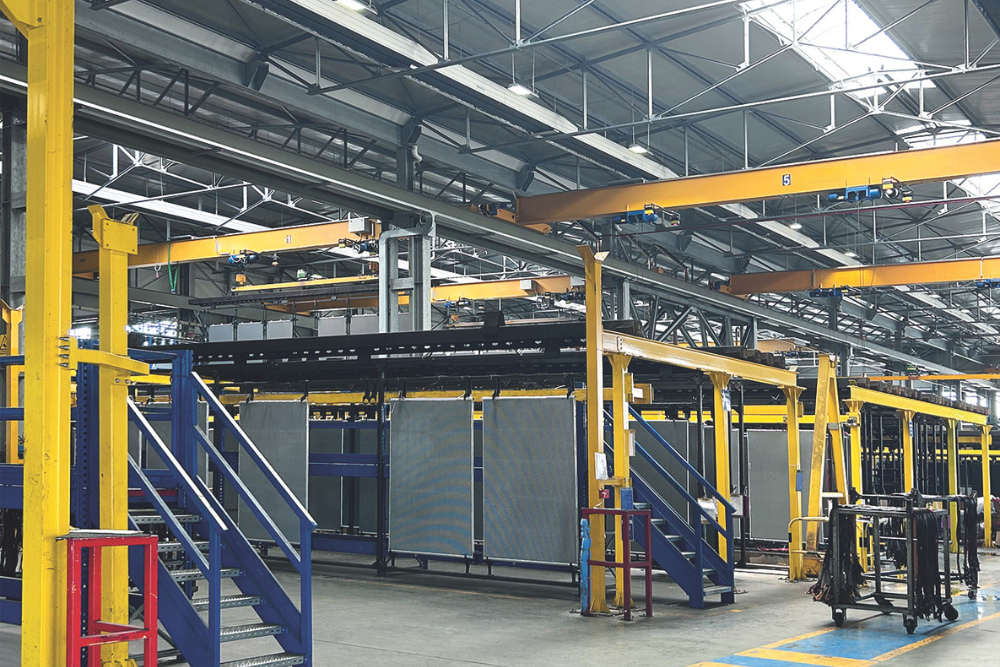 The loading area where components are placed onto the monorail conveyor. © ipcm
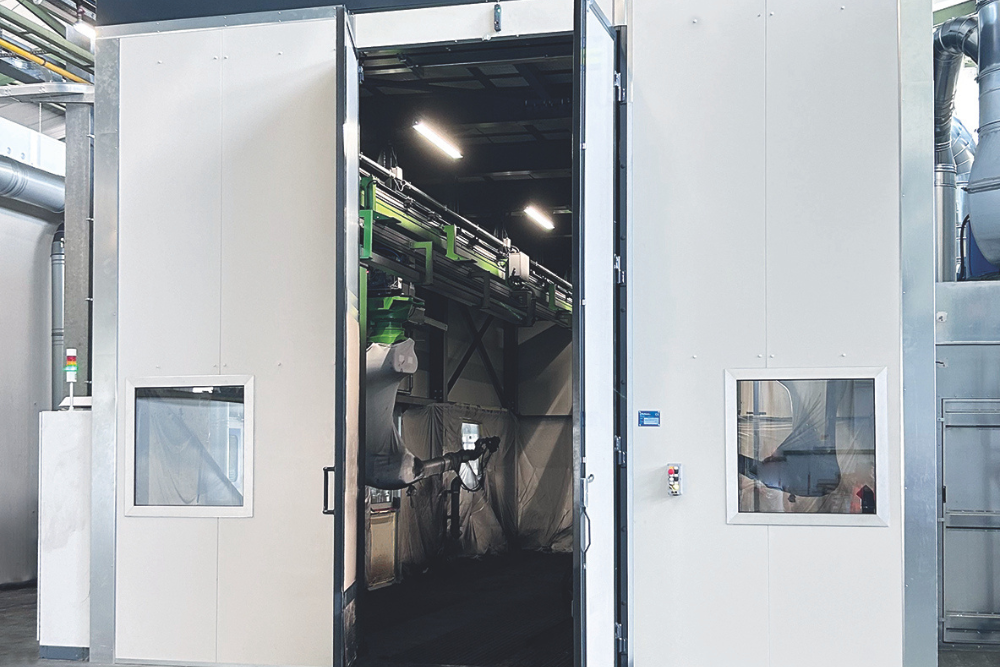 The outside of the UV top coat application booth. © ipcm
Over a century of innovation and the 80/20 vision
“Modine Manufacturing Company was established by Arthur Modine in the United States in the second decade of the 20th century, with the aim of designing advanced heat exchange solutions,” explains Cristian Michelin, marketing & advertising specialist at Modine CIS Italy. “From the outset, it distinguished itself for its highly innovative approach, going on to collaborate with Henry Ford to supply radiators for the famous Model T car and thus contributing to the development of the automotive sector. This technological DNA has remained unchanged over time and has enabled the company to establish itself as a leading manufacturer and industrial partner in the field of thermal management.”
Over more than a century, it has followed a path of steady growth, expanding globally from the 1980s onwards and gradually consolidating its presence in the HVAC-R and industrial markets. At the same time, Modine has continued to develop its technological offering, increasingly focusing on energy efficiency and sustainability. In recent years, it has also embarked on a major strategic reorientation based on the Pareto principle, or the 80/20 rule[1], which advocates concentrating resources on the activities and products that generate the greatest value for the company and its customers. Today, Modine is a global organisation operating in over twenty countries, with a high degree of diversification both geographically and across its target sectors.
The patented ElectroFin® coating process
ElectroFin® is an electroplating process that provides complete surface protection, ensuring uniform coverage even in the most complex and hard-to-reach areas (see the technical information box below). This technology offers highly effective protection against corrosion, even in particularly aggressive environments, and helps preserve the thermal performance of heat exchangers over time, extending their service life. Its value lies in its ability to combine thermal efficiency with durability throughout the system’s life cycle. “The process has been designed to ensure uniform, complete coverage of the entire heat exchanger while maintaining an extremely thin coating, typically just a few microns thick,” explains Claudio Mazzariol, manufacturing engineer at Modine CIS Italy. “This preserves the system’s original efficiency and prevents localised build-up and bridging between the fins.”
The cycle follows a controlled sequence of stages, beginning with alkaline cleaning to remove surface contaminants and continuing with the immersion of components in a cataphoresis bath. After coating, each part is rinsed and transferred to a drying oven, which hardens the coating into a uniform, adherent, and corrosion-resistant epoxy film. “Depending on the application conditions,” adds Mazzariol, “the cycle can be completed with a UV top coat to improve resistance to sunlight exposure. It was precisely to optimise this operation that we implemented the two robots supplied by CMA Robotics, replacing the previous manual spray application equipment, which we still use for particularly large components.”
ElectroFin®: high precision thanks to innovative application technology
Thanks to the development of ElectroFin® technology, the company can treat heat exchangers for the HVAC-R segment, the power generation industry, and highly specialised applications in the offshore and aerospace sectors. “In these environments, corrosion protection is crucial to operational continuity and asset durability,” says Michelin. “The high levels of corrosion resistance achievable with the ElectroFin® process are comparable to the requirements of the most severe corrosivity class (CX). The defining feature of this treatment is its high precision, which in turn calls for significant automation. The decision to partner with CMA Robotics therefore stemmed from the need to improve the consistency of our treatment, increase productivity, and reduce the variability associated with manual processes, particularly in complex operations.”
A robotic solution for consistent results
The primary objective of integrating a robotic system for applying UV top coats (currently water-based) was to achieve a level of repeatability that the previous manual process could not match. “Factors such as the operators’ actions, their posture, and the length of working shifts can have a significant impact on the final quality of the coating,” explains the team at Modine CIS Italy.
CMA thus developed a robotic station comprising two opposing articulated devices, precisely calibrated to the line’s production requirements. This made it possible to retain the existing conveyor system and, therefore, automate the process without resorting to highly invasive modifications. “The results achieved have confirmed the effectiveness of this solution,” Michelin emphasises, “also facilitating its gradual roll-out to the Group’s other plants.”
“The system consists of two GR680 series articulated robots positioned opposite each other and mounted on the ceiling with a seventh positioning axis, each managed by its own control panel,” describes Marco Zanor, the CEO of CMA Robotics. “They feature a scanning system, also mounted on a seventh axis, and an enclosed buffer area to protect the sensors from overspray, ensuring they are not affected by the sprayed product. The system is also equipped with a CPR-S control panel for managing the scans.”
The GR-680 robots are electronic machines with six axes of movement, designed to automatically perform all the processes required for surface treatment, such as liquid or powder coating on surfaces including metal, wood, plastic, ceramics, and resin applications. “Greater flexibility,” continues Zanor, “is achieved thanks to the exceptional design of the robot arms, which allow each axis to rotate through 360°, thus reaching every point on the workpiece.”
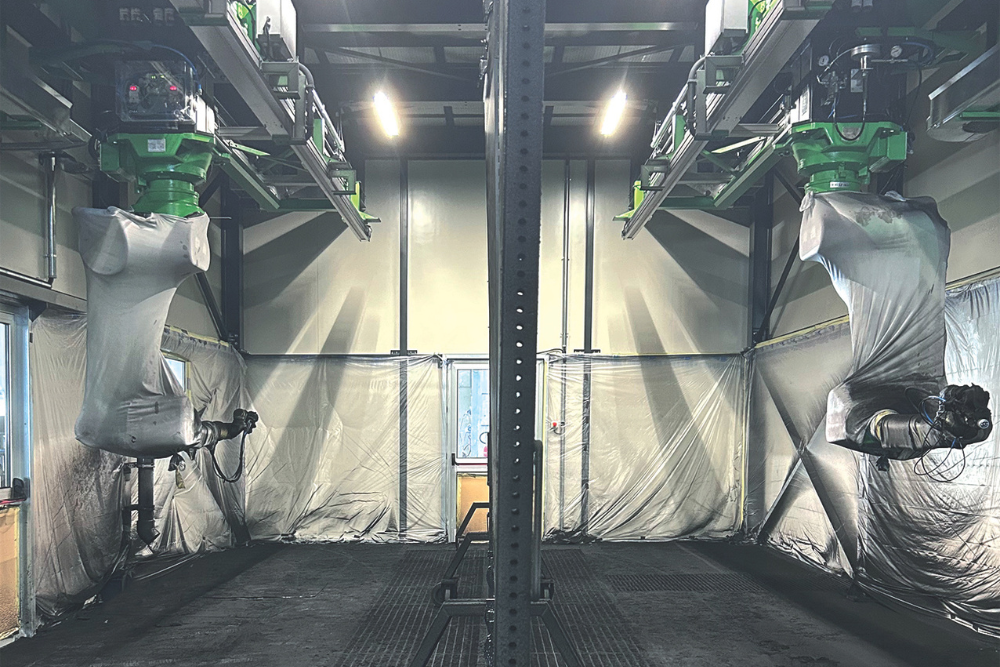 The two articulated robots installed by CMA Robotics. © ipcm
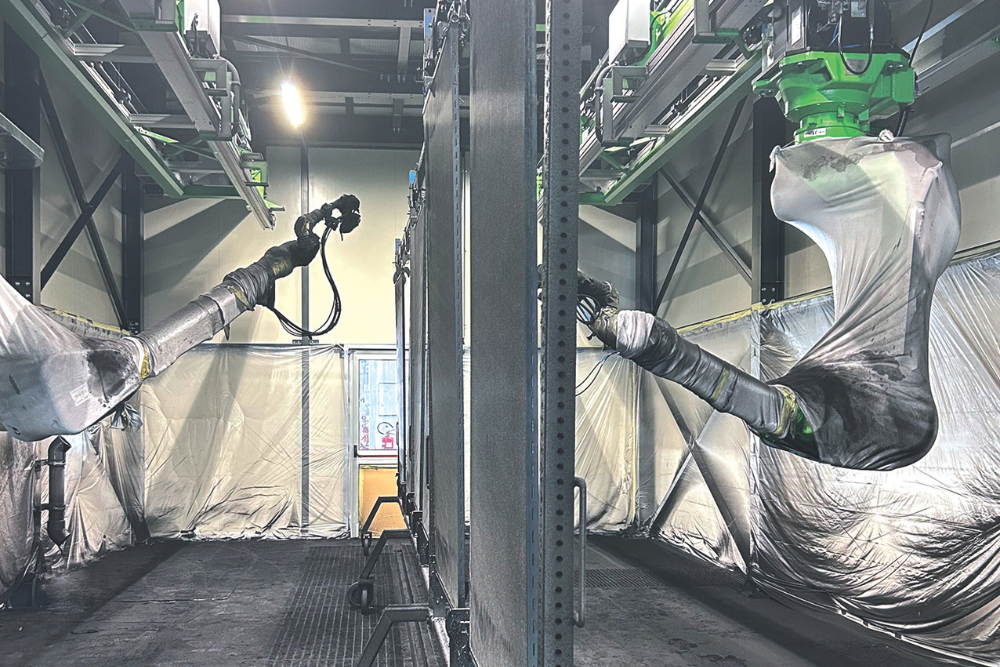 During application, the robotic arm precisely replicates the operator’s movements, ensuring the same sequence of actions is performed consistently and repeatably. © ipcm
The challenges of the automation project
The implementation of the automated system featuring two opposing robots marked a significant evolution in the application process, prompted by the switch to a water-based UV coating. This transition from solvent-based products has led to changes in the process management system and in the control of environmental conditions. “The use of water-based coatings has introduced new variables into the drying phase, making it necessary to work jointly with CMA to optimise temperature and humidity settings,” explains Mazzariol. Unlike solvent-based systems, which are more flexible during the drying phase, water-based formulations require an extremely precise balance of parameters: drying too quickly can cause surface defects, whereas an excessively slow process compromises film quality.
“Collaborating with CMA, we have developed an application system that ensures maximum deposition precision, even on complex geometries such as those found in microchannel heat exchangers. The angle of the spray guns and the adjustment of the spray pressure allow the coating to penetrate a few millimetres into the fins, ensuring uniform protection across the entire surface. Our goal is to maximise the paint’s penetration capacity: the greater the coverage in the internal areas of the heat exchanger, the higher the overall level of protection,” emphasises Michelin.
The line’s current semi-automatic configuration is an intermediate stage of development: the aim is to move progressively towards a fully automated system to cope with increasing production volumes. “This set-up already allows for a high degree of operational flexibility,” confirms Michelin, “as it enables us to handle different product types with varied sizes and shapes. This is particularly important in a market characterised by significant fluctuations in demand and the need to rapidly adapt production to a wide range of industries.”
When robots do not equal higher speeds
The purpose of introducing robotics at Modine’s Italian plant was therefore not to increase coating speed, but to ensure the consistency and repeatability of operating parameters. Applying a UV top coat requires very precise process parameters: excessive speed would compromise the paint’s ability to penetrate between the fins and reach the internal surfaces of the heat exchanger. For this reason, the robots operate with cycle times essentially similar to those of the best specialist operators, but with absolute consistency in their trajectories, spray angles, and application distances. “In the manual process,” explains Mazzariol, “the operator was required to carry out a complex sequence of steps, adjusting the spray gun to different angles to ensure complete coverage of the component: a complex task, made even more difficult by the typical operating conditions in the coating booth. Automation has transferred these tasks to the robot, which repeats them identically on every part, eliminating variables linked to human judgement and ensuring a higher finishing quality.”
The resulting benefits include not only greater consistency of application but also a significant reduction in rework: the colour of the paint product makes it particularly difficult to spot coverage differences during application, and any defects often only become apparent after drying. “The greater precision and repeatability guaranteed by the system
developed with CMA have definitely helped reduce the need for corrective measures.”
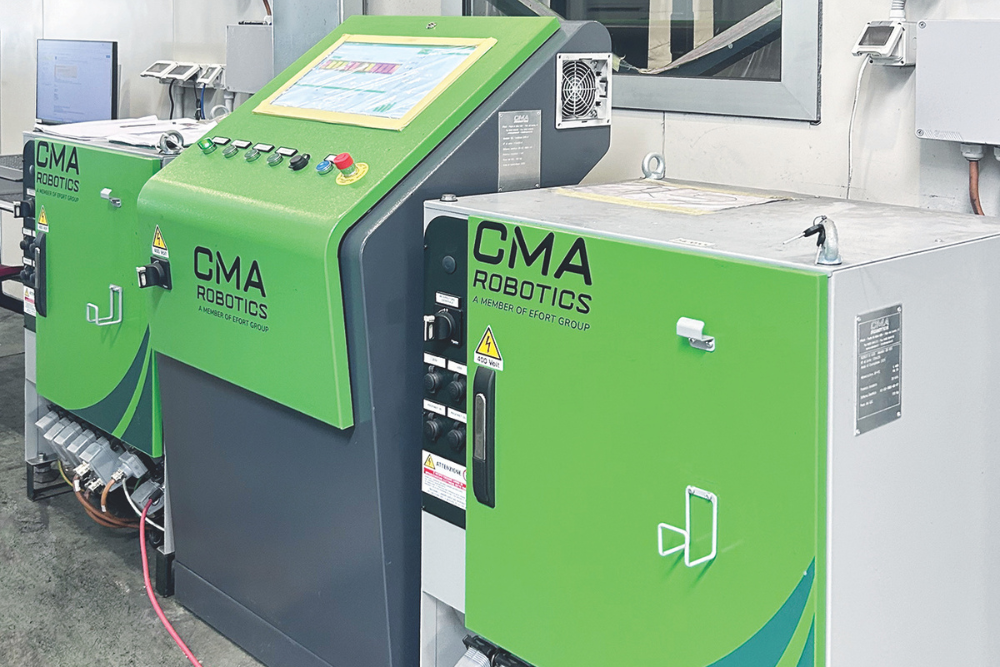 The control unit with the PLC managing the two articulated robots. ©ipcm
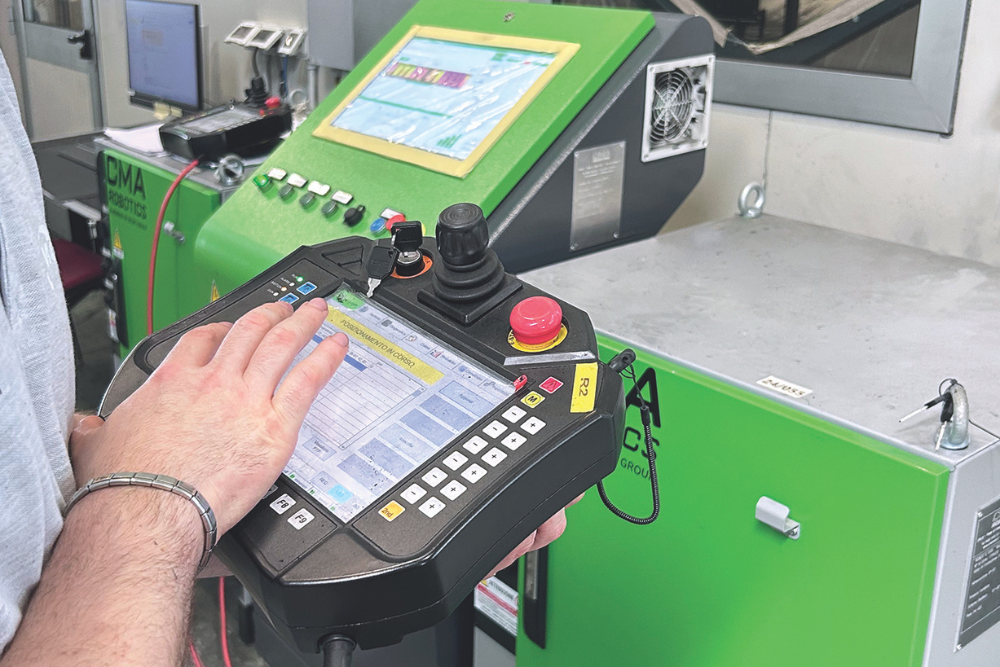 The mobile panel. ©ipcm
Advanced technical solutions
In addition to application automation, the project developed with CMA Robotics has included the integration of advanced sensor technology to continuously monitor key consumption figures, with the aim of building an increasingly comprehensive database to support programme optimisation over time. “We intend to gradually extend this system to other stages of the ElectroFin® process as well, to further reduce operational variables and improve control over them,” says Michelin.
Another distinctive feature of this project is the three-dimensional scanning system: unlike a solution based on two-dimensional scanners, which can only detect the presence of components, this can identify the three-dimensional geometry of incoming parts and any protrusions they may have. “The coating sequences are programmed using a scanning system fitted with a set of Wenglor sensors,” explains the CEO of CMA Robotics. “Individual points are recorded and, with the help of proprietary software, converted into a continuous and coordinated coating process. Point corrections, movement speeds, connection elements, and process parameters can be adjusted at any time. The vision system can detect any protruding areas, and the robot will adjust the programme to maintain a safe distance from the pipes, increasing the spraying distance if necessary.”
“This feature is particularly useful for heat exchangers with manifolds, fittings, or other protruding elements,” points out Mazzariol. “The scanner generates a 3D map that enables the robot to automatically adapt the application trajectories, avoiding potential collisions and focusing the application exclusively on the surfaces to be treated.” This has also proved particularly advantageous when handling different product types loaded simultaneously onto the same bar. The system can identify the position and geometry of each component, automatically adjust the spray guns’ path, and optimise the application of the coating without requiring substantial changes to the line’s programming. The addition of a dedicated axis for depth detection has also made it possible to handle components with particularly complex three-dimensional geometries with greater precision.
Conclusions
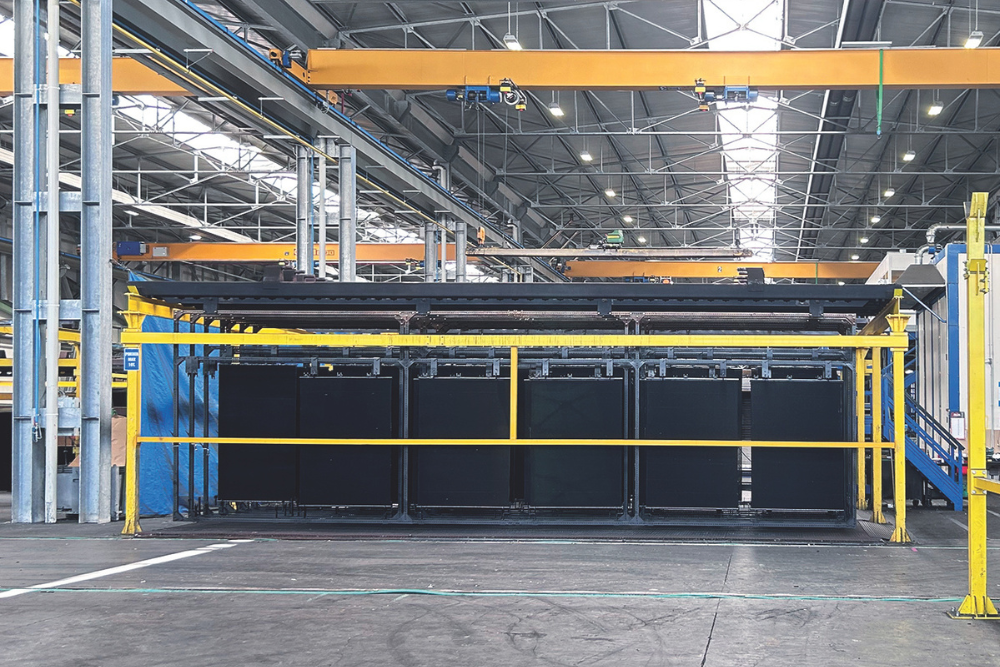 The storage buffer for parts awaiting unloading before packaging and final dispatch. ©ipcm
“This automation project is still evolving,” says Michelin. “We are already considering further developments to introduce new features and gradually increase the system’s level of integration. Plans include automating the loading stage, extending UV treatment to other types of heat exchangers, and possibly implementing colour-change equipment should further tints be required to meet the market’s customisation needs.”
“Looking to the future,” concludes the marketing & advertising specialist, “Modine will continue to invest in developing sustainable, high-value technologies, with a particular focus on advanced cooling and the most cutting-edge sectors. The integration of automation into production processes will increase, as part of a vision to drive the sustainable transition of the entire HVAC-R sector. On this journey, collaboration with technology partners such as CMA Robotics will become increasingly central, enabling us to make our processes faster, more efficient, and better controlled, reducing waste and contributing to sustainability objectives aligned with our vision, summed up in the motto ‘Engineering a Cleaner, Healthier World’.”
[1] The Pareto principle, also known as the 80/20 rule, states that in many phenomena, about 80% of the effects stem from 20% of the causes. In an industrial context, it is often used to identify the products, customers, or processes that generate the most significant share of results, enabling resources and investments to be concentrated on the activities with the greatest impact.
Technical insights into the ElectroFin® e-coat process
The ElectroFin® cathodic electrodeposition process differs from traditional spray or dip coating operations by forming a thin yet uniform protective film, even on the most complex geometries, ensuring complete coverage without compromising heat transfer performance.
Each component is inspected; approved parts are then assigned a unique code to ensure full traceability throughout the process and for their entire life cycle. Before treatment begins, all manifolds, tubes, and fittings are carefully masked to prevent paint or chemicals from entering the system.
The heat exchangers are then subjected to an alkaline cleaning stage to remove oils, dust, metal particles, and other contaminants generated during manufacturing, handling, and transport. This is followed by two rinsing stages.
During the process, the positively charged resin particles migrate under the influence of an electric field towards the workpiece’s metal surface, which is connected to the negative terminal. The system developed by ElectroFin® has been specifically designed to ensure uniform electric field distribution and complete coverage of the component. Unlike conventional technologies, the electrodeposition process exhibits self-limiting behaviour: as the film forms, the coated surface becomes electrically insulating and progressively slows further deposition. This enables extremely uniform thicknesses to be achieved, preventing localised build-up of material, surface defects, and bridging between fins. The result is continued protection even in the most difficult-to-reach areas, such as cavities, edges, and finned areas.
The entire process is managed by a digitalised control system that continuously monitors operating parameters and enables operators to verify that the film has been applied correctly. This ensures virtually complete coverage of the heat exchanger’s external surface and a level of quality consistency that is difficult to achieve with manual application methods.
Once the coating phase is complete, the component undergoes a final rinse and is transferred to the drying chamber. Here, the coating is gradually heated to the cross-linking temperature, allowing the epoxy resin to cure fully. The result is a continuous, compact, uniform film with high adhesion to the metal substrate and excellent resistance to corrosion, chemicals, salt spray, moisture, and pitting. Controlled cross-linking also eliminates the risk of sagging, dripping, or film failure, ensuring a smooth, uniform surface finish.
One of the distinctive features of ElectroFin® technology is its extremely thin coating layer, designed to maintain heat transfer capacity and maximise airflow through the finned pack. Despite its thinness, the protective film combines hardness, flexibility, and mechanical strength, enabling it to protect both traditional tube-and-fin systems and microchannel heat exchangers (MCHEs).
For applications installed in environments subject to intense solar radiation, the process can be completed by applying a UV top coat. This additional layer helps preserve the epoxy film’s aesthetic appearance and colour stability over time, reducing the effects of discolouration caused by prolonged exposure to ultraviolet radiation.
Thanks to its properties, the ElectroFin® coating is used in particularly demanding applications, such as coastal and offshore facilities, power stations, refineries, wastewater treatment plants, and industrial or urban environments characterised by high humidity, atmospheric contaminants, and corrosive atmospheres. Under these conditions, it significantly extends the service life of heat exchangers, reducing maintenance requirements and operating costs throughout their life cycle.