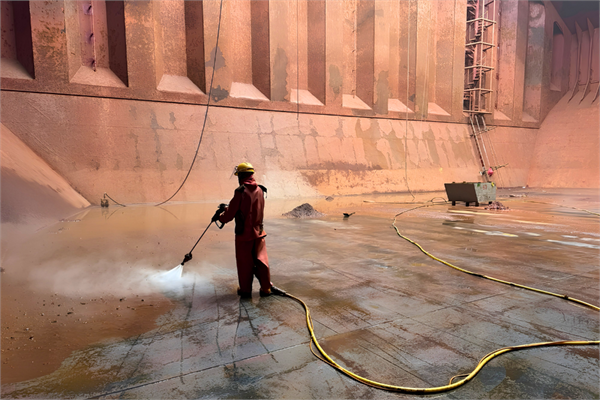
Heavy-duty cargo hold coating solutions from Steelpaint help shipowners avoid expensive steel replacement.
German corrosion protection specialist Steelpaint says it is seeing a marked increase in the number of owners trialling its heavy-duty Stelpant system on cargo hold tank tops and other high-wear areas, with a significant proportion of those trials progressing on to larger applications and fleet orders.
For decades, tank tops have remained one of the few areas inside bulk carrier cargo holds that many operators have chosen not to protect. The argument being that the constant impact damage during the loading and unloading of iron ore and coal, combined with mechanical impact from bulldozers, grabs, aggregates, and other abrasive cargoes, made the regular repeat coating work nothing more than a costly exercise.
“We've reached a point where owners are starting to question assumptions that have existed for years. Shipowners are naturally cautious. They don't want to be the first to try something new, but they certainly don't want to be the last. Once operators see comparable vessels successfully using the system, confidence grows remarkably quickly. In many cases an owner starts with a small test patch before progressing to a complete tank top, then perhaps a full cargo hold or several holds, before eventually introducing the system across multiple vessels. We see a very clear progression from an initial trial to larger applications and then repeat orders,” has commented Frank Müller, Director of Steelpaint.
The company’s zinc-rich Stelpant PU-Zinc system can be applied under normal commercial operating conditions, allowing owners to evaluate performance through repeated loading, unloading, and cargo hold washing cycles. Minimal standard steel preparation is required, such as dry blasting or the more environmentally friendly wet blasting.
Steelpaint says this practical approach has proven critical in convincing owners that coating tank tops can deliver long-term results. The company is now undertaking around ten trial applications each year, representing a noticeable increase over previous years.
“The last major newbuilding peak for bulk carriers was around 2010. That means the average bulk carrier is now around 15 or 16 years old and cargo hold steel condition continues to deteriorate year by year. Because of the current balance between supply and demand, together with the slower pace of fleet renewal, shipowners are willing to keep ageing vessels operating for longer. That makes corrosion prevention much more important. Owners are looking at ways to extend vessel life, reduce future docking costs and minimise the risk of replacing steel on tank tops and lower hopper areas,” has stated Li Yinlong, General Manager of Steelpaint China.
“Classification societies regularly monitor cargo hold steel thickness throughout a vessel's life. As corrosion reduces plate thickness, owners can eventually be required to replace sections of steel during drydockings. As fleets continue to age, we believe more operators will view tank top protection not simply as another coating, but as part of a long-term asset management strategy,” has concluded Frank Müller.
While the steel itself represents part of the cost, Steelpaint says the much larger financial impact often comes from the extended off-hire period required to complete steel renewal. Based on its analysis, Steelpaint estimates that maintaining cargo hold steel through planned coating maintenance and periodic touch-up repairs could reduce lifecycle costs by up to US$4.5M per large bulk carrier through avoided steel renewal and reduced downtime.