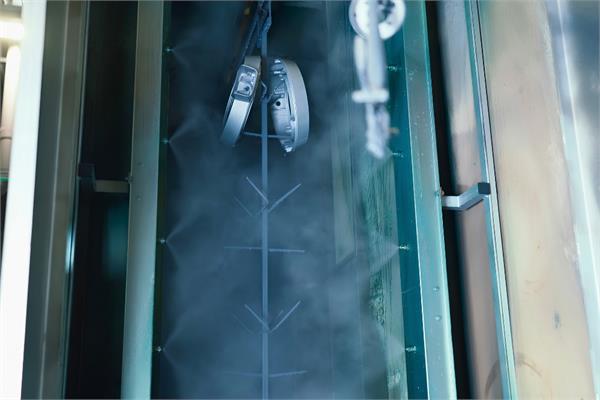
With APNR 2.0, Henkel aims to make no-rinse pretreatment an increasingly versatile solution for metal processors seeking to improve operational efficiency, reduce resource consumption, and meet evolving environmental requirements.
Rising energy and water costs, increasingly stringent environmental regulations, and the transition to chrome-free processes are driving demand for more efficient and sustainable metal pretreatment solutions. In response, Henkel has introduced APNR 2.0 - Adhesion Promoter No Rinse - the latest generation of its established adhesion promotion technology, designed to optimise resource consumption, streamline operations, and enhance production efficiency.
Combining an upgraded equipment concept with broader application possibilities, APNR 2.0 delivers measurable operational benefits. According to Henkel's internal evaluations, the new generation can reduce process water consumption by up to 50% and compressed-air demand by up to 20% compared with its predecessor, depending on line configuration and operating conditions.
Since its introduction in 2015, Henkel's APNR technology has been adopted in more than 100 installations worldwide, particularly in facilities where space constraints, compact production lines, and the transition to chrome-free pretreatment require flexible, resource-efficient solutions.
Unlike conventional pretreatment systems, APNR replaces the final passivation bath with a precisely controlled spray application of an adhesion promoter. The solution is freshly mixed inline and deposited as a thin, uniform film onto the still-wet metal surface, eliminating the need for subsequent rinsing. This approach enables more compact line configurations while reducing water and chemical consumption without compromising corrosion protection or paint adhesion.
The technology also simplifies process management. By applying the chemistry directly to the surface at a controlled concentration, APNR eliminates issues associated with bath aging and reduces the need for complex analytical monitoring. Water and chemicals are consumed only in the quantities required to achieve the desired coating layer, offering significant advantages over conventional final-rinse cascades.
Its compact design also makes APNR particularly suitable for retrofitting existing pretreatment lines with limited available space. In architectural aluminum applications, the technology can eliminate the conversion bath entirely, facilitating the transition from hexavalent chromium-based systems to chrome-free alternatives while substantially reducing water consumption and maintenance requirements.
The latest APNR 2.0 generation introduces Henkel's new EcoFlex control unit, featuring an updated control architecture and redesigned pumping system for precise, consistent application. The system continuously monitors key process parameters, including conductivity, pressure, and tank levels, while supporting integration with digital production environments. These improvements are designed to further optimise water and compressed-air consumption, minimise production downtime, and simplify day-to-day operation.
Moreover, Henkel is developing new formulations with lower water requirements and enhanced spray nozzles to ensure reliable application across complex component geometries and demanding production configurations.
“Many customers have already addressed the major levers in degreasing and phosphating. With APNR 2.0, we are now giving them a tool to optimize even the last meter of pretreatment, economically and sustainably. Lower media consumption, less complexity, and even more stable surface performance, this is exactly what the new generation is designed to deliver,” has noted Steffen Ruesse, Director Global Equipment & Machine Learning Applications at Henkel.