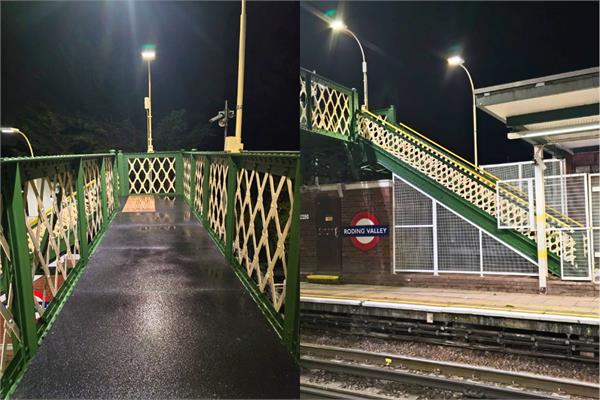
Steelpaint has recently completed a key contract involving the application of its advanced polyurethane-based corrosion protection system to the footbridge at Roding Valley London Underground Station. The project highlights a growing shift within the rail industry towards long-life, moisture-cured protective coatings, as contractors aim to cut unplanned maintenance and reduce whole-life costs.
Transport for London (TfL) contractor M Group Rail & Aviation
chose Steelpaint’s three-layer, moisture-curing polyurethane system for its proven durability, reliability and ease of application. The coating system—applied by Peterborough-based Specialist Painting Group (SPG)—comprised the Stelcatec-L-PR anti-corrosive primer, the Stelcatec-L-NT intermediate coating, noted for its adhesion and mechanical resilience, and Stelcatec-L-TC, a UV-resistant topcoat providing long-term gloss and colour stability. The full system was applied to a Dry Film Thickness (DFT) of approximately 300µm.
“It allows contractors to continue working in conditions where conventional coatings would be out of spec. TfL was looking for ways to strengthen durability and reduce lifecycle costs and project times, and the Steelpaint technology was the perfect solution,” has declared Ben Fallows, Director of TfL.
“The coating system we have supplied provides the highest level of corrosion protection. As infrastructure owners, like TfL, continue to look at ways of reducing maintenance costs and downtime, more durable protective coating systems have a critical role to play,” has commented Perry Poppelaars, a director at Recoat UK, Steelpaint’s UK sales and distribution agent.
The polyurethane-based system has attracted strong interest since receiving formal Network Rail approval in January 2025, following both laboratory testing and a test application on “gingered” steel under real-world ambient conditions. During a demonstration in March, representatives from Network Rail and several major painting contractors observed the complete three-coat system being applied and cured within four hours using standard rollers, with adhesion tests confirming reliable performance on marginally prepared surfaces.
“For us, the big benefit was the reduction in rework risk. The coating system performed consistently from start to finish, which meant we weren’t losing time to unexpected surface failures or remedial preparation. It’s encouraging to see suppliers pushing forward with modern coating technologies that genuinely add value to rail projects. It represents a step forward from older systems and has clear potential for broader adoption across similar structures,” has stated Sean Mullett, contracts manager at M Group Rail & Aviation.
Interest from rail contractors has continued to build, with several companies assessing the system for use on minor bridges, platform canopies, gantries and other access structures where maintenance closures can have significant operational and commercial consequences.
“The UK has become one of our fastest-growing markets, largely because asset owners are demanding longer-lasting protection and more predictable performance from their coating systems. We see a clear shift towards solutions that reduce repeat maintenance and extend structural life, and that plays directly to the strengths of our technology. There is significant long-term potential in the UK, not just for the railways but other infrastructure projects. We will continue to expand our presence to meet that demand,” has added Frank Müller, Director of Steelpaint.