Adopting an innovative approach to business development, powder coating contractor New Colour recently completed a full overhaul of its line. The project involved collaboration with Avin, which, in addition to acting as the prime contractor and coordinating the work, reviewed the plant layout, revamped the curing oven, and fully re-certified the plant; Futura, which replaced the existing monorail conveyor with a power & free system complete with two loading and unloading elevators; and Gema, which installed a new, state-of-the-art powder coating booth alongside the existing one. The resulting plant’s high level of technological sophistication now ensures precision, full traceability, and optimised cycle times.
Technological progress is increasingly vital in making the world of work more accessible and inclusive. The digitalisation of production processes optimises workflows, supply chains, and product lifecycles within increasingly integrated environments and, at the same time, also creates a shared operational language that supports learning and training for the next generation in manufacturing companies. This point is emphasised by Massimo De Gianni, owner of New Color Srl (San Donà di Piave, Venice, Italy), a company specialising in powder coating components for various sectors, such as furniture, earth-moving machinery, white goods, construction, and metalworking.
“We are currently observing a generational shift: young people joining companies today are naturally more comfortable with digital technologies, even those used in production facilities, as they are part of their daily lives. Compared to previous generations, these operators often have an advantage, since new technologies can be more challenging for those who learned their trade in less digitalised settings. Machine functions are increasingly intuitive, which helps in both transferring know-how and applying it correctly. If our sector had remained solely reliant on traditional skills and manual processes, many companies like ours would have faced closure. Technological innovation, therefore, is crucial for maintaining operational continuity and supporting generational change.”
Already committed to a robust strategy focused on automation and environmental sustainability – the subject of a previous article published after our visit to report on the company’s new chemical-physical water treatment plant – New Color has recently undertaken another innovation-driven project, revamping its coating line and integrating it into an environment that was already technologically advanced and characterised by a workforce prepared to adopt new digital technologies. This included an update of the plant layout by Avin Srl (San Martino al Tagliamento, Pordenone, Italy), the conversion of the monorail conveyor into a power & free system by Futura Srl (Robecco Pavese, Pavia, Italy), the integration of a new Gema Europe coating booth alongside the existing one from the same supplier, and the optimisation of the parts traceability system developed by Avin in collaboration with Elettrica Srl (Padua, Italy), which was responsible for software development. Overall, the project’s industrial approach was aimed at maximising the line’s efficiency and ensuring the full operational and digital integration of all its components.
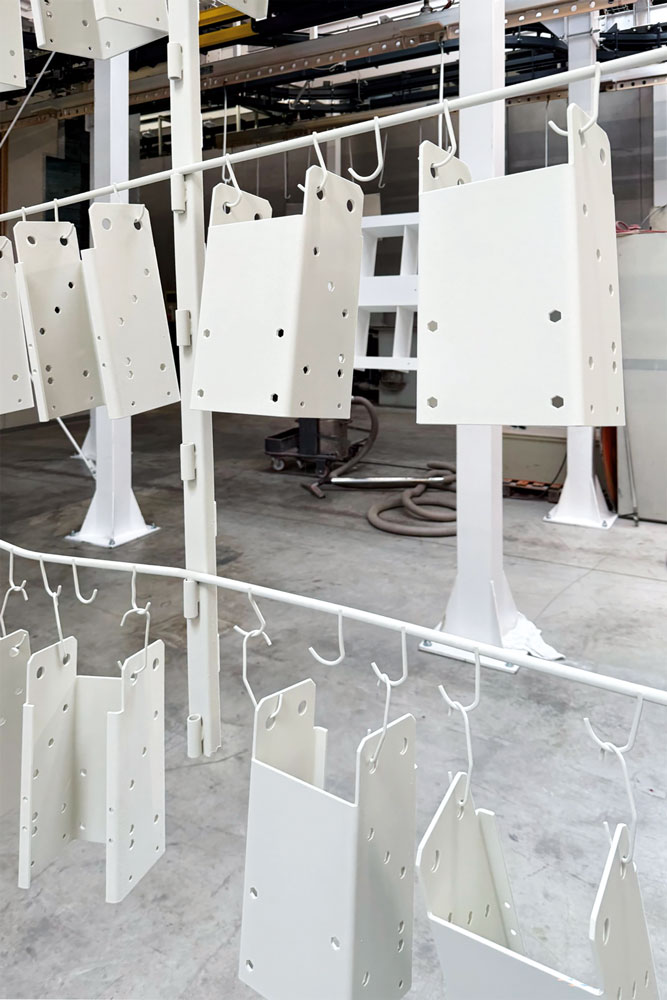 Since 1995, New Color has specialised in powder coating components across various sectors. Ⓒ ipcm
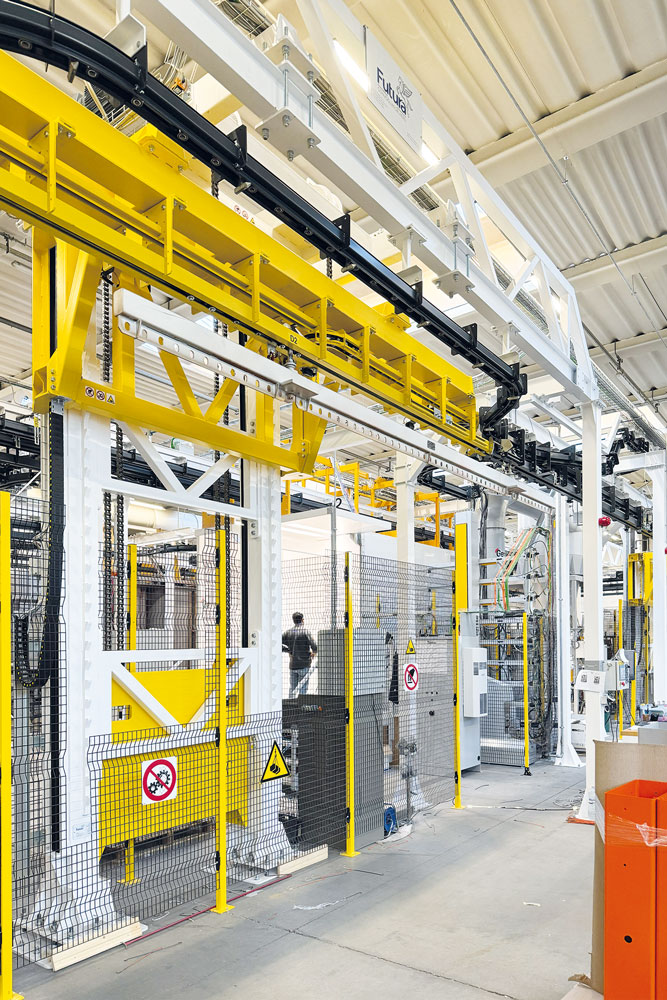 The loading and unloading area, featuring an elevator installed by Futura. Ⓒ Futura
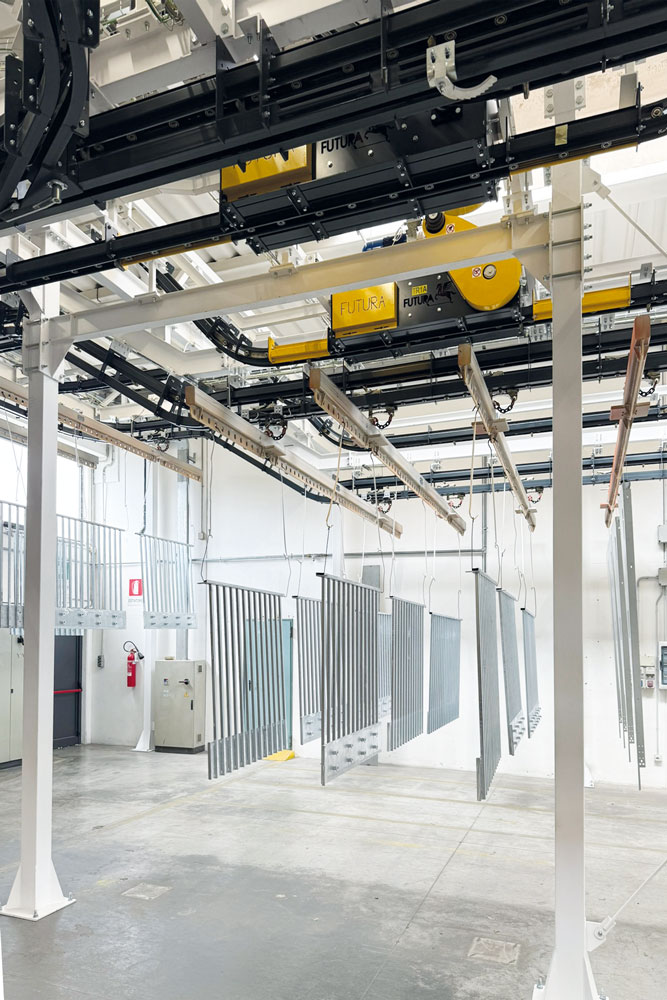 The storage buffer for workpieces waiting to enter the pre-treatment tunnel. Ⓒ ipcm
From a monorail to a power & free conveyor: a necessary choice for New Color
When upgrading a coating line, the conveyor system is the crucial element that determines the overall workflow: “Power & free solutions are becoming an inevitable choice for companies facing increased market demand, particularly for firms like New Color, which handles workpieces of varying sizes that can reach dimensions of up to 6000 × 2400 × 950 mm,” emphasises Massimo. “Last but not least, our new system can handle over 500 kg per load bar, a value previously unthinkable with our monorail conveyor.”
New Color was established in 1995 as a powder coating contractor and has grown steadily since then. “Thanks to our strong focus on the quality of products and processes, we have obtained Qualisteelcoat certification, ISO 9001 certification, and the Environmental Product Declaration (EPD). We also operate in compliance with REACH and RoHS regulations,” says Massimo. “We strongly believe in ongoing development and investment in new technologies, although never losing sight of our commitment to the environment. We currently specialise in powder coating various metals and alloys, particularly Sendzimir hot-dip galvanised steel. Thanks to our certified processes, we have become a partner to some of the largest and most established multinationals operating in a variety of sectors.”
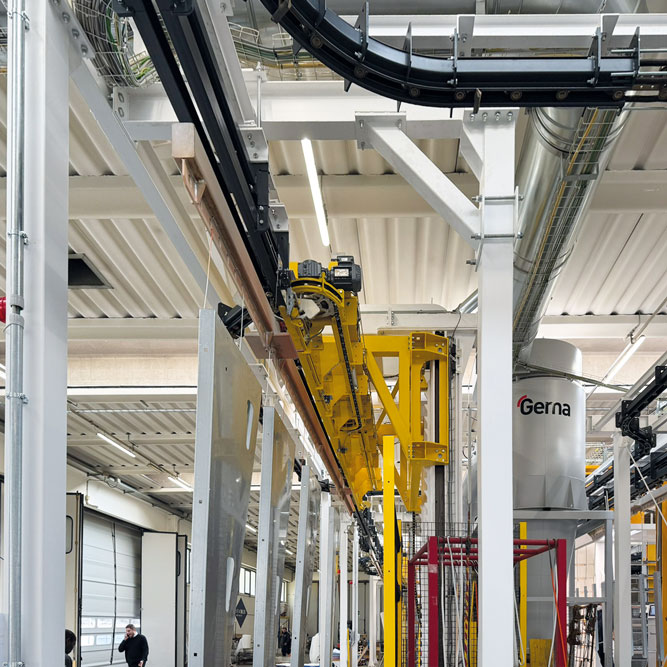 Futura oversaw the design of the conveyor, converting it from a monorail to a power & free system. Ⓒ ipcm
These partnerships involve managing increasingly large batches, often with large-sized components that require flexible handling methods and increased production throughput.
“In a monorail system, the line speed remains steady throughout the plant, and any misalignment during loading and unloading can alter the dwell times of parts in different treatment zones, which can negatively affect production timelines. Conversely, a power & free system allows for the creation of sections with varying speeds and provides control over the dwell time of components across different process stages. The switch to the power & free system designed by Futura was, therefore, a necessary choice for us, aligned with a strategy aimed at boosting plant efficiency, reducing production downtime, and optimising paint application: installing a new coating booth, which we had already planned, would have been pointless without the additional overhaul of the conveyor system.” As a result, the project carried out by Futura entailed the transition from a 236-metre to a 1-kilometre loop.
The power & free conveyor ensures predictable dwell times
During the design phase of this line revamping project, New Color identified some specific market requirements, including strictly controlled surface conditions in both the pre-treatment and curing stages. “In accordance with Qualisteelcoat guidelines, dwell times must be strictly defined, which is difficult to achieve with a monorail system. Thanks to our power & free conveyor, divided into four operational zones with different speeds, we can now ensure controlled dwell times in the pre-treatment, coating, and curing stations, thus fully complying with technical specifications in terms of drying, application, and above all, curing times and minimising the risks of over-curing and energy wastage. The clear goal is not only to ensure maximum operational flexibility – as expected of any coating contractor – but also to enhance energy efficiency and process sustainability.”
The redesign of the plant layout, carried out by Avin in collaboration with the other three suppliers involved in the revamp and made necessary by the integration of the additional state-of-the-art coating booth, also included fitting automatic access doors to the curing oven to maintain constant operating temperatures and a post-chamber to prevent heat loss. The combination of Futura’s power & free system with the second Gema booth led to a significant increase in production capacity and a marked improvement in energy efficiency, further enhanced by the replacement of the oven’s burner with an air stream unit. This investment was indeed part of a broader sustainability-focused initiative undertaken by the company, following the previous project concerning waste water treatment.
The new booth with dense-phase pumps
In fact, Gema Europe collaborated on the line’s layout upgrade, working closely with all the other companies involved in the revamping project. “We adapted our equipment to the line’s new design,” explains area manager Marco Peduzzi. “We repositioned the existing booth within the same foundation pit, moving it 30 cm to optimise the available space, and transferred the cyclone and filtration system to the opposite side compared with the previous configuration. We also collaborated actively with Futura and Avin, which handled the structural aspects of the revamp, to help define the most suitable setup for New Color’s workflow.”
The integration of the new Gema booth marked a decisive step in the development of the paint application area: “Alongside the existing booth, which was suitably upgraded with Venturi injectors, we installed a new cutting-edge booth equipped with 18 spray guns, AP02 pumps (the latest generation of dense-phase pumps available on the market), and a new OptiCenter All-in-One OC10 powder centre.”
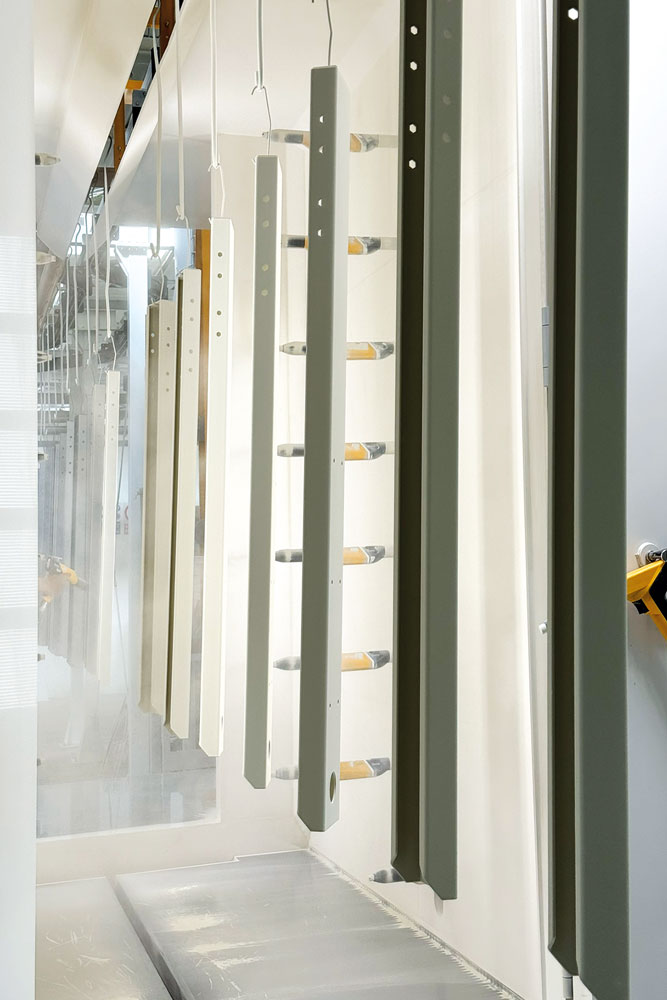 The new Gema’s booth equipped with 18 guns and new-generation AP02 dense-phase pumps. Ⓒ ipcm
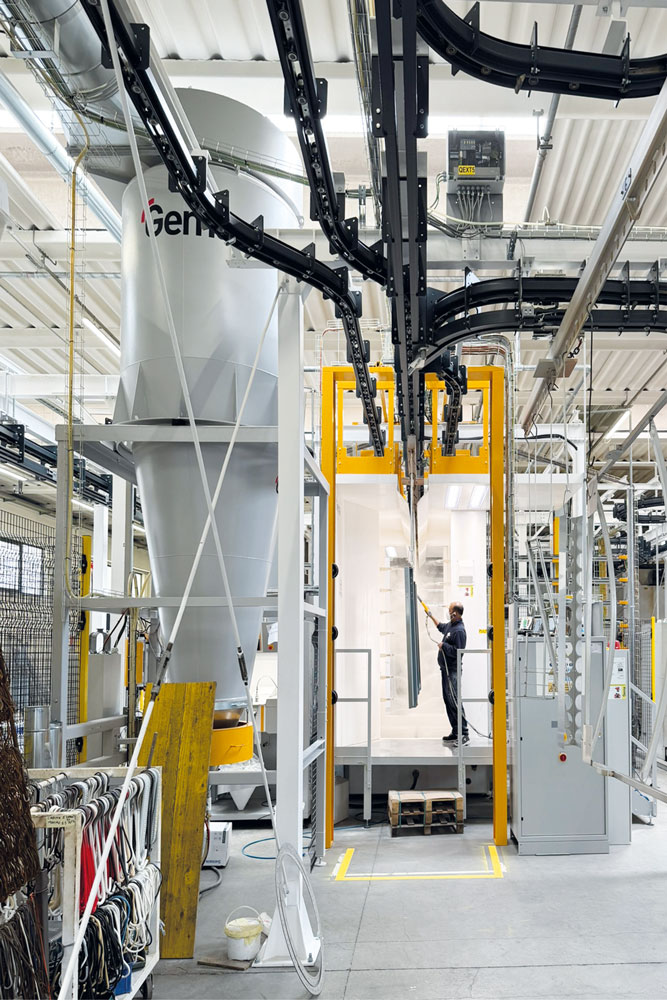 The increase to 18 guns in the new booth supports the optimization of the 3D scanning system, improving coating coverage and precision. Ⓒ ipcm
A comparison of two application technologies
De Gianni compares the Venturi application technology implemented in the existing booth with the dense-phase pumps used in the new one: “With Venturi nozzles, experienced operators are essential to ensure accuracy in the application process, so the end results depend on the workforce’s expertise. The dense-phase technology has largely solved this problem, as the last-generation pump system installed offers much more precise powder management and is also easier to maintain.”
“The new-generation OptiSpray AP02 pumps for dense-phase application open up new horizons in terms of coating quality and consistency,” confirms Peduzzi. “A further advantage lies in their long service life and ease of replacement. Whereas the pumps in the old booth had an average lifespan of around 1,000 hours, these exceed 2,000 hours. In practice, whereas previously a booth operating continuously on a single shift required servicing every six months, now maintenance is needed only once a year and can be performed in just a few minutes and without the use of any tools.”
Another point highlighted by Massimo concerns the management of colour changes, which in the past were among the most critical process aspects. “Working with two booths makes production much more flexible: while one booth is in operation, we can carry out the colour change operation in the other, avoiding line stoppages. This enables us to plan our activities more effectively, manage touch-ups on parts more efficiently, and optimise our overall lead times.”
Dynamic scanning and optimised application
The application equipment was complemented with a Dynamic Contour Detection system, a technology based on laser scanners designed to precisely identify products with complex or delicate geometries. Positioned at the entrance to the booth, the scanners capture two-dimensional images, which are combined with line speed tracking data to reconstruct the three-dimensional contour of each workpiece. The control system thus automatically manages the positioning and activation of the spray guns, which move along independent axes, accurately following the parts’ outline. Multi-angle technology ensures that even the most complex shapes are coated evenly, reducing the need for post-finishing, which is especially useful when treating large-sized components.
The adoption of this three-dimensional scanning system was also aided by the increase in the number of spray guns, from 12 in the first booth to 18: “In a 3D system, the greater the number of guns available, the easier it is to follow the contours of workpieces. The movement of the lower units, in particular, promotes better penetration and precision. At the same time, a greater number of guns helps to increase the overall electrostatic effect, improving powder transfer efficiency.”
A fully traceable process
The revamp of this line has also enabled mapping the entire process, creating a ‘road map’ for each component’s journey along the line, complete with all relevant process parameters. A further upgrade involved the pre-treatment tunnel: in every tank, including the rinsing ones, Avin has installed sensors to monitor key parameters, from pH to conductivity and temperature. A control system with a dedicated countdown timer for each bar has also been implemented in the drying and curing oven. “We have designed this tracking system so that every barcode associated with a part is matched with its specific batch’s recipe,” explains Massimo. “In practice, each component is given a sort of ‘identity card’ that makes it traceable at any stage of the coating process and even afterwards, at the customer’s request.
“The storage buffer within the oven ensures we do not waste a single minute: even the longest curing times, which can range from 40 to 60 minutes depending on paint thickness, are managed with the utmost precision. Finally, once the cycle is complete, a report is generated on request, which can be delivered to the customer or kept on file for any future checks.”
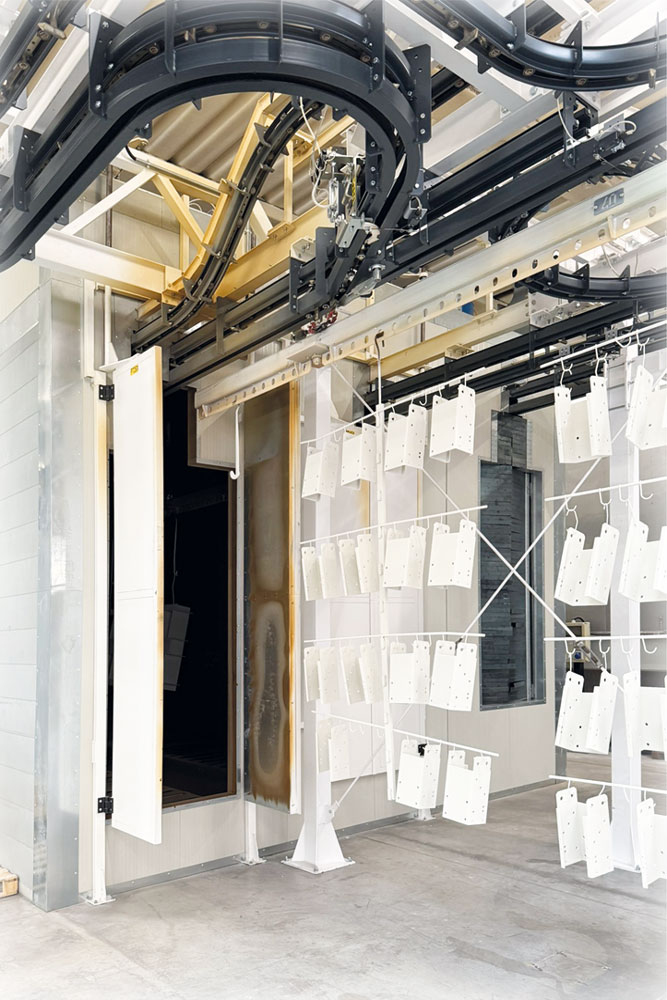 Avin’s reorganisation of the plant’s layout included installing automatic access doors in the curing oven to keep temperatures steady. Ⓒ ipcm
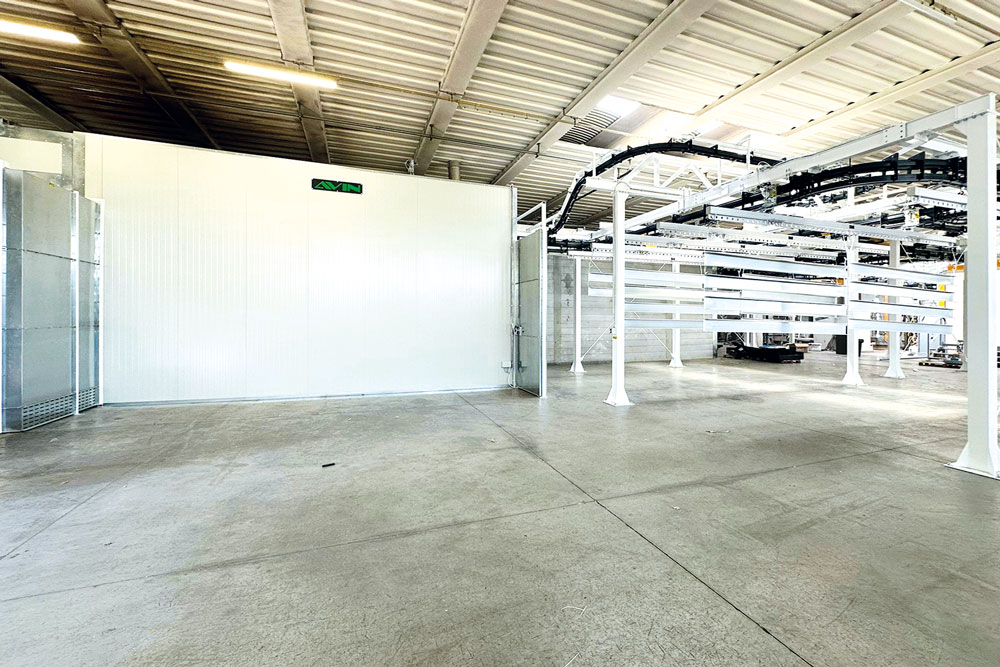 The new post-chamber installed by Avin at the oven outlet to prevent heat loss. Ⓒ Avin
Conclusions
New Color’s aim is to maximise automation to optimise batch management as effectively as possible. “Working with major clients means we must handle orders with a higher number of batches, less fragmentation, and increased productivity: ‘flexibility’ is the watchword for any contract coater, and if this is supported by advanced digital technologies, the coating process can make great strides,” emphasises Massimo.
The switch from a monorail handling system to a power & free conveyor has proved particularly strategic: “Previously, much of the control rested with the operator, which inevitably led to inconsistencies in processing times. Today, thanks to the solutions implemented, manual expertise has been transformed into automated processes. In practical terms, the operator now contributes around 30%, and 70% of the work is handled by the machine, ensuring reliable and consistent results without any risk of over-coating.”
Massimo also emphasises the importance of collaboration with suppliers: “This revamp was made possible through teamwork with companies that shared our vision and customised their designs to our needs. I must therefore thank Futura, Avin, Gema, and Elettrica, which did not restrict themselves to a simple supplier-customer relationship but embraced this project’s objectives with an innovative outlook. Digital industrialisation would not be achievable without such an advanced approach aimed to make technology more universal, standardising complex processes and making them more accessible to the new generations entering the manufacturing world today.”