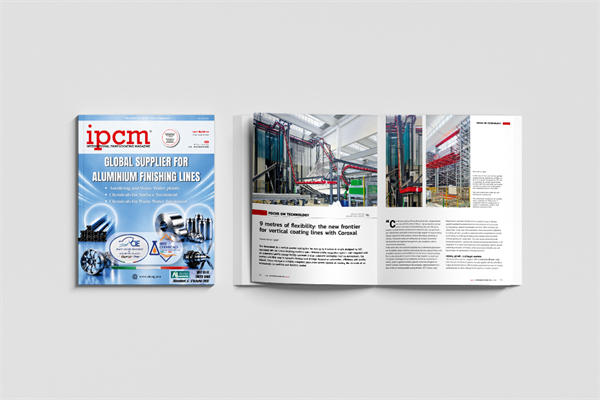
Read the latest issue of the magazine dedicated to surface treatments and organic and inorganic finishes - special issue on Architecture & Design!
In late 2025, in one of my editorials, I wrote that the word ‘resilience’ is so overused it has lost its meaning. Yet this year I find myself using it for the second time in these opening lines, which I write at the start of each new ipcm® issue to offer readers food for thought, rather than as a key to interpreting the entire magazine.
In March, I used the adjective ‘resilient’ to describe the Western manufacturing industry, which was facing an unprecedented energy crisis. Today, I must use it to describe what is increasingly guiding material choices in industries that require operational continuity and the ability to respond to critical situations: resilience, precisely.
I was inspired by a report produced by the ALUMINIUM 2026 trade fair (Düsseldorf, Germany, 6–8 October) in collaboration with Panorama Marketing, which featured interviews with stakeholders in the aluminium sector.
In applications characterised by particularly demanding and strategic operating conditions, ranging from transport and logistics to emergency management, critical infrastructure, and defence, reliability, durability, and operational readiness are increasingly important. In these fields, material selection is rarely based on cost comparisons alone: performance, weight, durability, workability, certifications, and regulatory compliance are all factors that help identify the most appropriate solution for a given application.
As governments and supranational organisations increase their investment in emergency preparedness, logistics, and critical infrastructure, there is a growing demand for materials that ensure efficiency, durability, and long-term performance under demanding conditions.
Aluminium continues to offer significant advantages where weight reduction, corrosion resistance, and operational efficiency are key selection criteria. And, when properly treated and protected with suitable finishes, it can meet increasingly complex technical requirements. This is where coatings, and more generally, all surface treatments that increase, improve, and enhance the intrinsic performance of this material, come into play.
Anodising and coating have kept pace with – and in many cases anticipated – the growing demand for higher efficiency, developing solutions that ensure ever-greater durability and corrosion resistance, even in the most aggressive environments. This evolution was by no means a given, as it was driven by regulatory constraints, such as the ban on hexavalent chromium and TGICs, which forced researchers to find new ways to maintain comparable or superior performance. Today, surface properties are integral to design using this material and to its ability to withstand the test of time.
You will find these topics explored in depth throughout much of this ipcm® issue, which also includes a focus on architecture and design, two industries traditionally closely linked to aluminium and serving as a testing ground for this metal as it enters ever-new and increasingly challenging sectors.
The aluminium industry is heading into the final months of 2026 amid a complex landscape. The reliability of energy and raw material supplies remains a crucial issue. At the same time, demand driven by electrification, the energy transition, and digital infrastructure is reinforcing the strategic importance of aluminium and its surface treatments.
At ALUMINIUM 2026, which this year will host over 800 exhibitors and is expected to attract more than 20,000 visitors over the course of the event’s three days, ipcm® will once again take centre stage with a stand (6M73), ready to be at the heart of all conversations that matter.
READ THE MAGAZINE!