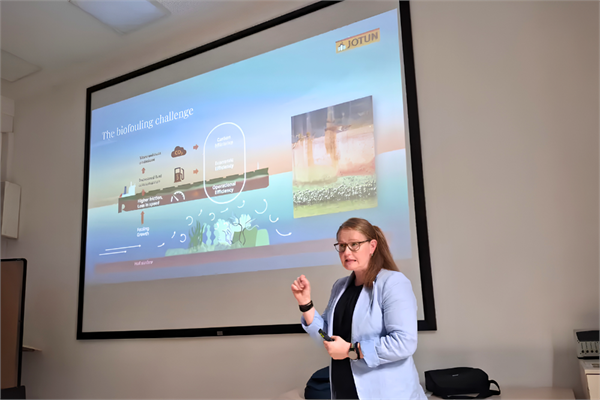
At PortPIC 2026, Jotun showcased research demonstrating how proactive hull cleaning and improved antifouling coating application can significantly reduce emissions, enhance vessel efficiency and limit marine biofouling. The research reinforces the role of advanced coating technologies and proactive hull management in supporting more efficient, sustainable maritime operations.
During the 7th Port Inspection & Cleaning Conference (PortPIC), held in Mülheim (Germany) in September 2026, Jotun presented two research papers highlighting the environmental and operational benefits of effective hull maintenance. As co-founder and main sponsor of the event, the company emphasised the importance of measurable performance and innovative technologies as the International Maritime Organization (IMO) progresses towards a binding biofouling convention.
The first study examined the lifecycle carbon footprint of Jotun Hull Skating Solutions, which combines antifouling coatings with proactive robotic cleaning. Independent verification by DNV across 33 vessels confirmed consistently clean hulls with no measurable speed loss over an average of 3.5 years.
For one large container vessel, the solution achieved a 17.7% reduction in CO2
emissions, equivalent to approximately 17,300 tonnes annually. Over a projected 25-year lifecycle, estimated emissions savings reached 432,500 tonnes of CO2, more than 200 times the solution's calculated carbon footprint.
The second study focused on improving antifouling performance in sea chests, critical seawater intake structures particularly vulnerable to biofouling. Trials conducted on six operational vessels demonstrated that controlled surface preparation and coating application significantly reduced fouling
compared with conventional shipyard practices, highlighting the importance of application quality and regular inspections.
The conference also explored developments in autonomous cleaning robots, artificial intelligence and underwater inspection technologies, alongside emerging international standards such as ISO 6319.
“As the IMO convention takes shape, owners and operators need solutions they can be trusted and data to back them up,” has stated Petter Korslund of Jotun.