Dradura Italia has recently installed a new fluidised bed coating plant for thermoplastic powders, developed by LEM Impianti, to expand its coating options for wire components used in the household appliance sector.
From dishwasher baskets to oven and fridge racks, as well as bottle racks, the wire components used in the household appliance sector must meet increasingly stringent requirements for corrosion resistance, durability, food safety, and aesthetics. Indeed, they operate in particularly demanding environments, being subjected to high-temperature cleaning cycles, continuous exposure to moisture, aggressive detergents, and thermal shocks, all of which call for consistently high performance over time. For this type of product, the quality of surface finishes is a key factor in meeting both functional and aesthetic requirements.
Among the various surface treatment technologies available on the market, plastic coating has established itself as one of the most effective solutions for protecting and enhancing these components, providing film uniformity, chemical and mechanical resistance, electrical insulation, and good visual appeal, while improving the user experience by delivering surfaces that are safer to touch and less prone to damage.
Dradura Italia, a company specialising in the processing of metal wire for the household appliance industry, has been performing plastic coating at its San Donà di Piave (Italy) site for over fifty years. To modernise its finishing department, the company recently invested in a new fluidised bed coating plant that uses not only polyethylene-based thermoplastic powders but also high-performance, next-generation polymeric materials. It entrusted the construction of this plant to LEM Impianti (Carate Brianza, Monza e Brianza, Italy).
The Dradura Group
Dradura was founded by the Stein family as a small family-run business in Germany more than eighty years ago. From the outset, it has specialised in producing wire components for the household-appliance sector, developing highly sophisticated expertise over time. Over the decades, it has consolidated its market position and evolved from a local business into a structured industrial Group, without ever losing sight of product quality and reliability. “This journey has led us to establish ourselves as a trusted partner to some major international household-appliance manufacturers, including Electrolux, Liebherr, BSH Hausgeräte, and Gorenje,” explains Maurizio Scalabrino, Head of Engineering at Dradura Italia Srl.
“In recent years, our company has undergone a significant corporate transformation. Dradura was acquired by Linkk Industrial GmbH, a German investment fund that brings together various companies from the industrial world. Within the Group, we are the hub specialising in metal wire processing and finishing, as part of an ecosystem that also includes companies active in the automation and production of systems for the automotive, pharmaceutical, and medical sectors.
This integration enables us to leverage cross-functional expertise and support a growth trajectory focused on technological innovation,” says Scalabrino. Today, Dradura is an international player headquartered near Kaiserslautern (Germany), with a logistics centre in the United States and three production plants in Europe: in San Donà di Piave (Verona) and Casale Monferrato (Alessandria) in Italy, and in Łódź, Poland.
From wire processing to the finishing department
The San Donà di Piave site, where the new plastic coating plant was installed, specialises primarily in baskets and grids. The production process for these items begins with the procurement of metal wire, supplied in coils or spools, with a diameter of 2.2 to 8 mm. “The first stage involves straightening and cutting operations, carried out using wire-straightening machines that transform the material into bars of the required lengths; alternatively, for certain types of components, CNC-controlled systems are used to process the coil directly, producing pre-formed elements and components ready for the subsequent stages. This is followed by the production of blanks, which can be carried out using manual, semi-automatic, or fully automatic processes, depending on production volumes and the type of product. In this phase, the parts that make up the structure of the finished products are assembled and welded. It is also at this stage that any features required for the subsequent surface treatment phases are prepared; for example, in the case of plastic coating, the parts are fitted with special hanging lugs, which are then removed once the process is complete,” explains Scalabrino.
The components are then transferred to the finishing department, where Dradura has a wide range of technologies at its disposal, including a galvanising plant, three powder coating lines, a chrome plating line, an electropolishing line, and the new plastic coating plant. “A few years ago, in line with regulatory developments and a growing focus on sustainability, we also replaced a hexavalent chromium plating system with a trivalent chromium line, significantly reducing our environmental impact and improving process safety,” he adds. After finishing, the products undergo quality control and are packaged to meet specific customer requirements.
The importance of plastic coating and the new plant’s technical specifications
“The dishwasher baskets and fridge racks produced at this plant undergo a plastic coating process because they must withstand repeated thermal cycling, exposure to aggressive detergents, and high-humidity conditions,” says Scalabrino. The system installed by LEM Impianti is designed to efficiently handle components with different geometries and weights, including wire diameters of up to 8 mm. “The new plant can operate with various types of polyethylene as well as new polyamide-based materials. In both cases, the pre-treatment processes have been optimised to improve environmental sustainability.”
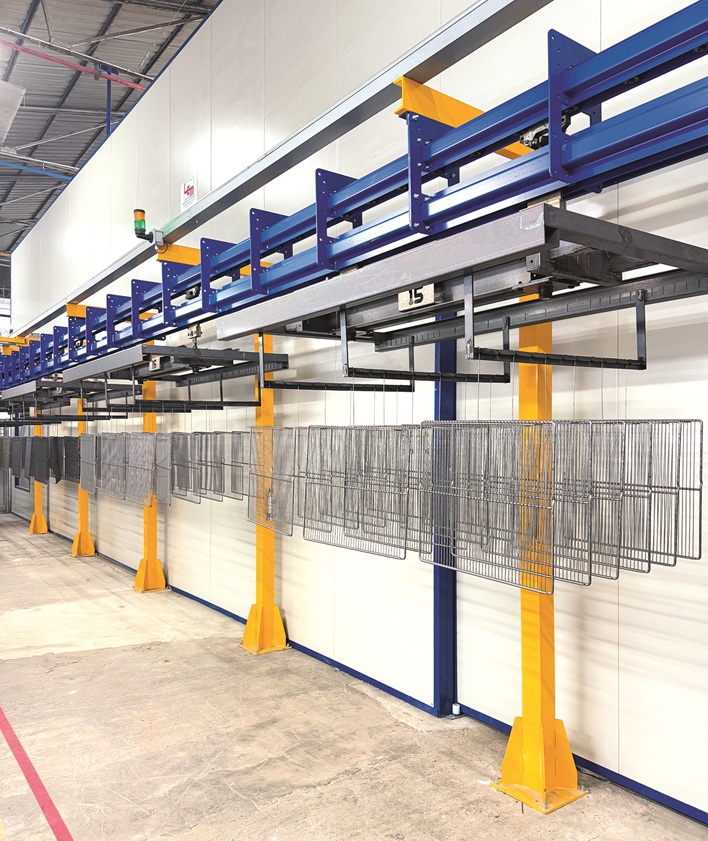 The loading area of the plant’s power & free conveyor. © ipcm
On the new plant, the cycle begins with the manual loading of components onto the power & free conveyor. This transports them to the hybrid preheating oven, which can be fuelled by gas or electricity. “Its temperature is carefully adjusted so that the metal mass reaches the required thermal level for adequate thermal inertia. The components are then immersed in the fluidised bed tank,” illustrates Paolo Sala, owner of LEM Impianti.
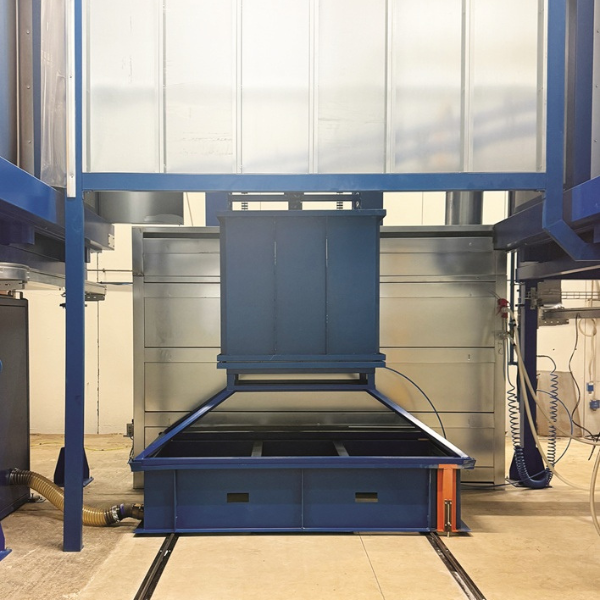 Fluidised bed immersion tank. © ipcm
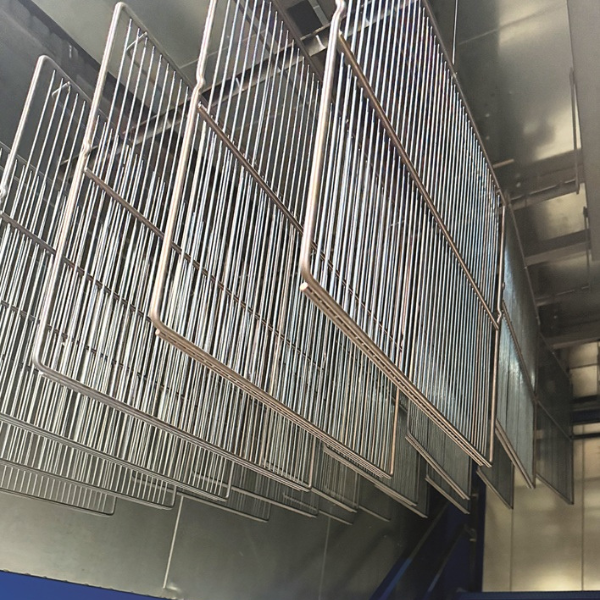 Components entering the bell-type curing oven. © ipcm
The plant is equipped with two Gema OptiFeed BigBag powder feeding systems, designed to transport and handle powder contained in BigBag sacks. After the thermoplastic coating is applied, the components are first transferred to the bell-type curing oven, then to a storage buffer, and once cooled, to the manual unloading station. Here, an operator can manually remove the hanging lug and, if necessary, touch up the finished product.
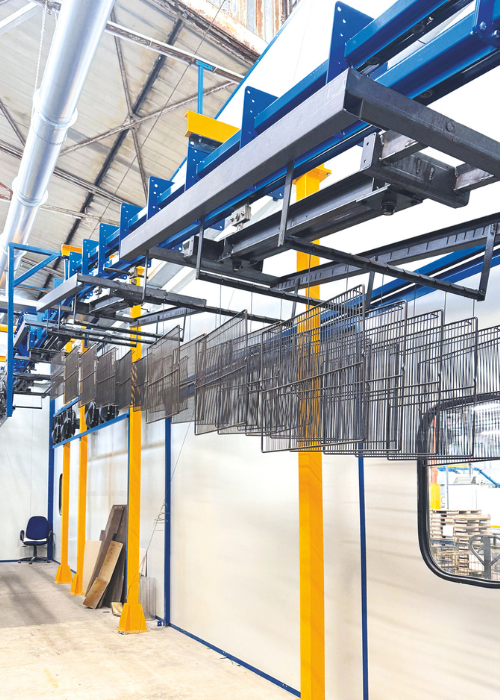 The storage buffer for cooling parts. © ipcm
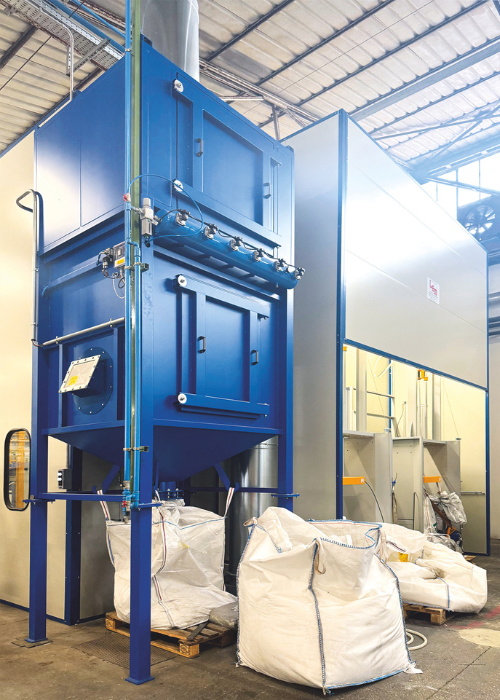 Gema’s OptiFeed BigBag powder feeding system. © ipcm
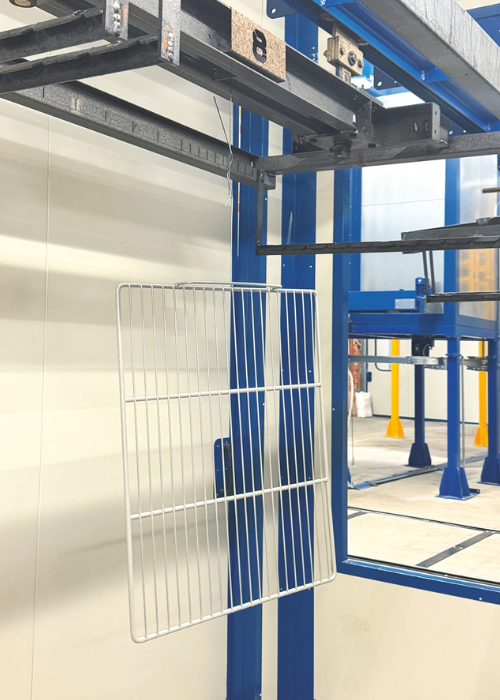 White, black, anthracite grey, and light shades are among the most requested colours in the refrigeration sector. © ipcm
“The system is characterised by high flexibility and operates in both automatic mode, using pre-set recipes, and manual mode, with the option to set and adjust each process parameter individually, according to specific production requirements. The plant’s configuration allows it to operate with a small staff, involved exclusively in the loading and unloading phases, while the rest of the process takes place within a fully controlled environment, protected by barriers fitted with interlocking devices to ensure maximum operational safety,” notes Sala.
The challenge posed by polyamide and the role of the plant engineering partner
The ability to use different polymeric materials in the plastic coating process enables the fulfilment of specific application requirements. Polyethylene is a well-established solution for numerous standard applications, even under low-temperature operating conditions, and can be modified with specific additives to improve its UV resistance or prevent yellowing over time.
Alongside this technology, shifting market demands are driving the adoption of higher-performance materials, such as certain polyamides.
These materials offer superior mechanical strength, abrasion resistance, and corrosion resistance, broadening the range of possible applications. However, they also require a more complex manufacturing process. In fact, polyamides require more demanding operating conditions than polyethylene, particularly with regard to processing temperatures and thermal cycle management. These characteristics call for careful optimisation of the preheating, immersion, and curing stages.
With the new fluidised bed coating plant installed at Dradura, the challenge was to optimise the process parameters to accommodate both materials. Polyethylene requires lower operating temperatures, whereas polyamide demands higher ones and specific cooling conditions, potentially involving thermal shock in water. “During the current development phase, LEM Impianti’s contribution is proving crucial, supporting our team in fine-tuning the process thanks to its technical expertise and know-how.
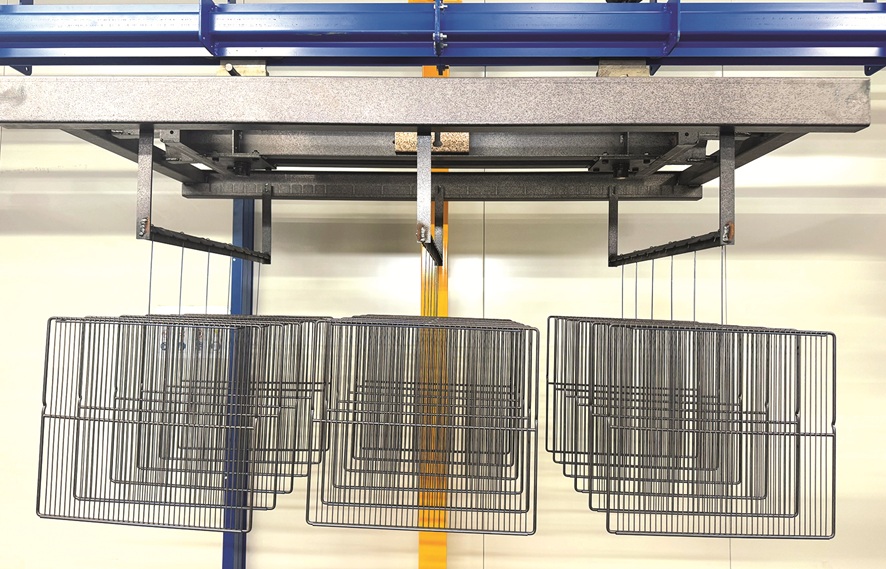 Fridge racks after the plastic coating process. © ipcm
The plant’s flexibility, which allows testing in both automatic and manual modes, has also enabled us to experiment with different application configurations and to accelerate parameter optimisation, reducing development times and improving our understanding of material behaviour,” says Scalabrino.
Continuous innovation to meet future challenges
The path Dradura has taken in recent years demonstrates that tangible innovation is possible even in a highly established sector, through advances in technology, processes, and materials. This company’s investments in its finishing department, particularly the installation of the new fluidised bed coating plant developed by LEM Impianti, marked a significant step towards more efficient, sustainable, and quality-oriented production. At the same time, Dradura’s openness to high-performance materials, such as polyamide, confirms its commitment to keeping pace with market developments and expanding its technological expertise.
“The choice of our technology partner was the result of a careful technical assessment that also took into account the level of technical assistance offered. The existing collaboration was also a decisive factor: LEM Impianti has always ensured ongoing maintenance of other installed systems and has provided prompt technical support when required. This aspect was fundamental in identifying a business capable not only of supplying the technology but also of supporting us as a true partner,” states Scalabrino.
“Although the plant has only been in operation for a few months and testing of different coating products is still ongoing, the main benefits observed include streamlined tank cleaning and significantly reduced colour change times, thanks to Gema’s automated OptiFeed system. At the same time, finishing quality has improved, and operator safety has increased through the ergonomic redesign of the loading and unloading stages, the reduction of the most strenuous manual tasks, and the introduction of protective barriers. Cycle automation and plant layout optimisation have also reduced staffing requirements, resulting in resource rationalisation and improved work organisation.
“Finally, a key factor concerns the sustainability of our production process. The introduction of a hybrid gas/electric system, together with improved energy efficiency and reduced heat loss in the oven, has helped minimise energy consumption and the plant’s overall environmental footprint. At a time when energy costs are a growing concern, this is a strategic factor of the utmost importance,” Scalabrino concludes.