For a company, expanding its range of target sectors and positioning itself as the ‘factory of the future’ for automotive components requires advanced coating plants, such as the one designed by Trasmetal’s Varnish Tech division for Prima Sole Components’s Oderzo site. Based on a skid-handling system that replaces the traditional power & free conveyor, this new line enables the intensive coating of large components thanks to opposing robots inspired by the automotive industry, which increase its flexibility and application capacity.
When we imagine a futuristic car factory, our minds immediately turn to robotic arms moving in concert, welding sparks lighting up endless assembly lines, and car bodies gliding silently through the coating, sealing, and assembly stages. This vision seems straight out of science fiction, yet it stems from a tangible truth: for over a century, the automotive industry has been a testing ground where automation, precision, and mass production have reached their peak. Therefore, it is no coincidence that the very concept of the ‘factory of the future’ takes the form of a perfectly synchronised automotive production line.
PSC-Prima Sole Components, a Group operating in the sector of plastic components for the automotive, transport, and household appliance industries and specialising primarily in systems for vehicle exteriors and interiors, has replicated this scenario at its headquarters in Oderzo (Treviso, Italy). In response to ongoing global instability affecting the sector, it has set itself the objective of renewing and modernising its production processes, both to meet the challenges of decarbonisation, in line with the European targets of the Green Deal for 2030, and to integrate emerging technologies such as artificial intelligence into its organisational and industrial models, with the aim of optimising production performance, improving product quality, and making organisational management more efficient.
With 70,000 m² of production space and around 450 employees, the PSC Group’s Oderzo facility is one of the largest industrial hubs in the region. The site is divided into three operational departments dedicated to plastic injection moulding, coating (with 3 dedicated lines), and the bonding and assembly of finished products. One of the company’s most recent investments concerned the coating department, developed with the support of Varnish Tech – now Trasmetal (Milan, Italy) — which had already collaborated on the system installed at the company’s plant in Poland.
The goal was to create an innovative two-level line capable of meeting the growing need for market differentiation, handling the resulting increase in production volumes, and coating large-sized components. In collaboration with the technical team of the Varnish Tech division, the Oderzo-based company introduced a technology typically used in the automotive sector: opposed robots. This made it possible to overcome application limitations linked to the complexity of specific components while maintaining high production efficiency.
Prima Sole Components: the automotive components hub
PSC’s history is closely intertwined with the evolution of the automotive and motorbike industries, with coating at the heart of its development. Founded in 1973 to serve the furniture sector, the company shifted its focus in the 1980s to producing components for the automotive, aeronautical, and railway industries, establishing partnerships with major Groups, and securing its first contract with Fiat Auto in 1987 for plastic parts for car exteriors.
Between the late 1980s and the 1990s, it consolidated its expertise by establishing Prima I.Ver., specialising in the coating of plastics, while expanding its target markets to include international clients. During the same period, the Group also entered the motorbike sector with Metalplastic, devoted to the production and coating of plastic components for motorcycles, and further strengthened its coating expertise through the acquisition of Tecnoproduct in Sezze (Latina, Italy), later renamed Tecnoprima. At the same time, PSC diversified its business by entering the household appliances sector with the creation of P.A.D., a plant dedicated to Merloni Elettrodomestici.
Following the launch of an internationalisation process in the early 2000s, the Group completed a strategic phase of its expansion in 2010 with the acquisition of Plastal Italia, later renamed Sole S.p.A., which also included the Oderzo plant – now one of the key sites for the production and coating of plastic components for the automotive and motorcycle sectors. “The Oderzo site,” explains its CEO, “was established in the early 1960s as Società Opitergina Lavorazioni Elettromeccaniche, owned by Electrolux. In 1993, it launched a joint venture with Plastal, a Swedish Group that entered administration following the 2008 crisis, leading to its subsidiaries being acquired by other industrial Groups: the Oderzo plant thus became part of Prima Sole Components.”
Today, the division operates in four main sectors and collaborates with the most important international OEMs of the automotive, truck, motorcycle, and light vehicle industries.
A production cycle focused on quality
The Oderzo site, together with those in Suzzara (Mantua, Italy) and Pontedera (Pisa, Italy), forms part of the Group’s thermoplastics division, whereas the sites in Scanzorosciate (Bergamo, Italy) and Hörgertshausen (Bavaria, Germany) make up the thermosets division.
Within the Oderzo facility, the moulding department is organised according to a production model based on advanced automated cells, dedicated to the manufacturing of components for the automotive and motorcycle industries, in line with the highest quality standards.
The department also integrates several automated phases of assembly, accessory fitting, and quality control directly on the machine, as well as advanced technologies such as laser sprue cutting. Among the most sophisticated applications are components with soft-touch finishes intended for industrial vehicles, developed to meet the requirements of the premium market segments.
Today, the facility integrates several cobots distributed across its production departments and advanced video management systems: these technological solutions have already been widely adopted in the moulding area and are now being progressively extended to the coating shop as well.
The coating department
There are 3 coating lines in operation at the Oderzo site. The first, installed in 2011 and expanded with a second booth in 2019, comprises 2 booths and 4 robots and is used to coat grilles and small components for both vehicle interiors and exteriors. The second plant, also commissioned in 2011, comprises 3 water-curtain booths and 6 robots.
The third plant, called NIVE, is equipped with three booths and ten robots. Commissioned to Trasmetal — which later merged with the Milan-based company Trasmetal, where it now operates as a specialised spray-coating division — the project was completed in 2026 and represents the most advanced solution. “The main difference among these plants,” explains the plant manager, “lies in the layout of their automated equipment: whereas in the first two, the robots are arranged in a face-to-face configuration, in the NIVE one, they are positioned according to a plant engineering logic that allows greater flexibility in production cycles. In addition, for the older line, continuous operation required a longer pre-treatment tunnel, whereas the skid-based configuration adopted in the two more recent ones allows for better modulation of the timing of individual process stages.”
Particular technological solutions were also introduced, such as the integration of blow-off robots after the pretreatment stage in both the second system and the NIVE, with different application methods for single-component products compared to two-component products. Significant differences also concern the management of the application phases: in the second plant, the final finish is applied in the second booth, whereas in the NIVE system, this phase was redesigned for process stability reasons
. “In the Trasmetal system, the conditions ensure constant internal airflow and provide more stable control over viscosity and film behaviour.”
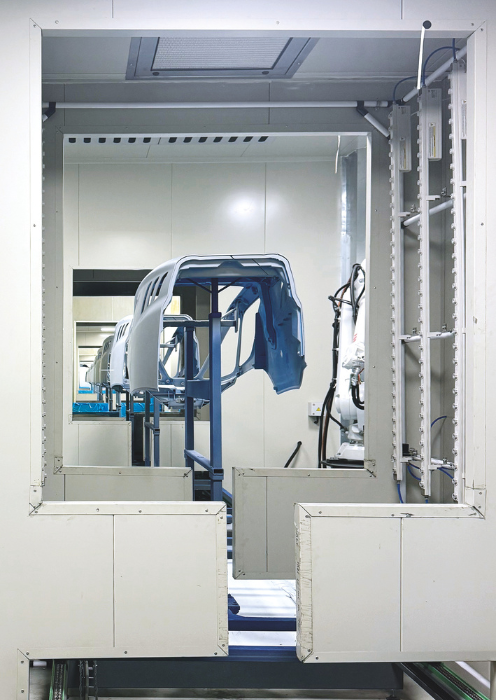 The 3 coatings booths in sequence. © ipcm
Key features of the NIVE system
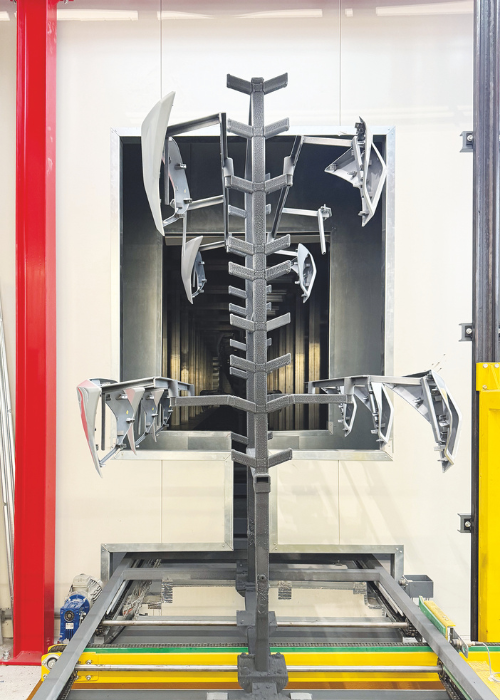
“The system consists of a series of skids capable of handling large e heavy components, distributed across the various stations along the line,” explains the head of the coating department. “The first is the loading area, where each skid is fitted with the required hanging devices. Following receipt of an order by the logistics department, the cycle is initiated.”
Afterwards, the components are conveyed to an automatic pre-treatment tunnel. At the end of the tunnel, a robotic blow-off station has been installed, where two robots operate sequentially on both sides of the parts, with programs tailored to each component.
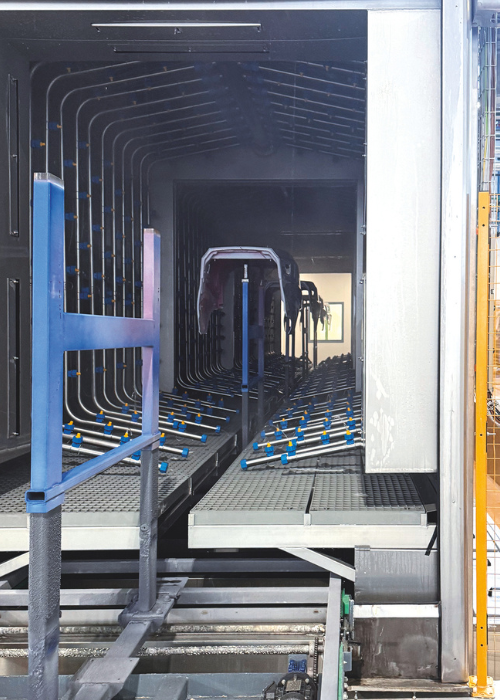 The entrance to the pre-treatment tunnel. © ipcm
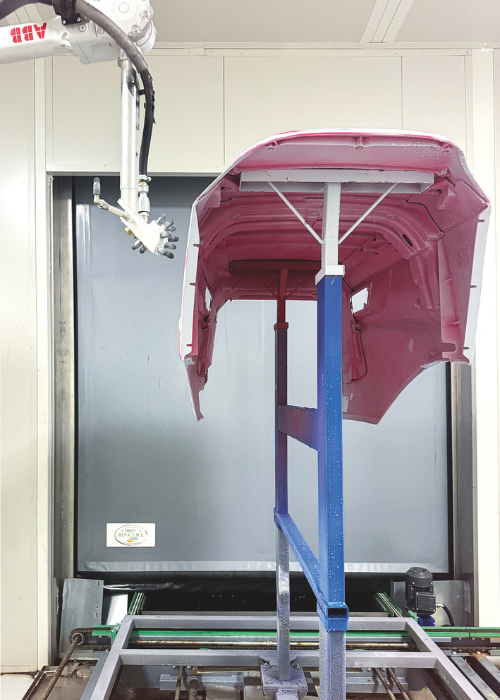 The robot for automated blow-off. © ipcm
After blow-off, the skids transport the parts to the drying oven, and then into a rotation station, which ensures correct positioning before entry into the first coating booth. This stage also includes a thermal stabilisation phase, which allows the components to cool gradually to room temperature, reducing thermal shock on entry to the coating process,” the technician continues.
Here, the coating phase begins with a surface activation step, necessary for treating low surface-energy material that require a preliminary treatment to ensure paint adhesion. “This is followed by the first coating booth, equipped with 2 opposing robots, a flash-off station, and the second booth for base coat application. In the third booth, depending on the specifications, either a clear coat or a top coat is applied, or the parts simply pass through in the case of special cycles. Finally, after a short flash-off phase, the parts enter the curing oven,” he continues.
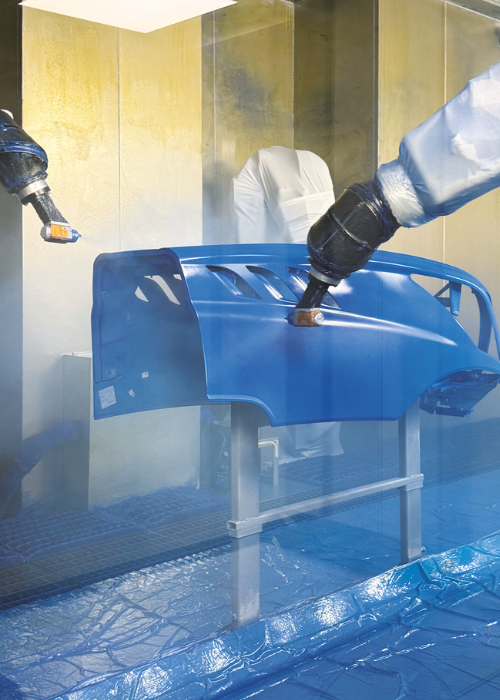 The base coat application booth. © ipcm
 The exit from the polymerisation oven. © ipcm
Once out of the oven, the components are transferred to an elevator that lifts them for controlled cooling to temperatures suitable for manual handling and subsequent packaging operations. For heavy parts, such as SMC parts, the system is supported by dedicated manipulators during both loading and unloading, following an ergonomic ‘zero-gravity’ approach that reduces the operational load on staff and enables handling of even very heavy parts. The line ends with a quality control station: all coated components are 100% inspected as they leave the line before being sent to the final assembly department.
Digitalisation as a tool for growth
Digital transformation represents one of the key elements in the evolution of the plant’s production model. “Through advanced supervision and monitoring systems, the company is able to support production continuity, improve activity planning, and ensure greater stability in operational flows.
The main process variables are continuously monitored via automated systems designed to ensure high standards of reliability and quality. The integration of digital monitoring and traceability tools also enables more efficient management of production activities and continuous control of plant performance,” the technician explains.
To support process design and optimisation, advanced virtual simulation technologies are used to validate adopted solutions and improve operational efficiency across the various production stages.
The integrated management of production data represents an additional strategic element of the group’s industrial model, helping to strengthen coordination between different operational areas and supporting increasingly fast and effective decision-making processes.
“Overall, digitalisation acts as a key enabling factor in consolidating PSC’s role as a strategic partner for the automotive sector and in developing innovative industrial solutions focused on quality, efficiency, and sustainability,” the CEO concludes.
The factory of the future for automotive components
The system built by Varnish Tech was initially designed to coat large bonnets, but over time its scope has gradually expanded to include new sectors and product types. “Today,” the PSC team states, “we can also paint other products, such as van grilles, and we have new applications planned in order to enter new strategic markets.”
“The choice of Varnish Tech was guided by the build quality we observed at the plant installed in Poland,” continues, “and confirmed by this supplier’s consistent support throughout all phases, from the construction of the line’s housing to after-sales support. This plant technology departs from traditional standards, replacing the power & free conveyor with a skid-based system – intrinsically more complex but more flexible in managing production flows – borrowed from the automotive sector. It is precisely this flexibility that defines the future of manufacturing: no longer rigid, vertical lines but production platforms capable of adapting to different products, markets, and volumes without compromising efficiency.”