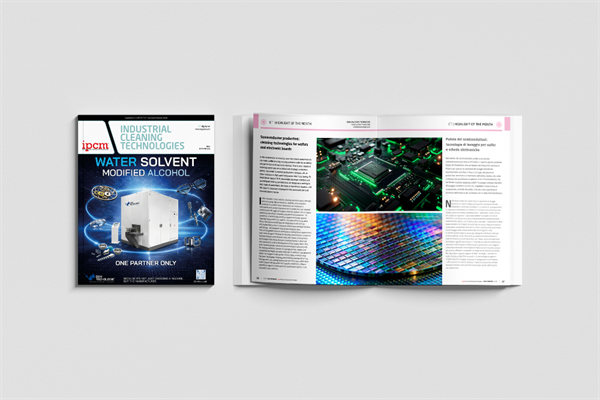
The new issue of the magazine dedicated to covering all aspects of industrial parts cleaning is available!
Several articles and reports in this issue of ICT focus on the growing pressure on PFAS (perfluoroalkyl and polyfluoroalkyl substances), a large and diverse group comprising thousands of chemical compounds with widely varying physical and chemical properties, health and environmental profiles, uses, and benefits.
On 7 February 2023, the European Chemicals Agency (ECHA) published a REACH restriction proposal for PFAS. The main reason cited is that these substances persist in the environment, but this does not necessarily mean they pose a risk.
The authorities that drafted the document outlined two possible restriction scenarios. Both involve banning the production, use, and placing on the market of PFAS as substances, constituents of other substances, mixtures, and articles or parts above specified concentration levels.
However, the OECD highlighted that the term ‘PFAS’ does not indicate whether a compound is harmful but only that compounds under this name share certain chemical characteristics.
The real problem is that PFAS are used in the manufacture of products across almost all industrial sectors, including consumer goods, which means they play a key role in our society.
Even more importantly, PFAS contribute to making many industrial sectors more sustainable: fluoropolymers, for example, which are also classified as PFAS but meet the OECD criteria for low-concern polymers, ensure longer service life, generate greater efficiency, play a significant role in achieving decarbonisation targets, and prevent premature obsolescence of products and assets.
The fight against PFAS should therefore not be a crusade in the name of sustainability but rather a reasoned, surgical attempt to regulate critical materials that remain irreplaceable in many applications.
In the cleaning sector, for example, PFAS are found in solvents used for degreasing and precision cleaning. At the same time, several new-generation solvents (some HFOs and modified alcohols) are PFAS-free and therefore provide future-proof, environmentally friendly solutions.
Our industry successfully replaced many carcinogenic solvents with high ozone-depletion potential years ago, and it is already moving towards a further transition without having to endure the demonisation of a technology.
READ THE MAGAZINE!