FANUC and NVIDIA are strengthening their strategic partnership to transform the industrial sector through the development of Physical AI and advanced simulation. The technological integration between both companies enables the creation of high-precision digital twins and the intuitive, real-time management of virtual factories.
The core of this collaboration focuses on interoperability between ROBOGUIDE, FANUC’s offline simulation software, and NVIDIA Isaac Sim, NVIDIA’s open robotics simulation platform.
Through this integration, users can programme and control robots in real time using virtual or physical teach pendants connected to ROBOGUIDE, simulating trajectories and cycle times identical to those of real machines.
The system operates under two main configurations:
- Optimised virtual environment: Isaac Sim operates in the foreground, leveraging NVIDIA Omniverse and Isaac Lab libraries. This allows complex operations—such as component assembly or the handling of flexible parts (for example, cables)—to be reproduced with precision.
- Physical Bin Picking simulation with NVIDIA PhysX: With ROBOGUIDE in the foreground and supported by the PhysX physics engine, the system can simulate picking randomly arranged parts from a bin. Thanks to the 3D Vision system, the robot identifies components and resolves extraction issues virtually, eliminating the need for physical shop-floor testing.
Utilising the NVIDIA Isaac GR00T N
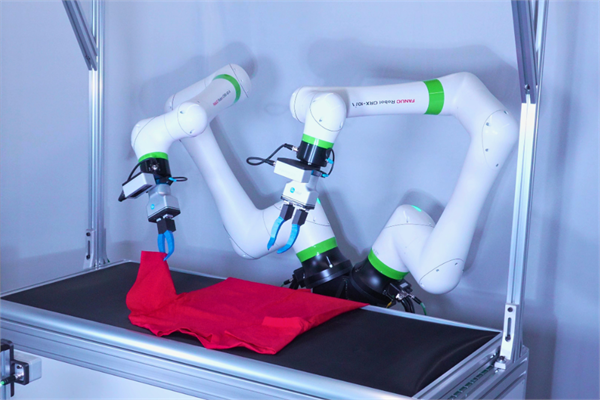
robotics foundation model, cobots learn by observing human operator movements via imitation learning. Combining this model with FANUC’s motion control algorithms allows the robot to adapt its trajectory in real time when dealing with deformable materials, achieving smooth, continuous movements.
FANUC has also upgraded its robotic systems by incorporating NVIDIA Jetson Thor, NVIDIA’s supercomputer designed for edge robotics. By replacing the Jetson AGX Orin module with the new Jetson T5000, the robot’s AI processing capacity has increased by more than 7.5 times. This enables cobots to detect people nearby and modify their trajectories in real time, making collision avoidance faster and safer.
This collaboration represents a paradigm shift for advanced manufacturing: the ability to evaluate, design, and train complex systems in GPU-accelerated virtual environments significantly reduces commissioning times, minimises design costs, and bridges the gap between simulation and the actual production floor.