Starting as a small family business and growing into an international company, TML has built its success on strategic investments, insourcing individual production stages, and direct quality control. Today, the company produces around 50,000 domestic hot water boilers a year and has chosen to insource its tank enamelling process by installing an automated system designed by Trasmetal. This forward-thinking investment has increased its autonomy, flexibility, and control over a crucial stage of the production process.
The Italian industrial fabric was built on stories like TML’s: businesses founded by people capable of turning an idea into a concrete project, a dream into a business, and a small family enterprise into a company that can compete in international markets. These are stories of sacrifice, determination, and courage, often originating far from the major industrial centres, in provincial areas where practical skills, trade knowledge, and the courage to look beyond were the real assets on which to build the future. This has been the journey of many Italian companies, which, starting small and facing years of challenges and continuous investment, have managed to grow without compromising their original values: family ties, a passion for the product, and a long-term entrepreneurial vision.
TML’s story fits perfectly into this model. “The company was founded by my father, Salvatore Loddo, who was originally from Sardinia and moved to Abruzzo in the 1960s after gaining extensive experience in the plumbing sector. He took his first steps in the family garage, driven by sacrifice, intuition, and the desire to build something of his own,” says Riccardo Loddo, the export managing director and a member of the second generation at the helm of the company. Over the years, that small artisan business has grown into an industrial Group comprising three production sites: one plant in Civitella del Tronto (Teramo, Italy), one in Floriano di Campli (Teramo, Italy) and one in Abbasanta (Oristano, Italy), with over 140 employees and a strong international presence. This growth has been built step by step through technological investments and strategic decisions that have enabled the company to become a leading name in systems for the production and storage of hot and cold water, for both domestic and technical applications.
Among these decisions was the creation of an in-house enamelling department dedicated to carbon steel boilers, made possible by a significant investment supported by Trasmetal (Milan, Italy), which supplied the surface treatment plant – and which fully shares TML’s philosophy, based on anticipating future needs through innovation, process control, and a commitment to quality.
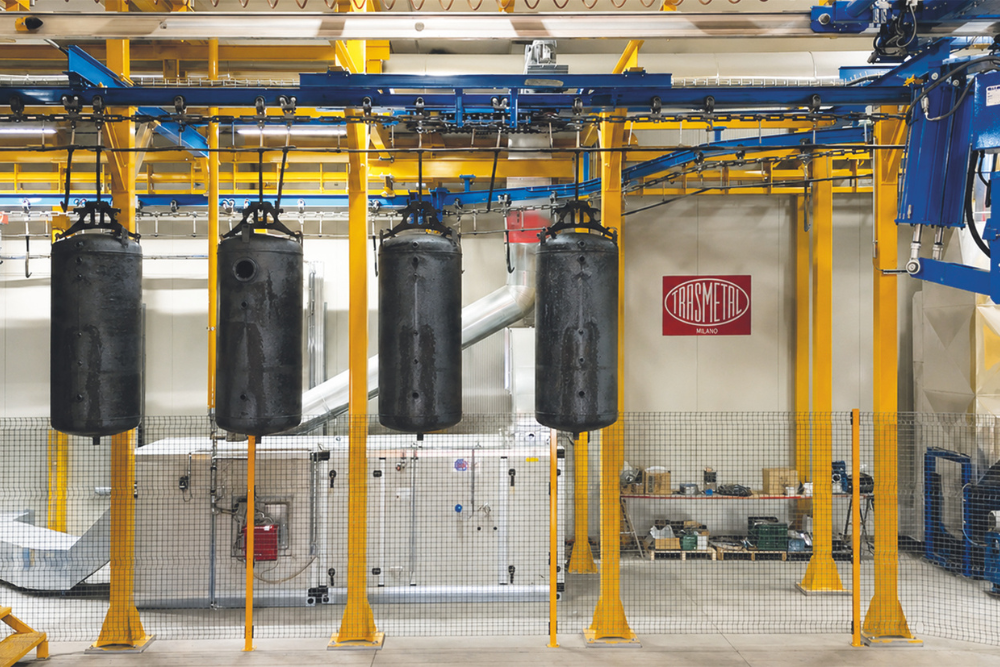 Overview of the enamelling plant supplied by Trasmetal. © Trasmetal
An integrated production process for domestic hot water boilers
In recent years, the sector of cold water and domestic hot water (DHW) tanks, solar systems, and heat exchangers has grown significantly. “Today, TML produces around 50,000 boilers a year and expects to achieve a turnover of €41-42 million, with exports accounting for 75% of production,” says Loddo. The company’s international presence now extends to numerous European and non-European markets, including Canada, the United States, Chile, the United Arab Emirates, Morocco, Jordan, Egypt, Algeria, Vietnam, Chile and many others. These results are the outcome of a production model that maintains in-house control over all key manufacturing stages.
The cycle begins with sheet metal (carbon and stainless steel) being processed through cutting and drilling. A roll bending stage then forms the cylinder. In about 40%-50% of products, a heat exchanger is fitted inside the tank. “In line with our strategy of gradually insourcing our production stages, we have also been manufacturing heat exchangers in-house since 2024, further strengthening our direct control over the entire supply chain and the quality standards of our products,” emphasises Loddo. The cylinder is finally sealed with end caps and transported to the welding department. The process then continues with the installation of fittings, test inspections, and the subsequent finishing and final assembly stages.
The technological heart: the enamelling cycle
“Only the internal surfaces of carbon steel boilers undergo the enamelling process carried out by the new Trasmetal plant. This is a crucial stage in protecting surfaces in contact with domestic water and ensuring corrosion resistance, reliability, and a long service life. Stainless steel boilers, on the other hand, do not require this treatment thanks to the material’s intrinsic properties. Otherwise, the production process remains unchanged,” adds Loddo.
The plant engineering company designed this fully automated system to meet TML’s specific requirements and ensure precise control of all process parameters. “After being hung on the conveyor, the components undergo an eight-stage pre-treatment cycle comprising degreasing, two rinses, pickling, further rinses, and passivation,” explains Paolo Colombo, head of Trasmetal’s enamelling department.
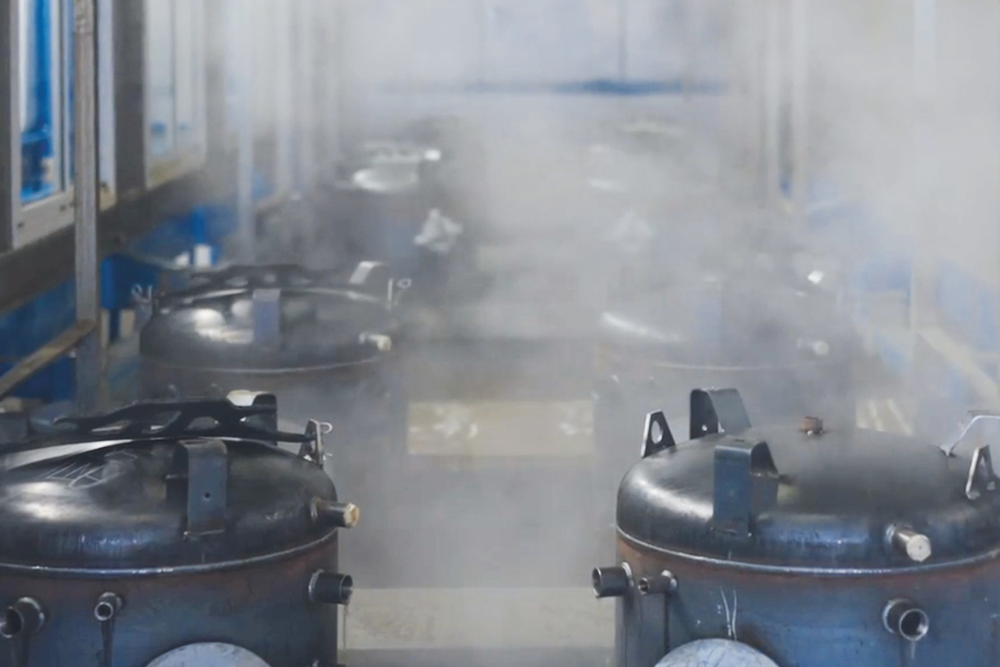 The boiler pre-treatment cycle consists of eight stages. © TML
The decision to adopt a spray pre-treatment system before applying porcelain enamel was the result of careful consideration by both TML and Trasmetal, aimed at defining a solution to meet the product’s specific requirements and the company’s quality objectives. “In this type of enamelling plant, immersion pre-treatment processes are usually employed, in which the entire boiler is immersed in various tanks containing the solutions required for surface preparation stages. However, only the internal surfaces of the tanks come into contact with domestic water and therefore need to be coated with enamel and thus pre-treated. Treating the entire product would have resulted in higher chemical consumption and more complex management of the waste water generated. For this reason, a spray application was chosen, making it possible to treat only the tanks’ inner surfaces and thereby reducing chemical consumption and environmental impact,” explains Colombo.
The boilers then reach the in-line automatic application systems, where two flow coaters apply liquid porcelain enamel. This is followed by a drying stage, essential for removing residual moisture before firing. “This step is particularly crucial for boilers fitted with multiple heat exchangers, as more complex geometries may require different drying times compared to simpler tanks,” notes Colombo. The cycle ends with the components entering the firing kiln, where the product undergoes three main stages: pre-heating, firing at about 800–850 °C, and controlled cooling. Gradual temperature control during both heating and cooling helps prevent thermal shock and preserve the integrity of the enamel layer.
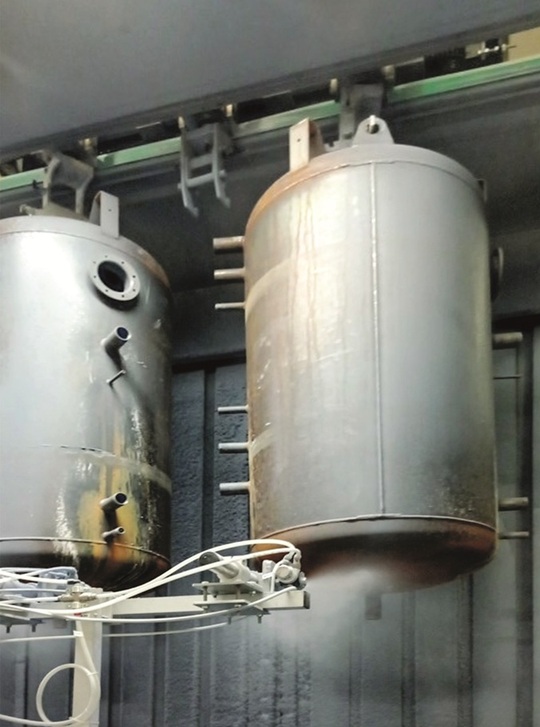 Two flow coaters apply the liquid porcelain enamel. © TML
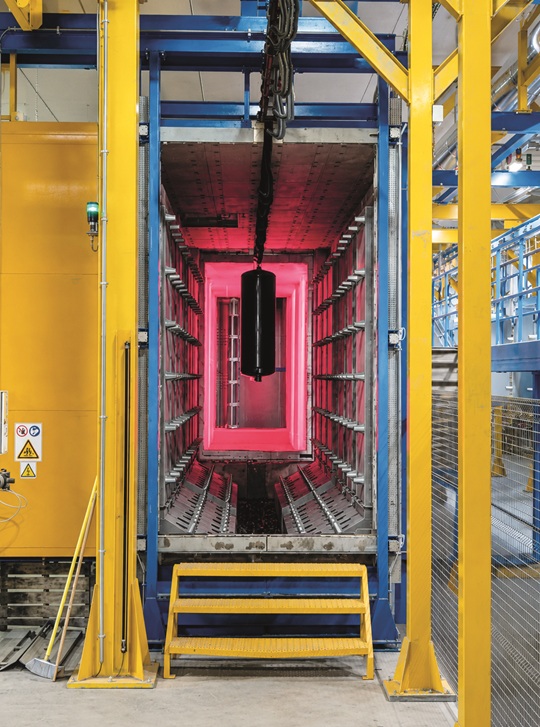 The enamel is fired at temperatures of approximately 800–850 °C. © Trasmetal
“As regards the boilers’ external finish, the treatment varies by capacity: small to medium-sized models do not require any coating, as they are subsequently covered with insulating polyurethane foam, which forms the product’s final finish. For larger sizes, ranging from 800 to 2,000 litres, the tanks are cleaned of residual scale generated during the manufacturing process and then protected with a coating system,” says Loddo.
Investing in the future despite the figures not yet supporting it
The decision to install a new enamelling plant arose from a specific need: to support TML’s production growth by gaining greater control over a stage considered critical to product quality. “Before this system was installed, we relied on external contractors. With the increase in volumes and market demand, this solution began to show its limitations, particularly in terms of logistics management, production flexibility, and the ability to directly adjust process parameters,” indicates Loddo. “However, the main reason was to gain greater autonomy and guarantee total quality.”
Insourcing the enamelling process was another step towards greater direct control over the production chain. The ability to monitor every variable in the process enables TML to tailor it to each product’s specific characteristics, from the boiler’s capacity to the heat exchanger’s geometry. “Contractors inevitably have to deal with different components and a multitude of variables,” adds Loddo. “We, on the other hand, can adapt every process parameter to our specific production requirements, taking into account the size of the boilers, the thickness of the steel, and the construction characteristics of the products. This gives us direct control over the workflow and enables us to guarantee consistent quality across every tank. One of the most important parameters is undoubtedly the density of the enamel, which directly affects application uniformity and coating quality. That is why our technicians carry out daily checks to ensure the process is always operating under optimal conditions.”
 The boilers reach the in-line automatic application machines, where two flow coaters apply the liquid porcelain enamel. © TML
The investment in this enamelling plant aligned with TML’s long-term vision. “When we decided to purchase it, we did not yet have the production volumes to justify such a significant investment in the short term. However, this choice proved strategic, supporting our growth and pursuing a clear objective: never to compromise on quality.” The plant became operational in 2022, perfectly timed to capitalise on the extraordinary boom that swept through the market. It was a highly forward-thinking decision: without the in-house enamelling plant, or if work had started later, TML would not have had the production capacity and flexibility needed to ride that wave, nor would it have achieved the extraordinary success it subsequently attained.
Skills sharing and the human factor in entrepreneurship
The construction of the new plant resulted from ongoing exchanges between TML and Trasmetal, aimed at sharing their respective areas of expertise. “We had known Trasmetal for some time, and the decision to install an enamelling plant had been maturing for years,” says Riccardo Loddo. “The project was complex, but the collaboration was constructive and focused on finding the best technological solutions. We know our product and its requirements very well. Therefore, we needed a partner to design a bespoke system tailored to our specific needs, which in the tank sector are particularly complex due to high thicknesses and operating pressures.”
This interaction sparked a process of mutual growth. Although Trasmetal had previously developed similar systems for boilers and tanks, the challenges posed by TML pushed its technology further. A prime example was the optimisation of the enamel drying cycle before firing: the presence of multiple coils within the same boiler required a joint study to precisely calibrate drying times (which range from around 30 minutes for empty products to 1.5 hours for those fitted with two or three heat exchangers) and to prevent residual moisture from compromising final quality. “The value of projects like this,” Colombo emphasises, “lies precisely in the ability to combine two complementary perspectives: the plant engineer brings technological expertise, and the manufacturer has detailed knowledge of how its product behaves. TML has helped us understand where we could make technological advances, developing a process that is more efficient and, at the same time, has a lower environmental impact thanks to the reduction in chemicals and waste.”
The success of this project also owes much to the Loddo family’s forward-thinking approach and their ability to look ahead, turning a technological challenge into an opportunity for growth. These are precisely the decisions, often made before the market has clearly signalled the need for them, that chart the course for companies seeking to build their own future. “A key factor in the success of this partnership was the owners’ direct involvement. When working with people who have an in-depth understanding of their product and a clear vision of their goals, dialogue becomes more effective, and the project takes a clear direction right from the start. We were able to engage directly with those involved in the production process, learn about the company’s real challenges, and work together to develop a solution capable of supporting its growth,” concludes the head of Trasmetal’s enamelling department.