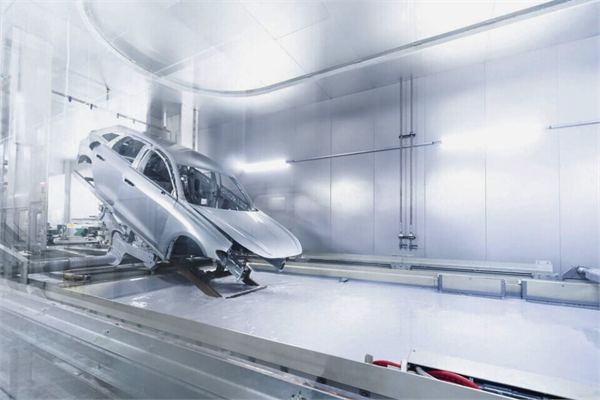
Audi leverages AI to optimise paint shop operations and boost efficiency across coating processes.
Audi is accelerating the adoption of artificial intelligence (AI) across its production and logistics operations, transforming traditional factories into smart, data-driven environments. Central to this effort is the automaker’s cloud-based platform, which enables real-time control of production processes and supports employees with AI-powered tools.
“Our roadmap for AI and digitalisation is turning our plants into smart factories where AI acts as a partner, supporting employees with tailored guidance. From ergonomically challenging tasks handled by AI-assisted robots to intelligent chatbots relieving administrative burdens, we are reshaping production with smart solutions,” has stated Gerd Walker, Board Member for Production and Logistics at Audi.
At the heart of Audi’s digital transformation is the Edge Cloud 4 Production (EC4P), now operational across its German production plants. By combining conventional automation technology with cloud computing power, EC4P enables faster implementation of new functions, reduces hardware requirements, and stabilises processes—while enhancing IT security and lowering maintenance costs.
In vehicle assembly, the EC4P allows centralised, cloud-based worker guidance, delivering real-time updates on vehicle specifications and regional versions. More than 1,000 industrial PCs have already been decommissioned as a result. In the body shop for the A5 and A6 series in Neckarsulm, virtual programmable logic controllers (vPLC) now replace traditional hardware controllers, coordinating roughly 100 industrial robots with millisecond precision—allowing several hundred vehicle bodies to be produced daily across three shifts.
Audi is placing particular emphasis on AI’s potential in coating and paint shop operations. The Weld Splatter Detection (WSD) system, running on the EC4P, identifies weld spatter on car underbodies and marks it with light. A robot arm then grinds down the spatter, removing a physically strenuous task from human workers. This system, the first of its kind within the Volkswagen Group, is set for rollout in six plants, including those involved in large-scale series production.
Further innovation comes from ProcessGuardAIn, Audi’s in-house AI solution for monitoring manufacturing processes. Leveraging the cross-plant P-Data Engine, the system standardises plant and process data to allow rapid development and scaling of AI applications. In the Neckarsulm paint shop, pilot use cases already monitor cathodic dip coating and pretreatment processes in real time, detecting anomalies early and optimising chemical dosing. Full integration into series production is planned for the second quarter of 2026.
Audi is also exploring AI-supported dryer operation in its paint shops in cooperation with the Innovation Park Artificial Intelligence (IPAI) in Heilbronn. By connecting temperature and airflow controllers to AI models adapted from other industries, the system adjusts drying conditions in real time, increasing energy efficiency and reducing resource use. Energy savings are being tested through to summer 2026.
Across its global network, Audi is scaling AI use and sharing insights between plants. At Audi Hungaria, AI is enhancing transparency and efficiency throughout the value chain, while at Audi México, management uses AI-driven production reports to make data-informed decisions in real time.
Audi emphasises responsible AI deployment through its Code of Conduct and a dedicated AI policy, underpinned by principles of respect, security, and transparency. The Data Sharing Code of Practice ensures all operational data is handled safely and ethically.
“By combining our production expertise, innovative strength, and strong partnerships, we are setting standards for data-driven manufacturing—especially in coating and paint processes—decisively and responsibly,” has concluded Gerd Walker.