Visa Impianti has designed and built a new powder coating plant installed at WAMGROUP’s headquarters. Developed in accordance with Industry 5.0 principles, this line incorporates Wagner powder application technology and a Futura power & free conveyor system, enabling increased production capacity and the handling of a very wide range of industrial components.
In recent years, the debate about the future of the manufacturing industry has gradually shifted from the paradigm of digitalisation, typical of Industry 4.0, to a broader and more complex model: Industry 5.0. This is no longer only about adopting advanced technologies but also about introducing a more balanced view of production systems that combines technological innovation, environmental sustainability, and energy efficiency without losing sight of the central role of people in industrial processes. While the 4th Industrial Revolution emphasised system connectivity, automation, and data management, Industry 5.0 adds a layer of complexity: that of a smart and responsible factory where digitalisation, energy monitoring, and process integration become tools for enhancing competitiveness and reducing the environmental impact of production activities.
Even the most seemingly consolidated manufacturing processes, such as coating, are undergoing a profound transformation. Today, coating lines are becoming smart systems capable of communicating with corporate IT systems, monitoring energy consumption, optimising raw material usage, and maintaining increasingly high quality standards. The investment made by WAMGROUP, a multinational company headquartered in the province of Modena (Italy) and specialising in technologies for powder management and water treatment, exemplifies this very trend. With nearly 60 years of history, over 2,500 employees, and a production and sales network spanning more than 50 countries, this Group clearly demonstrates how technological innovation can drive industrial growth yet remain firmly rooted in local communities.
Its Wam Industriale site has recently installed a new powder coating system that embodies the principles of Industry 5.0 in tangible terms. This line was designed and built by Visa Impianti (Tregasio di Triuggio, Monza e Brianza, Italy) based on a systematic approach emphasising technological integration, energy management, and operational ergonomics as the project’s core elements. Every component of the system works in harmony to enhance overall performance in terms of both efficiency and sustainability. In particular, the power & free conveyor system developed by Futura (Robecco Pavese, Pavia, Italy) enables the adjustment of production flows and the adaptation of part movements to specific processing requirements, while the application technologies supplied by Wagner (Valmadrera, Lecco, Italy) dynamically adapt to the geometric characteristics of components to optimise powder transfer efficiency and minimise waste while ensuring high quality standards.
Glocalisation as a growth strategy
Founded by Vainer Marchesini in Ganaceto, in the province of Modena, in 1968 as a small mechanical workshop specialising in the custom manufacture of tubular screw conveyors for concrete batching plants, WAMGROUP has gradually grown into a global leader in technologies for bulk material handling and water treatment. “In the 1970s, the company began to standardise its products, although it still offered the option of customising them to meet specific requirements. With the establishment of WAM S.p.A. in nearby Ponte Motta di Cavezzo in 1978, the foundations were laid for a more structured organisation, ready to look beyond Italy’s borders,” says Matteo Reggiani, marketing & communications director at WAMGROUP.
The 1980s marked the start of the Group’s international expansion, with the opening of its first foreign subsidiaries in France, Germany, and the United States. Simultaneously, WAM invested in research and innovation by establishing the WAM Research Laboratory, which was accredited by the Italian Ministry of Education, University, and Research (MIUR) in 1988, to strengthen the technological approach that would fuel future growth. In the 1990s, the Group took a decisive step towards localising production, opening its first factory in China in 1995 – a pioneering achievement for an Italian company at that time. During this phase, WAM expanded its product range, automated its production processes, entered new industrial sectors, from food to chemicals, and experimented with the use of innovative engineering polymers.
From 2000 onwards, the company has embraced a philosophy of ‘glocalisation’, a blend of localisation and globalisation. “For us, it’s not a question of relocation, it’s a choice of smart localisation. Our subsidiaries and facilities are not merely focus on production; they are there to serve local markets with greater speed, flexibility, and proximity to customers,” explains Reggiani. This philosophy has guided the Group’s international expansion, with factories and subsidiaries not only in Europe and Latin America, but also in Africa, Australia, and Türkiye. “Today, WAMGROUP operates in more than 50 industrial sectors, including construction materials, food and feed, chemicals, lithium battery production, materials recycling, and civil and industrial water treatment. Our product range is equally comprehensive and includes screw and chain conveyors, bucket elevators, industrial mixers, shut-off and feeder valves, rotary valves, dust filtration systems, and machines for solids-liquid separation and waste water treatment,” illustrates Nicola Manzali, the general manager of WAM Industriale.
A complex production process and the importance of coating
Such a broad range of products intended for a variety of industrial sectors inevitably translates into complex production processes. “Our production cycle begins with a series of machining operations on sheet metal, including laser cutting, panelling, and bending, followed by welding and metalworking to produce the structures and components required for our different product lines. Afterwards, the components, made from carbon steel or stainless steel, move on to the next stages. In particular, all carbon steel parts undergo a powder coating process before final assembly,” explains Manzali. “Coating not only protects their surfaces against corrosion and harsh environmental conditions but also ensures aesthetic uniformity and quality, meeting high standards across an extremely diverse range of products, from small mechanical components to large panels and structures.”
To support production growth and the development of new product lines, WAM has recently installed a new, more adaptable coating line that can handle larger components and operate alongside the existing plant, which remains in service. The new system, designed and installed by Visa Impianti, will therefore not only increase the company’s production capacity but also ensure operational continuity and reduce the risk of bottlenecks throughout the entire process. “Our Group’s filter division alone produces 12,000 units a year at this site, and its goal is to reach 30,000 filters, so we definitely needed both a backup for the existing plant and a system capable of meeting our new production requirements,” indicates Manzali.
The coating cycle and the new plant’s technical characteristics
“The process begins in the loading area, where the operators place the components, which can measure up to 5,000 x 1,000 x 1,600 mm, on the load bars, each with a maximum load capacity of 500 kg. Given the size of the treated workpieces, both the loading and unloading stations are equipped with automatic elevators that lower the load bars, easing the operators’ work and reducing ergonomic risks. This solution aligns with the principles of Industry 5.0, where a focus on ergonomics and safety helps to improve not only working conditions but also overall process efficiency,” says Filippo Inversani, production technologist at WAM Industriale.
The components are then transported by Futura’s power & free conveyor to the pre-treatment tunnel, where they undergo a pickling stage, a rinse with mains water, phospho-degreasing, a second rinse with mains water, and a final rinse with demineralised water. “Finally, each component undergoes nanotechnology passivation using a process developed by Chemetall (Giussano, Monza e Brianza, Italy), which improves corrosion resistance, salt spray performance, and durability even in particularly harsh environmental conditions,” indicates Inversani.
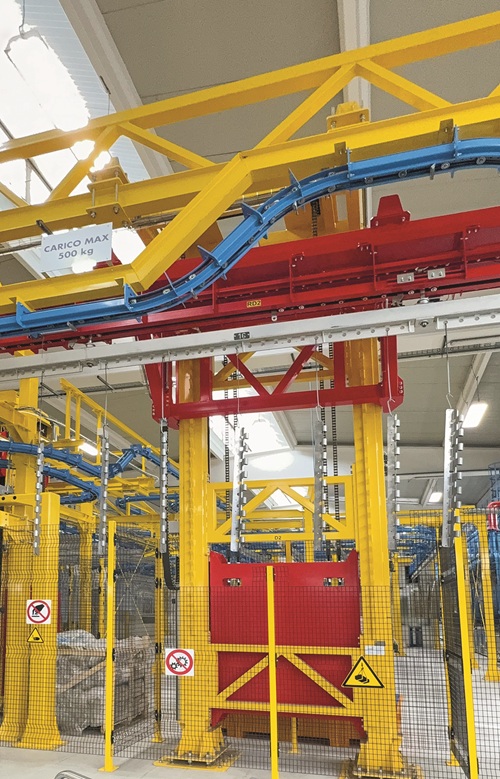 Both the loading and unloading stations are equipped with automatic elevators that lower the load bars, easing the operators’ work and reducing ergonomic risks. © ipcm
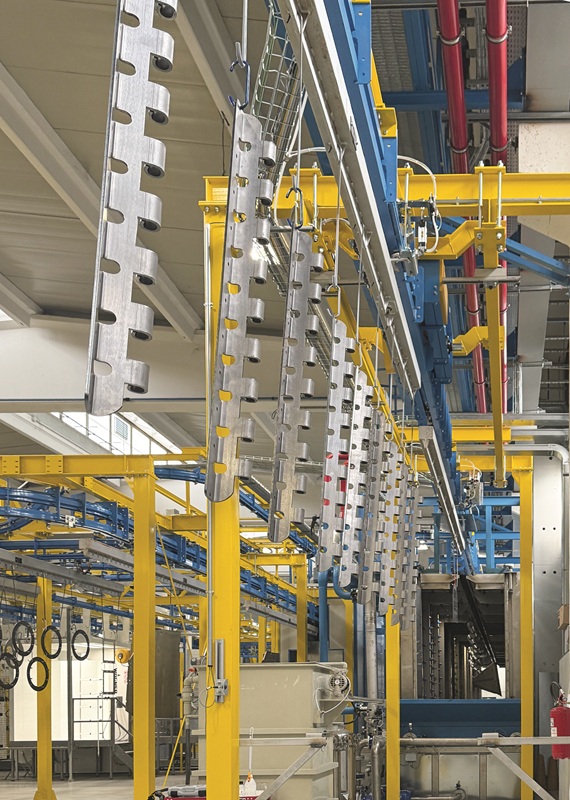 Components at the entrance to the pre-treatment tunnel. © ipcm
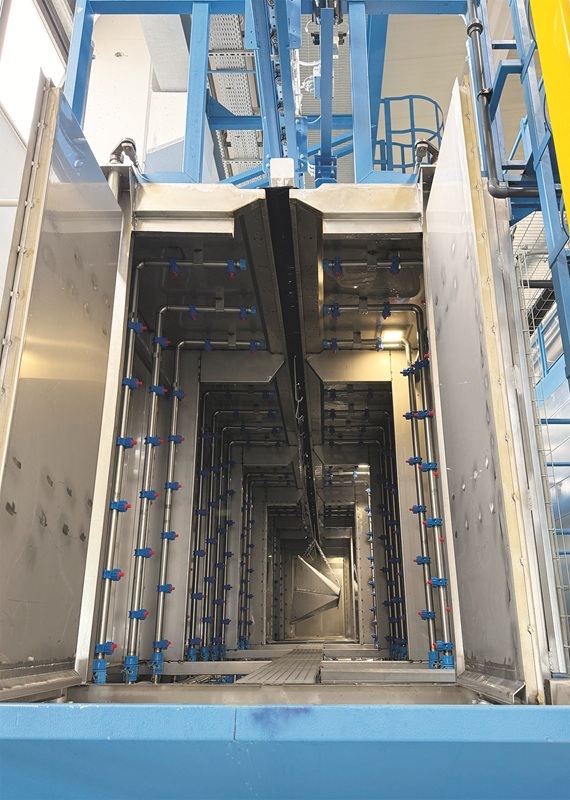 The tunnel’s nozzles. © ipcm
“Before entering the pre-treatment tunnel, dedicated sensors measure and verify the incoming parts’ dimensions to prevent any damage to the equipment or the workpieces themselves,” adds Paolo Massari, sales manager at Visa Impianti.
After pretreatment, the components pass through the drying oven powered by a direct-flame burner and are then conveyed first to the powder coating booth supplied by Wagner and subsequently into the curing oven, where they dwell for about 1 hour at a temperature of 180-190 °C. This is followed by a cooling phase and automatic unloading via elevators. “To improve productivity and meet our operational requirements, we asked Futura to design a conveyor that splits at the oven’s exit: if the treatment cycle is complete, the component moves to the cooling area before unloading; if a second coat is needed, it is sent directly back to the booth for this additional stage,” explains Inversani.
“Together with Futura, we have also placed strategic storage buffers to better manage the end of the cycle. The purpose was to prevent oxidation, which can occur when parts remain inside the pre-treatment tunnel at the end of a working day. With the new plant configuration, the operators can empty the line at the end of each shift, transferring the load bars to the storage buffers so the components do not remain in the plant and are not exposed to the risk of oxidation,” adds Visa Impianti’s sales manager.
“All recipes and process parameters, such as pre-treatment times, curing temperatures, and spray gun settings, are integrated into our MES system. This enables us to automatically manage the entire production cycle, tailoring each stage to the specific characteristics of every component and paint product while achieving high quality standards, full traceability, and maximum operational efficiency,” states Inversani.
Powder application and management technologies
“10 automatic spray guns are installed inside the booth, 5 on each side. Due to the wide variety of dimensions and shapes of the parts being treated, the plant has been designed to adapt dynamically to the specific characteristics of each component. At the entrance to the booth, a contour detection system using photocells identifies the size and position of the incoming part and activates only the necessary guns, positioning them accordingly. This enhances application uniformity and minimises paint waste,” explains Cristian Boem, area manager at Wagner. “One of WAM’s main objectives at the start of the project was specifically to decrease powder consumption, which is why the spray guns operate in this manner. Furthermore, the application technology used is state-of-the-art in terms of electrostatic efficiency: around 80% of the powder dispensed by the guns is actually deposited on the workpiece, while the remainder, known as overspray, is recovered and fed back into the production cycle.”
At the core of the application system is the SuperCenter Evo powder centre, which ensures high repeatability and consistency in powder quality through the continuous blending of virgin and recovered powders. All powder coating flows are consistently monitored using load cells that precisely measure the quantities used and track consumption by batch or colour, providing reliable data for cost control and process optimisation. “The colour change system is also highly efficient: thanks to Wagner’s patented solutions for cleaning the booth and its internal surfaces, the entire process is completed in around 10 minutes. Since WAM carries out an average of 8 colour changes per day, this speed is crucial for maintaining high productivity levels and reducing line downtime,” concludes Boem.
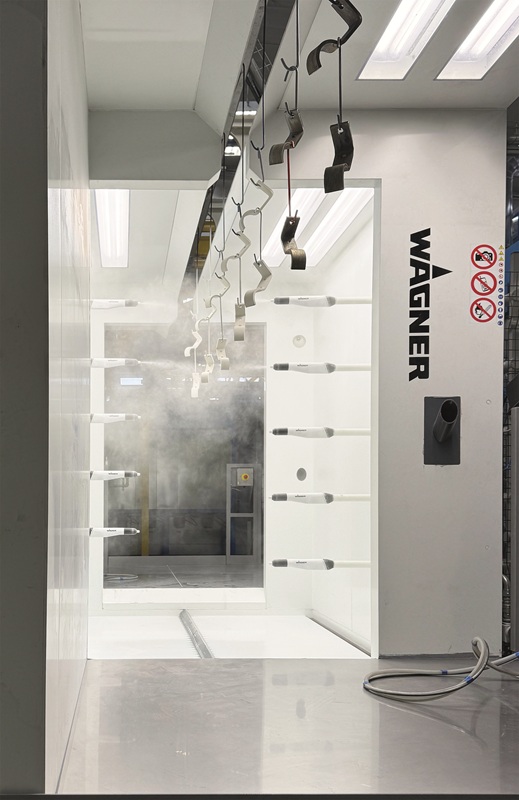 The application booth features 10 automatic spray guns, 5 on each side, which are activated only when needed, depending on the size and shape of the part to be coated. © ipcm
A plant designed in accordance with the principles of Industry 5.0
One of the most significant aspects of the project concerns the plant’s compliance with the Industry 5.0 paradigm. “The line is fully connected to our company’s digital systems and enables real-time monitoring of production data, process parameters, and energy consumption. Compared to earlier solutions based on the Industry 4.0 framework, the implementation of a plant meeting the Industry 5.0 requirements entailed a particular focus on its integration with the company’s IT systems. However, such a high level of complexity has paid off, as we now have access to advanced tools for controlling and optimising our production processes and reducing our energy consumption,” says Caterina Cau, buyer at WAM Industriale.
“Another interesting feature of this system is its readiness for future energy developments, since it has been designed to be converted from gas to electricity without requiring any significant structural changes, enabling further improvements in energy efficiency over time,” notes Massari.
“The construction of our new plant was made possible through the collaboration of several technology partners. We entrusted Visa Impianti with the design and installation tasks, recognising its high standards of quality and its experience in building highly automated industrial coating systems, and we worked closely with the technical teams of Wagner, our long-standing partner in coating application technologies, Futura, which developed a conveyor tailored to our production needs, and Ecoteam for the demineralised water production system. The result is a highly customised line that is perfectly calibrated to our specific requirements,” concludes Manzali.