Bosch’s Aveiro plant was the focus of an investment plan aimed at expanding production capacity for heat pumps destined for the European market and supporting the energy transition in the construction sector towards high-efficiency models. A new powder-coating line designed by Fimel was installed as part of the project and integrated with a hybrid curing oven fitted with Infragas’ BOOSTERCAT® catalytic IR panels.
In recent years, the European construction sector has undergone a profound transformation. Buildings are no longer conceived solely as living or functional spaces but as complex energy systems, designed to reduce consumption, interact with the surrounding environment, and progressively reduce their carbon footprint. The paradigm of Nearly Zero Energy Buildings (NZEB) is increasingly prevalent and is now a cornerstone of European energy transition policies.
An NZEB is not simply a ‘more efficient’ building; it is the result of an engineering balance between its envelope, services, and energy generation solutions. Indeed, reducing energy consumption begins with the quality of the building envelope: advanced thermal insulation, thermal bridge control, high-performance windows and doors, and excellent airtightness significantly reduce energy loss. This is complemented by the building services systems, where every technology must operate at maximum efficiency. For example, controlled mechanical ventilation systems with heat recovery units ensure air exchange without compromising the building’s energy performance by recovering much of the heat from the exhaust air. Heat pumps, on the other hand, transfer thermal energy from low-temperature sources to the building’s interior via an electrically powered thermodynamic cycle, enabling Seasonal Coefficient of Performance (SCOP) values that are significantly higher than those of traditional systems. The widespread adoption of these technologies is closely linked to the decarbonisation of the European construction sector, a key driver for achieving climate targets. This scenario is now a reality in many Northern European countries and is rapidly taking hold in Germany, France, Spain, and Italy, where the transition to low-emission buildings continues at a steady pace.
The widespread adoption of heat pumps and their role in the energy transition also became evident during the ipcm® team’s visit to Bosch Home Comfort’s site in Aveiro (Portugal). The plant was recently the focus of an investment plan to increase production capacity and strengthen an industrial ecosystem designed to meet growing demand for energy-efficient technologies. The goal was to consolidate Bosch’s role in the European heat pump supply chain and support the market’s shift towards increasingly sustainable and electrified solutions. As part of this development plan, a new powder coating plant was also installed, designed and built by Fimel (Águeda, Portugal), featuring a hybrid curing oven fitted with BOOSTERCAT® catalytic infrared panels from Infragas (Mappano, Turin, Italy).
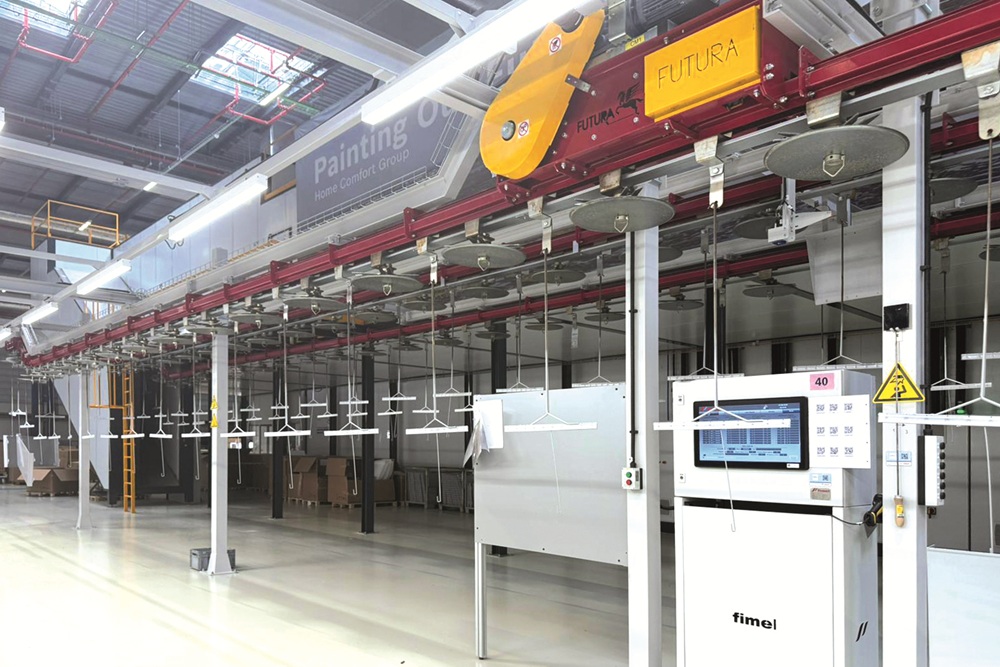 Overview of the new coating line installed by Fimel. © ipcm
The expansion of the Aveiro plant
The history of Bosch in Portugal is, in fact, the story of an industrial transformation that mirrors the evolution of the European energy sector. It began in 1977 in Aveiro with the founding of Vulcano Termodomésticos, a company specialising in the manufacture of gas water heaters, which quickly became a leading player in the local market. The decisive turning point came in 1988, when Bosch acquired the business and integrated the plant into its international production network. “From that moment onwards, our site adapted to the varying needs of the German and Northern European markets: production shifted from water heaters to wall-mounted boilers, solar thermal systems, and on to heat pumps and advanced solutions for home comfort.
Today, this plant is one of the strategic locations of the Bosch Home Comfort division and a key industrial hub for technologies relating to air conditioning and domestic hot water production,” says José Oliveira, a process engineer at Bosch. The Aveiro site is also a technology laboratory: it has been the birthplace of pioneering solutions, such as the first connected water heater, controllable via an app – a sign of a transformation that has steered air conditioning and hot water production towards an increasingly digital and integrated model. Its R&D team works on projects ranging from heating systems to IoT solutions and remote diagnostic tools. It is therefore no surprise that the Aveiro site is now one of Bosch’s leading European centres for the development and production of heat pumps, technologies set to play an increasingly central role in the evolution of energy-efficient buildings.
The new coating line
The production cycle for heat pumps begins with the receipt of raw materials, mainly steel sheets, some of which are stamped, machined, and coated in-house. At the entrance to the line, the loading area is where components are manually placed onto a monorail conveyor designed by Futura (Robecco Pavese, Pavia, Italy). The load bars, developed jointly by Fimel and Bosch, are tailored to the geometry of the components to be treated. Each load bar is fitted with a code-based identification device that is scanned immediately after loading, enabling the plant’s management system to recognise the parts and automatically set the correct treatment cycles. The components then enter the pre-treatment tunnel, which performs 8 stages. “The tunnel is equipped with a waste water treatment system, featuring redundant pumps to ensure operational continuity in the event of a fault, as well as ultrafiltration and automatic dosing units,” explains Virgilio Direito, a sales engineer at Fimel. “After pre-treatment, the parts pass through a hybrid drying oven powered by both gas and electricity, then transfer to the coating booth, which is installed in a cleanroom under controlled conditions. Before entering the booth, the conveyor can rotate by 90° depending on the component’s geometry, allowing the spray guns to evenly cover all surfaces to be treated.”
“The Wagner automatic booth is fitted with SuperCenter EVO powder management unit and designed to ensure rapid colour changes, high reliability, and zero contamination", Direito illustrates. The spray guns are fed by a Polifluid® system from Eurosider (Grosseto, Italy) which uses dry nitrogen as the carrier gas rather than standard compressed air. This technology enables more stable powder transfer, high deposition efficiency, reduced waste, and greater application uniformity, thereby improving process stability and coating quality.
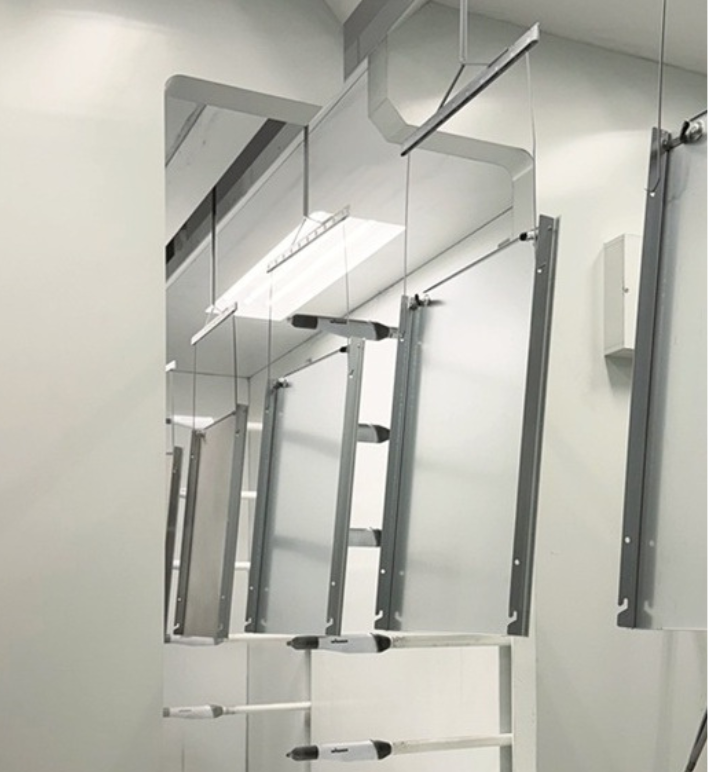 The coating booth. © ipcm
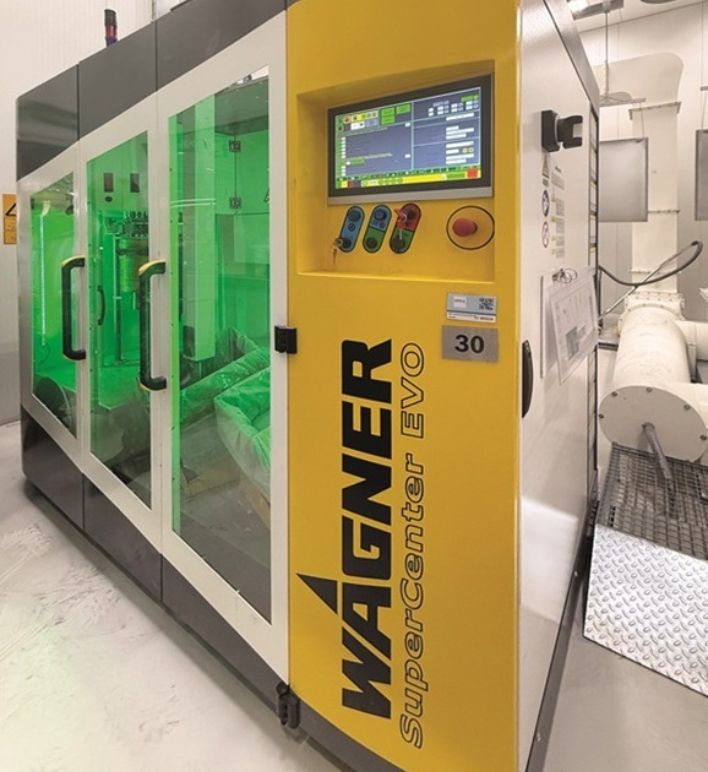 Wagner’s SuperCenter Evo powder management unit. © ipcm
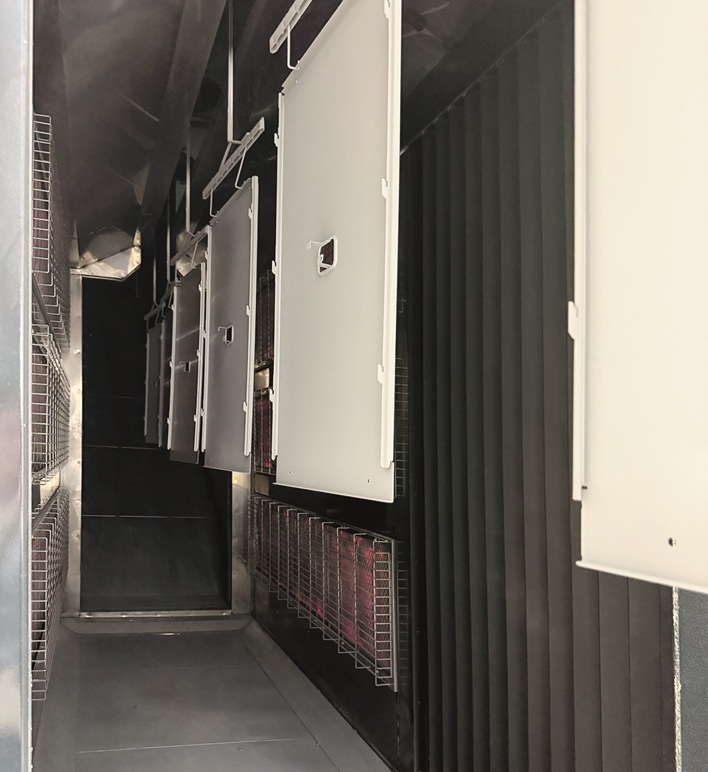 The curing oven fitted with Infragas BOOSTERCAT® panels. © ipcm
The curing phase
After paint application, the conveyor transfers the components to a bell-type hybrid curing oven fitted with Infragas BOOSTERCAT® panels. These are advanced, ventilated, gas-fired catalytic infrared panels with a BOOST effect (IR energy + air), ideal for promoting powder gelling on components requiring high-quality finishes. They combine catalytic heating with a forced ventilation system comprising built-in air ducts or air supply flanges positioned at the rear of the burner. This solution ensures uniform, controlled heating of workpieces and improves energy efficiency and process stability.
As well as significantly reducing thermal processing times compared with a single hot-air oven, the BOOSTERCAT® catalytic infrared panels enable rapid powder curing, with three key benefits: preventing dust formation, saving energy, and protecting the environment.
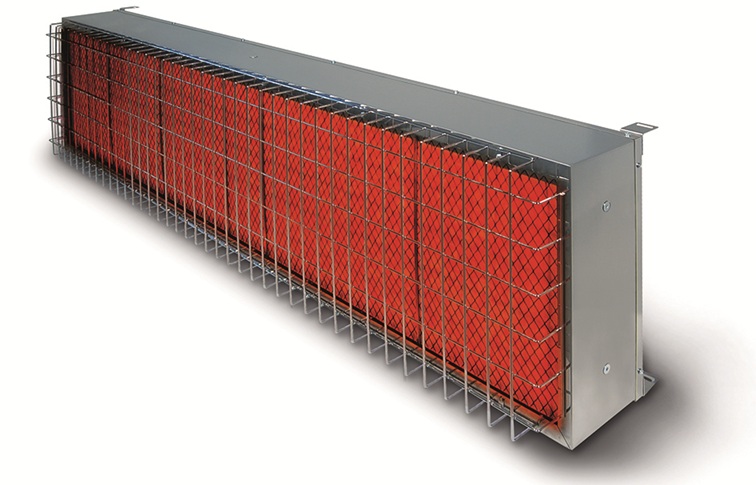 The BOOSTERCAT® panels from Infragas. © Infragas
Environmental friendliness is in fact inherent in Infragas’ catalytic technology, which converts gas into infrared energy without producing a flame. This chemical-physical reaction ensures that no unburned fuel or carbon monoxide is released. The innovative BOOSTERCAT® infrared panels thus enable equipment manufacturers to reduce oven length, shorten processing times, increase productivity, and improve the quality of their finishes.
Digitalisation and predictive maintenance in line with Industry 4.0
The coating line at Bosch’s Aveiro plant operates in line with Industry 4.0 principles, integrating automated systems, advanced sensor technology, and digital data management to enable continuous monitoring and traceability throughout the cycle. “The key parameters, i.e. temperatures, cycle times, chemical and physical conditions, and operational variables, are monitored in real time via a network of sensors distributed along the line and transmitted to the company’s MES system, where they are recorded, analysed, and archived,” says the process engineer.
The production system is based on a recipe-driven approach: each component is identified on incoming by a QR code and linked to a specific coating programme. This automatically sets all process parameters, including pre-treatment cycles, application settings, and the type of coating product, eliminating manual intervention and ensuring full process repeatability. Control also extends to colour management via an automatic cross-check system that verifies the match between the part code and the powder loaded into the SuperCenter Evo device: if an inconsistency is detected, it prevents the cycle from starting.
The data is also transmitted in real time to Bosch’s maintenance department. “Our approach is based on condition-based and predictive strategies, achieved through the continuous analysis of data from the line.
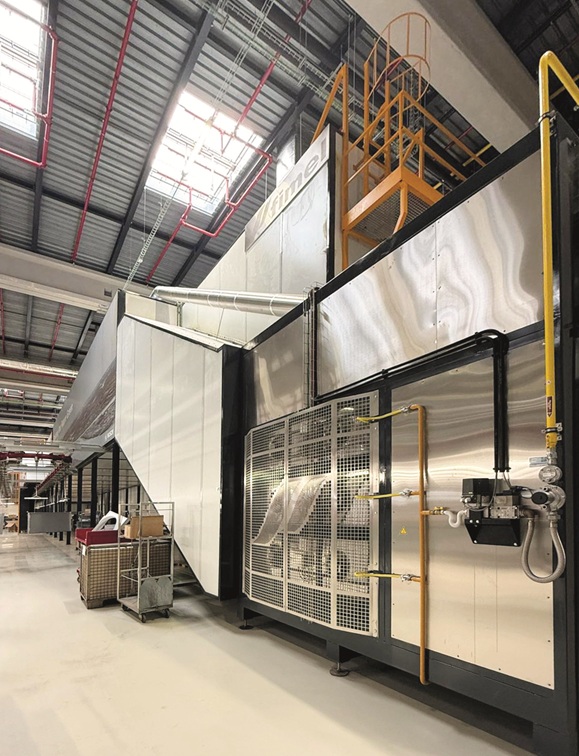 Overview of the bell-type oven. © ipcm
 Any deviations from the set parameters, such as changes in temperature, pH values, or other critical indicators, trigger automatic alerts that enable us to take prompt, targeted action,” explains Rui Rodrigues, maintenance manager at Bosch. “Maintenance activities are carried out by a small number of specialist suppliers, including Fimel for the coating line and other technical partners for the various plants installed within the factory, with the aim of standardising maintenance procedures and increasing their effectiveness. All our systems are equipped with sensors and connected to a centralised platform, enabling continuous monitoring of motors, devices, and even energy variables, in collaboration with the infrastructure department for the analysis of gas and electricity consumption. This complex organisation has facilitated the transition from reactive to predictive maintenance, significantly reducing plant downtime. In coating processes, the ability to anticipate faults is a critical factor for production continuity. An additional level of automation is also being implemented, which involves the automatic generation of maintenance orders based on sensor alarms and their assignment to the relevant suppliers, thereby progressively reducing the need for manual intervention.”
Conclusions
The development of the Bosch plant in Aveiro aligns with the European industry’s shift towards increasingly digitalised, automated, and efficiency-focused production models. “We chose our technology partners, particularly Fimel and Infragas, for the proven reliability and quality of their products. Fimel is a long-standing partner, having also built our previous coating line 23 years ago", says Oliveira. “Our collaboration with Infragas is also built on a long-standing relationship, which has evolved from
the installation of traditional infrared panels on our original plant to the integration of the latest BOOSTERCAT® technology into the new curing oven.”