RS Barcelona, a leading name in the world of table games such as table football, table tennis, billiards, and shuffleboards, has radically transformed these products, elevating them from recreational items to genuine design pieces. Today, its creations are designed to blend seamlessly into high-end settings such as hotels, luxury residences, offices, and hospitality spaces. To meet design requirements that are increasingly focused on design and architecture, it has been collaborating for over fifteen years with AkzoNobel, which supplies a wide range of high-performance powder coatings for architectural applications.
Play is one of the oldest and most natural human activities. Even before it became a form of entertainment, it was a tool for learning, building relationships, and discovery. Through play, we develop creativity, intuition, strategic thinking, and a collaborative spirit; we break down barriers, set aside our usual roles, and genuinely connect with others. It is no coincidence that philosophers, educationalists, and neuroscientists recognise play as an essential component of our emotional and social well-being. As we reach adulthood, however, play tends to disappear from our daily lives, as if it were something to be consigned to childhood or leisure time. Yet its power remains undiminished. A game of table football, a spot of table tennis, or a break spent playing pool can change the rhythm of the day, stimulate the mind, encourage interaction, and spark new ideas. Whether at home, in the office, or in hospitality settings, play thus becomes a catalyst for positive energy and relationships.
In recent years, this realisation has profoundly transformed the role of playing tables, which have evolved from simple recreational items once kept in garages or out-of-the-way spaces into pieces of furniture designed to take centre stage in contemporary interiors. Today, football, tennis, and pool tables are centrepieces of sophisticated interiors, perfectly integrated into the language of design and architecture.
This shift has elevated playing tables to design objects and, in many cases, to genuine luxury items. Fine materials, meticulous craftsmanship, and attention to every detail define their aesthetic and functional value. Surface finishes play a crucial role in this context, as coating quality not only guarantees protection and durability but also lends character, depth, and uniqueness to products. It is precisely on this vision that RS Barcelona (Barcelona, Spain) has built its identity, transforming play into an aesthetic and social experience capable of bringing beauty, conviviality, and well-being to the most unexpected spaces. The collaboration with AkzoNobel, which has lasted for over fifteen years, has played a key role in this journey: its powder coatings enhance any surface, highlighting the purity of shapes, the texture of metals, and the elegance of design.
From metalworking to the art of play
The history of RS Barcelona began in 1975, when Rafael Rodríguez Castillo set up a small sheet-metal workshop in Viladecans, on the outskirts of Barcelona. Thanks to the quality of its manufacturing and a deep understanding of metalworking, the company grew over time into a well-established industrial enterprise. However, with the entry of his sons Rafael and Sergio, a new ambition emerged: to move beyond contract manufacturing and create products that would fully express the family’s design expertise and creative spirit. “Working for others provided stability,” says Maria Carrasco, marketing manager at RS Barcelona. “However, we felt a desire to create something of our own. We had the know-how, the experience, and the production capacity. All that was missing was the courage to turn them into a project that truly represented us.”
The opportunity arose almost naturally. For years, the company had been manufacturing metal components for gaming tables, and drawing on this experience, the Rodríguez Sevillanos decided to rethink the traditional table football game with a completely new approach. “It was not an immediate success. Unveiled at a trade fair in the entertainment sector, our first prototype proved too sophisticated and expensive. But what for many would have been a failure became a strategic turning point for RS Barcelona. We realised that our product did not belong in the world of traditional gaming. To find its place, it had to speak the language of design,” explains Carrasco. This is how the RS2 came into being – the football table that would change the history of RS Barcelona forever. Elegant, minimalist, and meticulously crafted in every detail, it is designed to fit into homes and complement other furnishings. “We aimed to take playing tables out of home garages or traditional bars and turn them into centrepieces of living spaces,” continues Carrasco.
In the years that followed, the company gradually broadened its creative range to include tennis tables, pool tables, shuffleboard tables, portable barbecues, and furniture accessories. Every product is created with the same mission: to integrate play into domestic, workplace, and hospitality environments, creating spaces that are more dynamic, inclusive, and people-oriented. At the same time, RS Barcelona has consolidated its overseas presence, particularly in the United States, where start-ups and major companies in Silicon Valley have adopted its products as tools for well-being and socialising in the office.
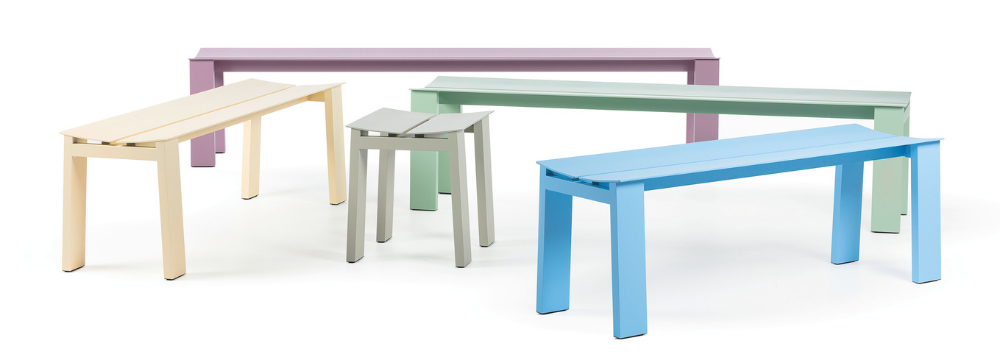 In addition to playing tables, RS Barcelona has developed a furniture collection, including benches inspired by traditional sports seating, designed to enhance the experience of play and socialising. © RS Barcelona
Today, RS Barcelona defines itself as a brand specialising in the ‘art of play’, blending design, craftsmanship, innovation, and well-being to create objects that enhance the quality of everyday life.
The production cycle
Production at RS Barcelona begins with the arrival of raw materials, mainly steel and aluminium, which undergo a thorough quality control process. Depending on the component’s intended use and the required manufacturing processes, the material is directed to different stages, some of which are carried out by external partners: processes such as laser cutting, cataphoresis, and shot blasting of stainless steel are outsourced to selected suppliers capable of guaranteeing high technical and quality standards. Afterwards, all components are returned to the factory in Olesa de Montserrat, where the core of production takes place. All the key machining processes, including punching, bending, and welding, are indeed carried out in-house. These stages enable the complex shapes that characterise RS Barcelona’s products to be achieved. Once these operations are complete, the parts are transferred to the coating shop.
“The decision to insource the finishing process was strategic, driven by the need to maintain maximum control over both quality and productivity,” the company’s marketing manager states. “Outsourcing the coating process to external contractors did not provide us with the flexibility needed to handle small batches, frequent colour changes, and a high level of customisation. Additionally, for products aimed at the premium and luxury segments, finishing quality and colour accuracy must be absolutely consistent.”
Textured and glossy finishes
After the manufacturing stages and previous surface treatments, the components are sent to the coating department. Here, they are manually hoisted onto an overhead crane and transferred to the cleaning booth, where any surface residues are thoroughly removed with chemicals supplied by Proquimia. The parts are then transferred to the drying oven and, using the overhead crane, moved back to the coating booth.
The parts are then transferred to the drying oven and, using the overhead crane, moved back to the coating booth. “Applying the paint products manually, using equipment supplied by Wagner Spraytech, is critical for us. Our products feature complex shapes, recesses, and structural details that require a very high level of precision. Only manual application can guarantee uniform coverage, flawless surfaces, and a colour quality that an automated process would often fail to achieve.” This is followed by a curing stage in the oven, manual unloading, assembly, quality control, packaging, and shipping.
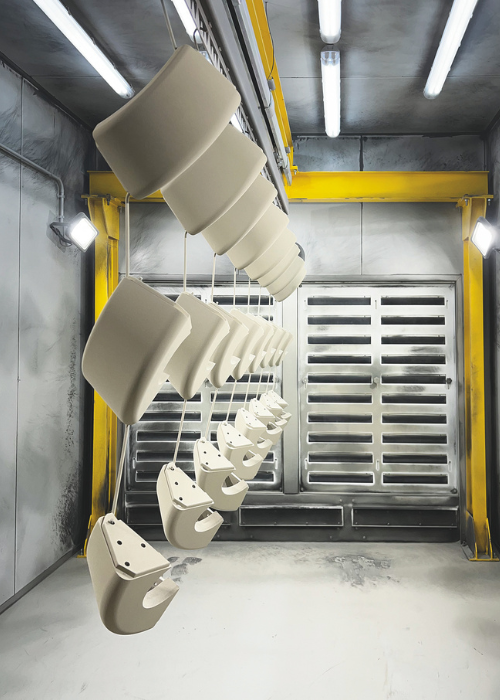
After application, an overhead crane transfers the parts to the curing oven. © RS Barcelona
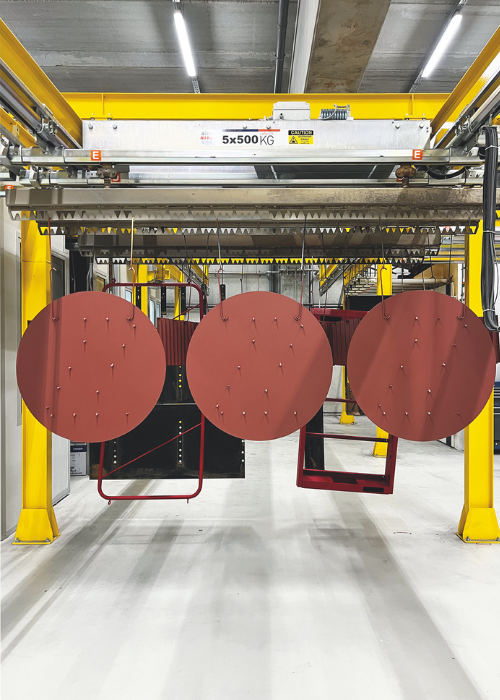
Coated components dwelling in the unloading area. © RS Barcelona
“RS Barcelona primarily uses polyester powder-coated systems for architectural applications, designed to ensure high performance even when used outdoors. Most of the company’s collections are, in fact, designed for use both indoors and outdoors and therefore require finishes capable of withstanding environmental stresses, wear and tear, and climatic variations over time. That is why the systems applied meet at least the Qualicoat Class 1 quality standard or higher,” says Nadia Garcia Criado from AkzoNobel.
RS Barcelona’s collaboration with AkzoNobel is indeed a strategic partnership focused on developing high-performance finishes that combine technical durability with aesthetic appeal. Over time, the company’s use of finishes has evolved significantly, moving gradually from high-gloss surfaces to a wider use of matt and textured finishes.
“These are now the most popular choice, particularly for products intended for outdoor use, as they offer greater resistance to wear and tear and atmospheric agents, ensure a more uniform colour appearance, reduce glare, and emphasise clean lines. At the same time, gloss finishes continue to be used selectively to create accents of light and add further sophistication to products. At the latest edition of Salone del Mobile, we presented a new collection of stools with a glossy finish that was very well received,” notes Carrasco.
Colour as a language of design
RS Barcelona’s colour palette comprises around twenty-one shades, ranging from neutral, understated colours such as white, black, and ivory to more distinctive shades such as terracotta, Nordic Green, and Steel Blue. Alongside these, there are also ‘wow-effect’ colours with strong visual impact, such as fluorescent yellow, orange, and rich reds like Traffic Red, designed to inject energy and character into spaces. “Colour trends arise primarily from dialogue with the worlds of interior design and architecture, but we also interpret them through a geographical and cultural lens: some colours work best in specific markets, whereas others are better suited to hospitality or corporate settings.”
In every project, colour becomes a distinctive element, making each playing table a true design statement. In recent years, its importance has grown with the introduction of the monochrome concept, a design solution that uses a single shade throughout an entire product. To make this possible, RS Barcelona has gradually replaced components previously made from HPL with coated aluminium parts, achieving total colour consistency and an even more minimalist, refined aesthetic. “With monochrome design, colour has become the absolute focal point of the product,” explains Maria Carrasco. “Having our own booth has enabled us to coat each component directly and no longer be dependent on the starting material’s natural colour. This has given us much greater design freedom and made even more extensive customisation possible.”
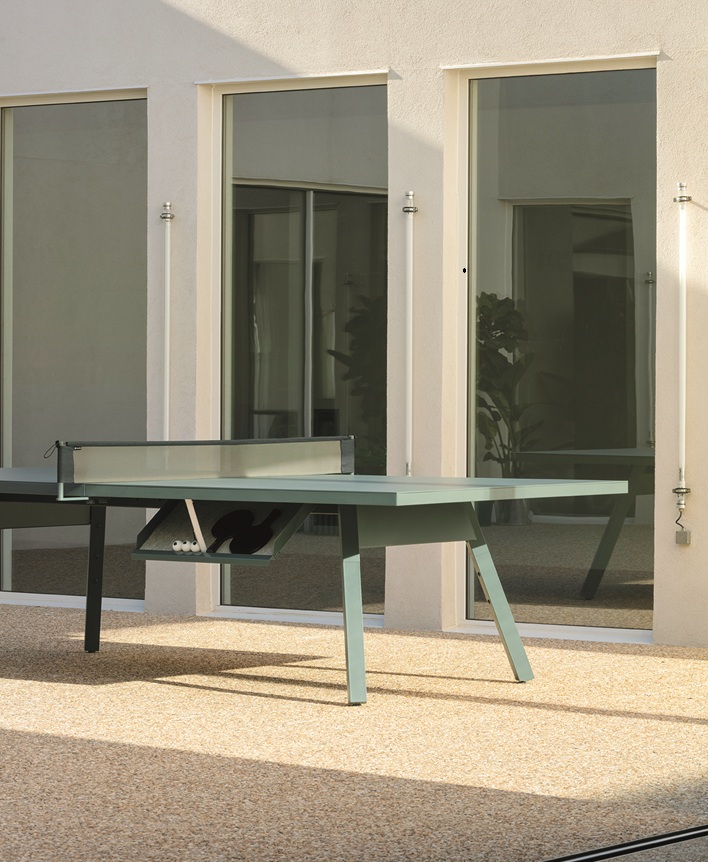
Outdoor components coated with systems designed to ensure long-term resistance and durability. © RS Barcelona
Sustainability and performance: the role of EPDs and VOC-free paints
This journey of technological and stylistic evolution was also made possible by the collaboration with AkzoNobel, which over the years has supported RS Barcelona not only as a supplier of powder coatings but also as a true technical partner. “When we decided to insource the coating process, we found ourselves facing a whole new world,” says Carrasco. “AkzoNobel’s technical team guided us every step of the way, advising us on the most suitable coating technology for our production and helping us define a workflow. Today, we can rely on high-performance finishes and a colour range that allows us to fully express our design vision.”
This collaboration also extends to sustainability, which is now increasingly central to contract and hospitality projects, as well as to high-end developments. Architects, interior designers, and general contractors are increasingly requesting detailed technical and environmental documentation for the materials and components used, to meet the requirements set out in the main sustainable building protocols and the ESG policies of end clients. “Our playing tables and furniture do not have a single environmental certification: we collect and provide declarations and certificates for all the materials and processes involved, including the finishes. In this respect, AkzoNobel’s support is particularly important.”
“Some of the powder coatings supplied by AkzoNobel also come with Environmental Product Declarations (EPDs) verified by independent bodies, which transparently report the environmental impact of the paint product throughout its life cycle, from the sourcing of raw materials to end-of-life. Based on a Life Cycle Assessment (LCA) compliant with international standards, EPDs are a vital tool for meeting the documentation requirements of the most demanding projects,” confirms Nanet Tamayo Durango, specification sales representative at AkzoNobel. “A further environmental benefit stems from the very nature of the powder coatings used. Systems such as those in the Interpon D range, developed for architectural and outdoor applications, are solvent-free and contain no volatile organic compounds. The absence of VOCs helps reduce the environmental impact of the coating process and improve working conditions, making these solutions a particularly sustainable choice without compromising on performance, durability, and aesthetics.”