Clerprem, a global leader in the design and manufacturing of ergonomic seating systems and interior components for the transport industry, has chosen TIGER Coatings’ powders to optimise the performance of its finishes for a market that demands ever-higher levels of graffiti resistance, corrosion protection, and application reliability across various metal substrates.
Traditionally, in the railway sector, innovation has been synonymous with improvements in interior design, aesthetics, and comfort, aiming to provide passengers with an increasingly welcoming environment and to make their journey a more pleasant experience. This is a trend the premium automotive sector has followed for many years, investing in the development of interiors that combine ergonomics, aesthetic appeal, and on-board well-being, to the point that the driving and travel experience has become one of the key factors in choosing a vehicle. The rail sector is now following suit, combining aesthetic and comfort requirements with new priorities for sustainability, accessibility, and the integration of advanced technologies into train interiors. Maintaining the aesthetic quality, cleanliness, and functionality of carriages over time is therefore essential for transport operators, who are expected to ensure high standards of service efficiency and interior appeal. Defaced walls, damaged surfaces, and graffiti are widespread problems not only in urban public spaces but also in railway stations and on public transport. According to estimates from German state railway company Deutsche Bahn, damage caused by graffiti, scribbles, and tags on floors, walls, and train interiors amounts to around €12 million and is on the rise.
The company has also highlighted that this negatively affects passengers’ perceptions and calls for prompt removal by specialist staff. While the ‘social’ tools available to combat vandalism remain limited, technology, particularly coating technology, now offers effective solutions, at least for preventing damage and speeding up cleaning. Specially developed coating systems simplify the removal of graffiti, reduce intervention times, restore the carriages’ original aesthetic appearance more quickly, and protect the quality of the treated surfaces. This requirement is inevitably reflected throughout the entire production chain, including manufacturers of parts for train interiors. One of these is Clerprem SpA (Carrè, Vicenza, Italy), which has been active for over fifty-five years in the design and manufacture of components for the transport sector.
“We develop seating systems for the automotive, railway, public transport, and commercial vehicle industries, always with the aim of delivering a superior travel experience for passengers,” explains marketing manager Elena Marchesi. “To achieve this, we must ensure that every component, from seating systems, headrests, and armrests to consoles and polyurethane padding, is manufactured using advanced processes without compromising Clerprem’s signature all-Italian craftsmanship.” This level of quality is ensured not only by machining operations carried out on innovative equipment but also by the coatings applied to aluminium, magnesium, and steel components. “For the railway sector, in particular, we use TIGER Coatings’ approved anti-graffiti powders, which facilitate the cleaning of defaced surfaces without the need for repainting and, at the same time, provide excellent corrosion protection.”
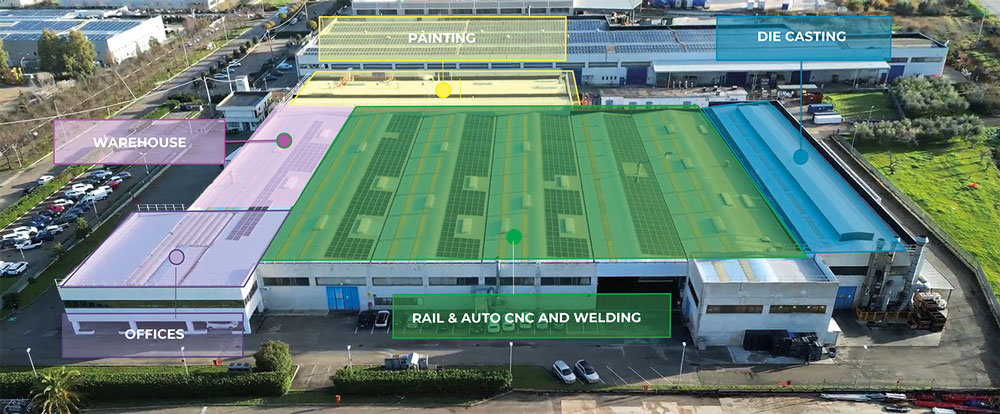 The Clerprem plant in Atessa (Chieti) with its various production departments. Ⓒ Clerprem
Clerprem: Italian-made products for the automotive and railway sectors
The history of Clerprem began in the late 1950s, when an innovative and unknown material was discovered: polyurethane. “At that time,” says Elena Marchesi, “the potential of this innovative material for padding cushions, armchairs, and sofas had yet to be fully explored, but it immediately became the starting point for developing this company, founded by Roberto Marchesi in Milan as the first business in Italy dedicated to the importing, processing, and distribution of polyurethane blocks.” In 1971, Clerprem relocated to Carrè in the Veneto region, building its first and main production plant there, which is now the Group’s headquarters. It then became one of the first companies to specialise in the cold foaming of polyurethane moulded components for automotive seats. Seven years later, Clerprem opened a second plant in Cumiana, near Turin, at the heart of Italy’s largest automotive hub. This specialised in the production of armrests, headrests, seatbacks, and seats, with the aim of ensuring just-intime supplies to leading national OEMs, including Alfa Romeo, and Fiat.
During the 1980s, Clerprem further expanded its expertise and diversified its production by launching new business units, including office chairs and armchairs for the furniture sector, as well as faux leather for the footwear and accessories sectors for the fashion industry – divisions that are no longer active. The expansion of its manufacturing capabilities continued with the opening of another plant in Atessa (Chieti) in 1989, dedicated to highly specialised processes such as CNC milling, tube and profile bending, robotic MIG, TIG, and laser welding for structural seat components, die-casting of aluminium components, and powder coating.
“A key milestone in our company’s history,” adds Elena Marchesi, “was the acquisition of a factory specialised in manufacturing seats for railway coaches in the former East Germany, near Dresden, in 1991, shortly after German reunification. This marked the birth of Clerprem Deutschland, which then transferred part of its assembly operations to Neustadt in Sachsen to supply seats on a just-in-time basis to the national railway industry. In 1997, Clerprem produced its first complete railway seat, thereby consolidating its second major core business alongside automotive components.”
The just-in-time model as a winning strategy
Whereas the first generation led by Roberto Marchesi focused on the construction and development of new plants across Italy, the second generation led by Gian Roberto Marchesi embarked on a path of international expansion, opening new production sites in Tunisia (2008), Mexico (2015), and the United States (2018). Following its entry into the American railway sector, Clerprem also began processing steel to meet the specific requirements of this market, which is traditionally less oriented towards the use of light alloys than the European market. “Growth has been driven by an industrial strategy centred on a just-intime approach and close customer relations,” states Elena Marchesi. “This has helped strengthen Clerprem’s role as a preferred partner to major international players, thanks to long-standing relationships, a high level of operational reliability, and the quality of our Italian-made products, tailored to our customers’ needs and perfectly blending comfort, safety, and design.”
Today, the Group employs around 2,000 people worldwide and serves a high-end clientele, particularly in the premium automotive sector, where a high level of specialisation and the use of high-performance materials characterise Clerprem’s production. Major automotive OEM customers include the Volkswagen Group (Audi, Porsche, Škoda, Bentley, and Lamborghini) Ferrari, Maserati, Cupra, Renault, Mercedes, and BMW. In the railway sector, the customer base is exclusively international and includes transport operators such as Deutsche Bahn, Siemens, Alstom, and Via Rail. In the automotive sector, Clerprem operates as both a Tier 1 and Tier 2 supplier and exports around 95% of its production; in the railway sector, it operates primarily as a Tier 1 supplier, directly providing complete seating systems and managing the full production cycle through to delivery to rolling stock manufacturers and transport operators.
Finishing: the hallmark of the Clerprem Group
“The powder coating process is carried out in a dedicated facility within the Clerprem Group, in the Atessa metalworking plant, as it is a demanding process”, points out Andrea D’Intino, the facility’s administrative manager, who leads the operational team alongside production manager Giacinto Giallonardo and maintenance manager and coating coordinator Rosato Mazzolena. “At this site, we carry out die-casting of aluminium components for railway carriage seats, as well as deburring, tumbling, shot blasting, and CNC milling. We also perform tube and copper-coated wire bending, laser cutting, automated MAG, TIG, MIG, and laser welding, as well as the final powder coating of steel, aluminium, and magnesium-alloy components. We stand out from our competitors through Italian aesthetic sensibility and artisan manufacturing: our processes are highly specialised, yet we never lose sight of attention to details and the human touch that defines true craftsmanship.”
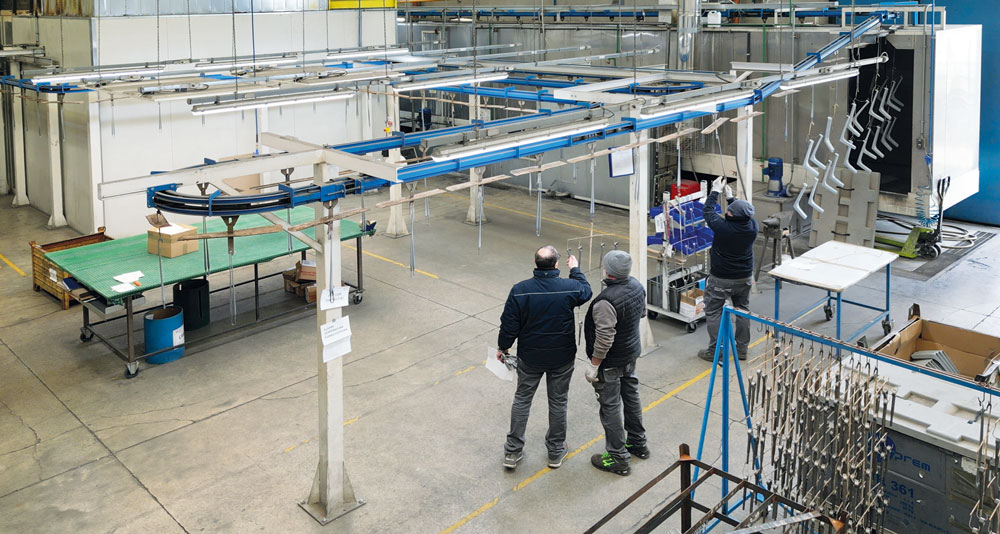 Overview of the powder coating line. Ⓒ Clerprem
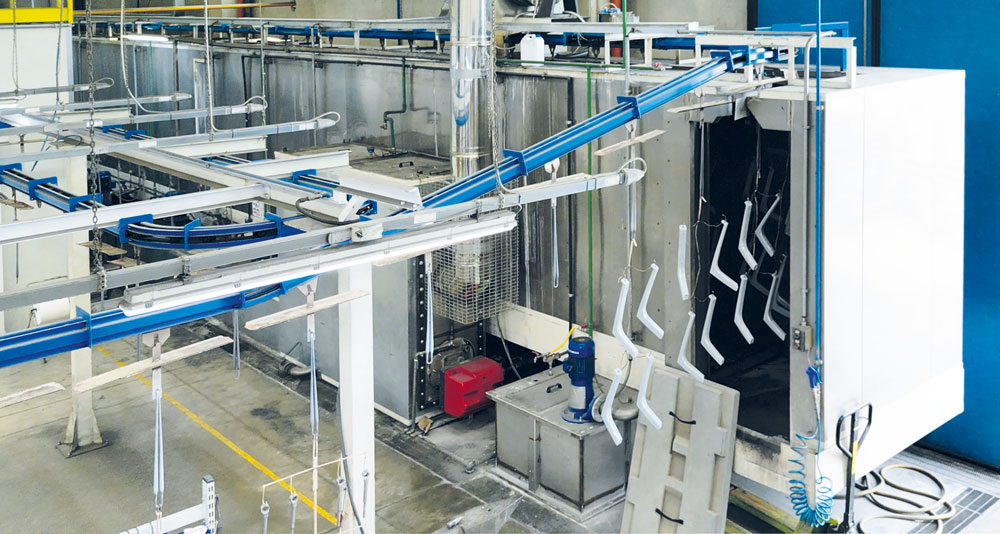 The recently revamped eight-stage pre-treatment system. Ⓒ Clerprem
Focus on detail is one of the cornerstones of the company’s manufacturing philosophy. “The components we produce are all visible,” emphasises D’Intino. “The care we devote to every aspect is greatly appreciated by our premium customers, who are extremely obsessed with the perceived quality of the final product. Every component must appeal to both our direct customers and the passengers who will use the train coaches, and finishes are key to creating an immediate positive impact.”
According to Clerprem, the rail sector is adopting quality standards that are increasingly aligned with those of the automotive industry, particularly in relation to surface aesthetics. “In addition to ever more strict requirements regarding finishing quality,” continues Mazzolena, “over the last ten years, the use of anti-graffiti paints has become increasingly widespread on both train interiors and exteriors to speed up cleaning and maintenance operations. These are delicate paint products, however, with a more glassy and brittle texture, which require careful and complex application processes.” Another change affecting this industry is the structural evolution of seating systems, which are now increasingly integrated with displays, USB ports, and other technological devices. “Alongside this development, it is necessary to keep the overall weight of the seats under control: this means making them lighter while still ensuring they pass the crash tests required by regulations. That is why we have begun exploring the use of magnesium, an extremely lightweight alloy that is also very tricky to handle because it is flammable. The change in alloy has inevitably required a review of our coating process: on die-cast components, some defects can only emerge after the paint has been applied, resulting in reworking costs.”
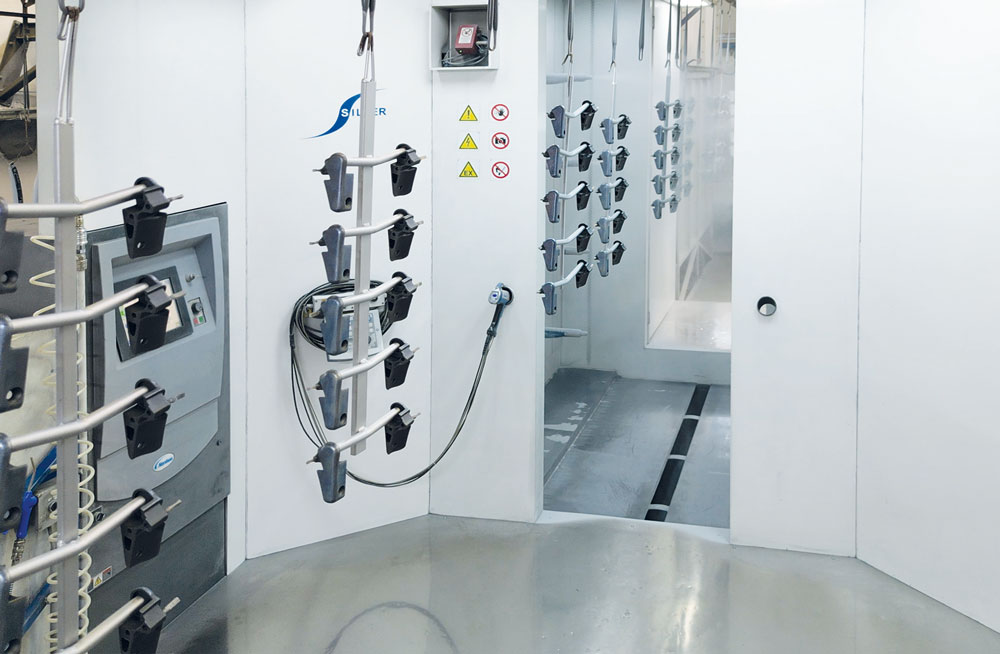 The inside of the booth during the application phase. Ⓒ Clerprem
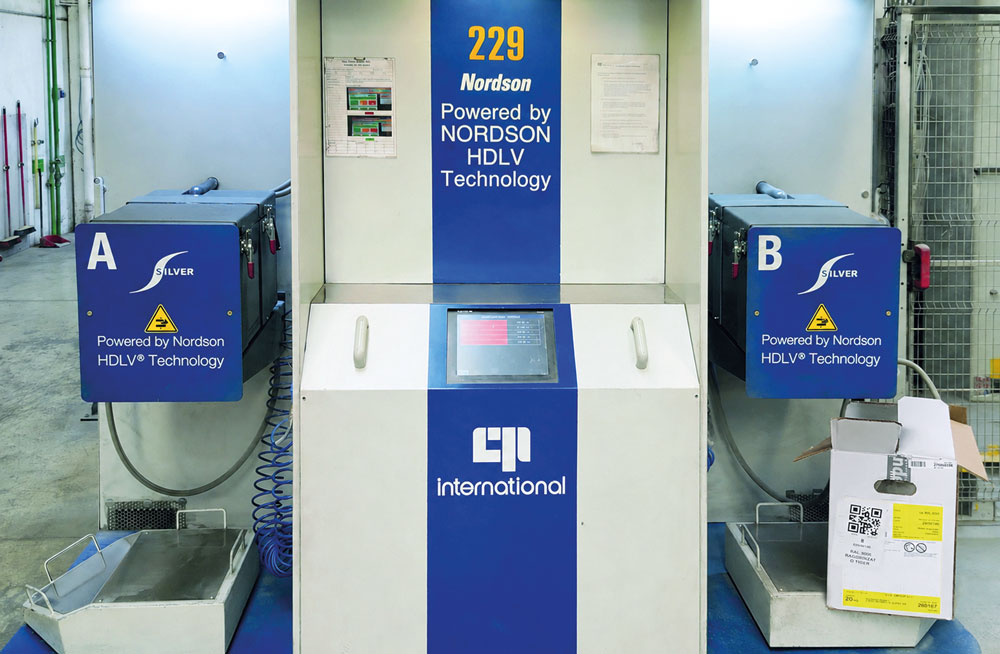 The booth’s powder centre. Ⓒ Clerprem
TIGER Coatings’ anti-graffiti and anti-corrosion powders
Clerprem’s coating process takes place on a recently revamped line that includes a monorail conveyor, an eight-stage pre-treatment system, a drying oven, a powder coating booth equipped with Nordson dense-phase application equipment, and a curing oven, entirely managed by a single PLC. “We apply two coats to all die-casted parts, which account for around 90% of our production,” explains Rosato Mazzolena. “Powders must therefore offer high flexibility and consistent performance regardless of the substrate.
“In recent years, with the increase of orders from German and American railway operators, we have chosen to apply TIGER Coatings’ approved antigraffiti and anti-corrosion powders. For us, it is essential to rely not only on suppliers capable of offering products approved by our customers, but also on actual partners that support us in developing solutions truly suited to our production needs. Our global distribution network requires the management of over 1,000 products, which means that, within a month, we can apply up to 40 different colours, with special effects ranging from micaceous and metallic to textured, smooth, and satin finishes. Within our Group, we are constantly working to raise the bar in terms of quality and ensure high standards for customers worldwide, making the management of the coating process a task that must be meticulous, flexible, and efficient.”
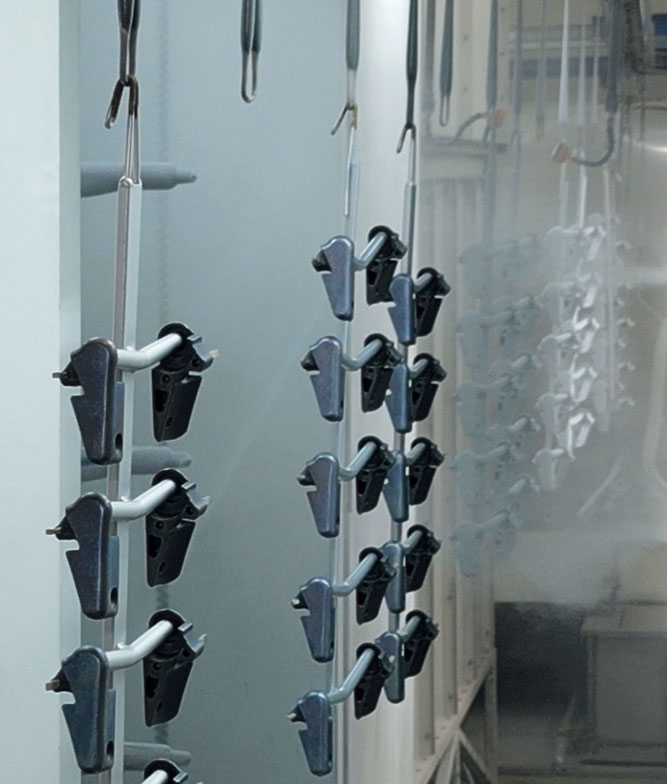 A detail of the powder application phase. Ⓒ Clerprem
“We supply Clerprem with a range of anti-graffiti and anti-corrosion powders specifically developed for the railway sector,” says Alberto Zancan, the sole director of TIGER Coatings Italia. “The epoxy-polyester products used as primers offer high anti-corrosion performance and functional characteristics that promote degassing, which is critical when coating magnesium alloys to ensure high performance and resistance to over-baking. As a top coat, we supply a polyurethane resin-based product from our 287 series, approved in accordance with the Deutsche Bahn DBS 918 340 standard for aluminium and steel components for both internal and external use; it ensures high resistance to weathering and corrosion, provides good application properties, and complies with standard EN 45545-2 regarding fire protection in the railway sector.”
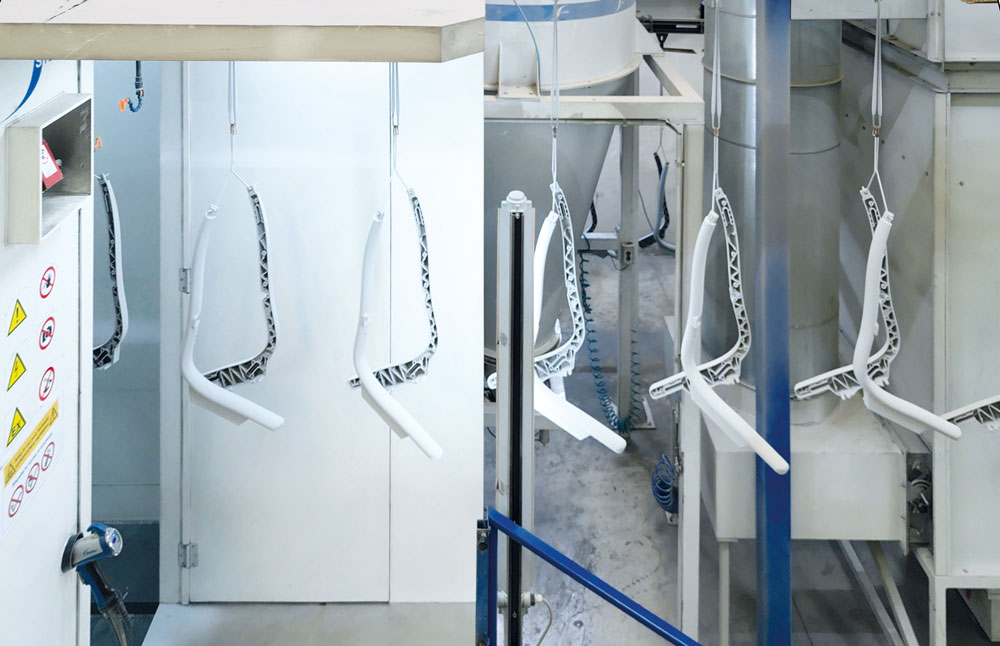 Components leaving the coating booth. Ⓒ Clerprem
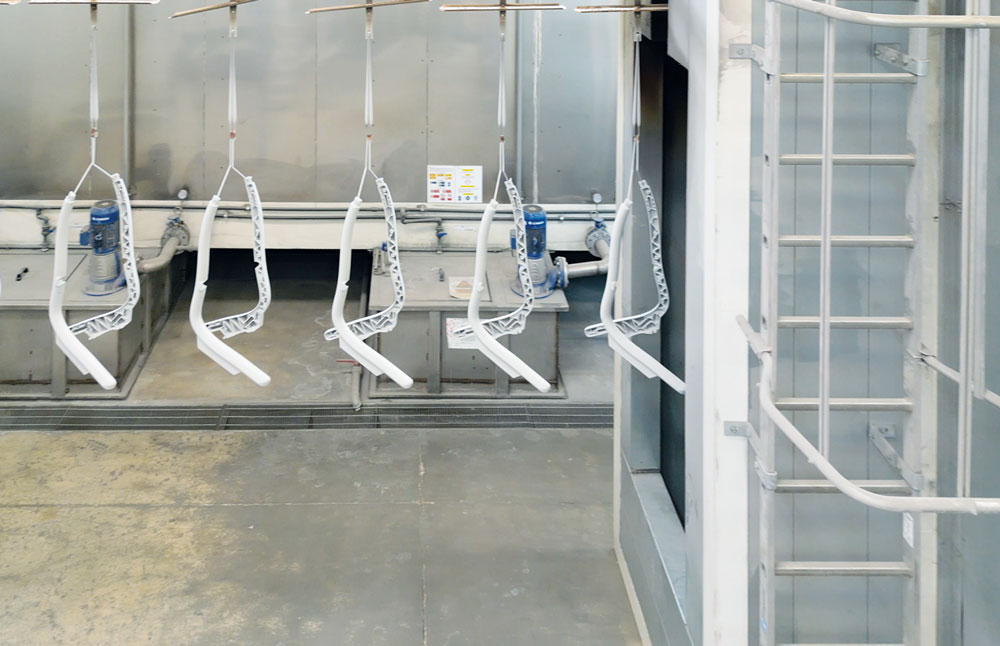 Components entering the curing oven. Ⓒ Clerprem
A long-standing partnership
“Alongside powder quality, the most positive aspect of our partnership with TIGER Coatings is the sense of trust we have built over time through ongoing mutual exchange,” emphasises Mazzolena. “For example, its technical team helped us resolve a serious issue with the processing of magnesium components, enabling us to bring the coating quality of these parts up to the same standard as other substrates.” Indeed, magnesium is a particularly delicate material to handle during surface preparation. “Unlike aluminium, it cannot be shot-blasted to remove defects resulting from die-casting. Together with TIGER Coatings, we have found a coating solution that avoids the need of subsequent reworking, and we have also established a research team to identify alternative chemical or thermal solutions capable of replacing mechanical pre-treatment.”
Another key aspect of this partnership is the paint manufacturer’s responsiveness. “We initially began by applying TIGER Coatings powders because they were included in one of our customers’ specifications,” says Mazzolena. “Subsequently, as around 90% of the coatings we use are now developed specifically for our requirements, we have also come to appreciate their speed in handling our requests, from formulation to delivery. This is a very important factor for our production line."
“One of TIGER Coatings’ strengths,” Zancan states, “is that it is a global company that still maintains a family-run structure, just like Clerprem. This enables us to retain considerable operational flexibility and to truly put ourselves at the service of our customers. We can compete internationally without compromising our fast response times, which make all the difference today: we can produce customised powders even in minimum batches of 60 kg, with average production times from two to three weeks from the first order receipt. Moreover, thanks to the widespread presence of TIGER Coatings sites internationally, we can support customers operating in different markets, adapting to local regulations and to the constantly evolving application requirements of the railway and other sectors. The ability to guarantee consistently high aesthetic and performance standards worldwide is now a fundamental strategic requirement for manufacturers operating in the premium segment of the railway industry.”
“Shaping the mobility of the future,” concludes Elena Marchesi, “also means creating products whose surfaces can withstand wear and tear over time without compromising aesthetics, while preserving the comfort and character of the spaces people travel through every day.”