Specialized in the production of components, tools, and spare parts — both metal and rubber — intended for machines, machinery, and equipment in the agricultural sector, O.F.A.S. S.p.A. recently decided to completely renovate its powder-coating plant to increase energy efficiency, reduce consumption, and ensure high product performance. This choice also addressed the growing market demand for high-quality, customisable finishes that enhance the aesthetics and durability of agricultural components and machinery. Verona Impianti 2002 was the partner selected for the project.
In recent years, we have reported several times in ipcm®_International Paint&Coating Magazine on the profound transformation underway in the agricultural machinery sector. Tractors, ploughs, and seeders, to name but a few, are no longer mere work tools that need to be robust and reliable to operate in all weather conditions; increasingly, the market demands impeccable finishes, high aesthetic quality, and customisation options, much like in the automotive world. It is more a cultural change than a technological one, shifting the focus from functionality alone to the perception of value, identity, and attention to detail.
This new approach no longer concerns only bodies or chassis but also extends to components that are not necessarily visible, such as discs for harrows or seed drills, designed to penetrate the soil, work the ground, and withstand wear and tear. Nowadays, even these parts are expected to look their best: buyers of agricultural machinery no longer focus solely on performance but also on overall aesthetics, colour consistency, and attention to detail in every single component. Standards have changed.
O.F.A.S. S.p.A., a leading manufacturer of discs for seed drills and harrows, had recognised this well in advance: it had decided to invest in a coating plant to enhance its products several years ago. In 2025, growing market awareness, combined with the need to reduce energy consumption, which had become too high, prompted the company to take a further step forward. A few months ago, it invested in a new powder coating plant, capable not only of further improving the appearance of its discs but also of enabling rapid colour changes, energy efficiency, and maximum flexibility in the customisation of finishes. To carry out this project, the company turned to Verona Impianti 2002, which designed the entire coating line while integrating the conveyor supplied by SE.PO. and a booth from Wagner equipped with a quick colour-change system, which is key to responding promptly to customisation requests.
The background: how a family project evolved into a well-established industrial business
OFAS’ roots date back to the post- World War II period, when, as explained by Martina Favero, a member of the third generation of the Favero family, “six founding partners from two branches of the Favero family decided to combine their crafts skills and entrepreneurial spirit in a region scarred by the conflict and rich in materials to be recovered.” The mountains surrounding Mussolente were still littered with iron, metal components, and other remnants of the two wars — precious resources that the founders collected and used to build or restore the tools needed in the plains to help people get back to working the land.
“Our grandparents thus started with two small workshops that repaired garden tools, hand tools, and earth-moving equipment,” Martina adds. “It was a simple but practical way to contribute to the recovery.” The two companies, initially independent, decided to officially merge on 15 November 1954, a date that marked the beginning of the partnership between the two workshops and that recently saw the company celebrate its seventy-one years of activity.
The first headquarters was located in the centre of the village, still used as a warehouse today. In the 1960s, as production volumes steadily increased, OFAS moved to its current headquarters, again in Mussolente, which has been expanded several times over the decades to meet the evolving market’ needs.
During this period, it also made the decisive transition from artisan to industrial production: from manufacturing small hand tools, it moves on to more complex items, including components for ploughs and discs for seed drills and harrows
— the latter destined to become the core of its production and the primary field of specialisation of the Favero family.
In 1964, OFAS became a public limited company. In the following decades, the company further expanded its product range, and, in 2013, it began integrating steel production with vulcanised rubber manufacturing, becoming in 2016 the only company in the industry to offer two product families — steel and rubber — within the same production plant. Over time, HUBs and bearing lines were also added, although always with a strong focus on the agricultural sector, enabling OFAS to position itself as a one-stop supplier of a wide range of components. In addition to the items already mentioned, its product range spans from subsoiler blades to sweeps, from finger weeders to knives for feed mixers. Growth also continued at an international level. Since 2012, the company has been present in Spain with a strategic commercial-logistical office serving the local market, characterised by rugged terrain and therefore high disc consumption. Since 2017, it has also had a production branch in Poland, a key market as it is historically considered the ‘breadbasket of Europe’.
Advanced materials for enhanced performance
For OFAS, the ability to anticipate market needs translates into a constant commitment to technological innovation, in-depth research, and careful choice of materials and equipment. “As we mainly work with steel, we have been recently collaborating with selected mills and long-standing suppliers to develop special steels with characteristics exceeding the standards currently available on the market,” illustrates Nicola Favero, also a member of the third generation of the family. The aim is to extend the products’ service life and, at the same time, support the evolution of agricultural machinery, which is now designed to operate at ever-higher speeds and deliver ever-greater performance, leading to significant wear and tear and calling for materials that combine strength, reliability, and continuous performance. “It might seem counterproductive for our company to improve products subject to wear, such as discs, to make them more durable,” continues Favero. “However, the increase in the quality of raw material goes hand in hand with the improvement in the performance of the machines themselves: speed increases, operational potential grows, and as a result, so does the level of wear. Our solutions address this balance, reducing premature wear and tear and allowing the equipment to maintain high performance over time.”
The discs production cycle
The discs production cycle begins with the raw material, namely boron steel supplied in coils and sheets. The manufacturing process starts on a series of dedicated levelling lines and four cutting lines, which enable the production of components to the required dimensions. After cutting, the parts are cold-machined and subjected to drilling, turning and toothing operations. “We then perform hot forging with controlled-water quenching. This step allows us to achieve the right balance between surface hardness and core toughness, thus ensuring strength, durability, and consistent performance during field use,” explains Nicola Favero. After quenching, the discs are transferred to the surface preparation department, where they undergo shot blasting treatment with quartz sand. This operation smoothes their surfaces and removes impurities, creating optimal conditions for paint adhesion. After mechanical pre-treatment, the components enter the coating plant.
The requirements that led to the insourcing of the coating phase
The need to insource the finishing process had already become clear years ago, when OFAS installed its first coating plant to meet the increasingly complex technical, aesthetic, and production demands emerging with the company’s international expansion and the evolution of the agricultural sector. “Originally, our components were not coated because, for the type of products we manufacture, the presence of a paint layer often constitutes a disadvantage from a functional point of view, as an uncoated surface allows the machine to move more smoothly over the ground. There were no problems with corrosion either: during everyday use, discs are constantly rubbed by the soil or grass, which keeps their surfaces naturally shiny and prevents oxidation,” explains Nicola Favero.
However, with OFAS’ commercial expansion across various countries and the consequent need to manage stocks of machines ready for sale in outdoor warehouses, critical issues emerged regarding the aesthetic deterioration of components during periods of non-use. “No end customer is willing to accept an agricultural machine with visually compromised and oxidised components,” emphasises Favero, highlighting how this new awareness, dictated by commercial needs and growing expectations from OEMs, made it inevitable to start subjecting the discs and other components produced by OFAS to coating.
“Even today, within our production cycle, coating mainly serves an aesthetic purpose, as farmers no longer want to purchase mere work tools but rather aesthetically perfect products. It is clear that the agricultural and earth-moving machinery sector is gradually converging towards the quality standards typical of the automotive industry, in terms of not only performance and materials but also visual uniformity and overall perception of value,” notes Martina Favero.
For all these reasons, OFAS decided to install its very first coating system in 2013, replacing a spray booth installed in the 1990s. This was a dip coating line that was subsequently converted in 2015 into a powder coating plant. For about a decade, this system enabled managing the gradual increase in volumes and the growing demand for coated components, a trend further accentuated by the increasing need for colour customisation.
“Many customers asked us to paint our parts in their specific brand colour, and we ended up managing about 10 customised RAL hues on a permanent basis.” Over time, the increase in the number of colours available, together with the overall growth in demand, made it necessary to intensify production to three continuous shifts, keeping the equipment running 24 hours a day and resulting in increasingly significant energy consumption.
In 2023, OFAS began a systematic review of its internal processes to identify the highest-cost areas and found that coating had one of the most significant economic impacts. “We therefore assessed whether it would be more appropriate to revamp our existing plant or install a completely new one. After an in-depth analysis phase conducted through market studies and recommendations from long-standing partners, we identified the most suitable supplier and the solution best suited to our production needs. We chose Verona Impianti 2002 because it offered a tailor-made, energy-efficient system that could be seamlessly integrated into our existing production line.”
The conveyor as the core of the coating line
The components are loaded manually onto the conveyor, specially configured by Verona Impianti for handling the parts produced by OFAS. The conveyor first transports the workpieces to the automatic powder coating booth, then to the curing oven, through the cooling zone, and finally to the unloading area, adjacent to the loading one. “The conveyor, designed following in-depth discussions with OFAS, can handle loads of up to 60 kg per metre of chain, ensuring safe handling of even the heaviest components,” explains Stefano Tamellin, the owner of Verona Impianti. Another requirement concerned the time the components spent in the oven: to ensure complete curing with a parts thickness of up to 30 mm, they needed to dwell in it for approximately 50 minutes. To meet this condition, with the conveyor speed set at 1.80 meters per minute, the length of the track inside the oven is 90 meters.
“Immediately after curing, the components undergo a long cooling process, which is essential for dissipating the heat accumulated during this phase and preserving their dimensional and mechanical characteristics,” adds Tamellin. The conveyor configuration was carefully designed for this phase as well to ensure a uniform and safe flow along the entire line.
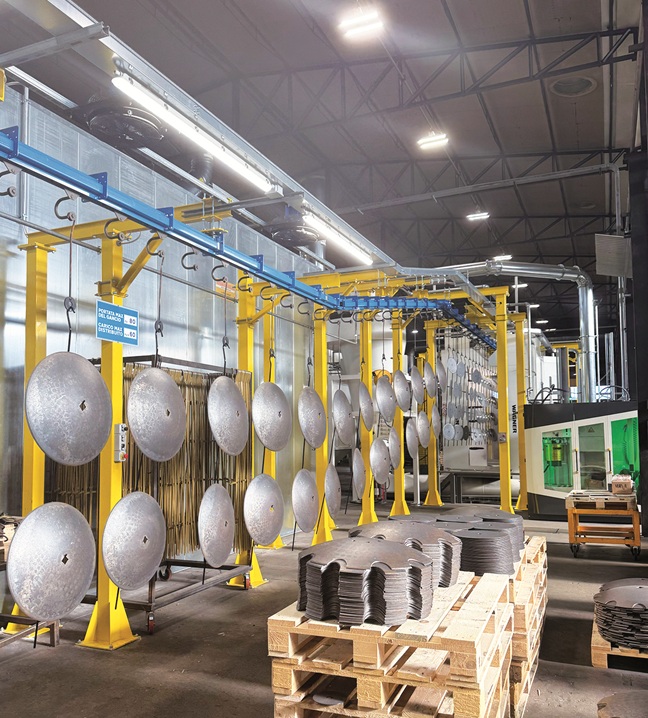 The manual loading area. © ipcm
The new coating booth for rapid colour change operations
OFAS also collaborated with Wagner, in synergy with Verona Impianti, to install a latest-generation coating booth entirely customised for its specific production requirements. “We apply a single coat of paint through automatic spray guns (6 per side). Wagner also supplied a SuperCenter EVO powder centre designed to ensure fast and reliable colour changes, a high automation degree, and no contamination between different colours,” says Nicola Favero. The new booth enables the application of all requested colours, from standard RAL hues such as black 9005 to custom shades, ensuring aesthetic consistency and a superior finish compared with the previous plant, with drastically reduced colour change times.
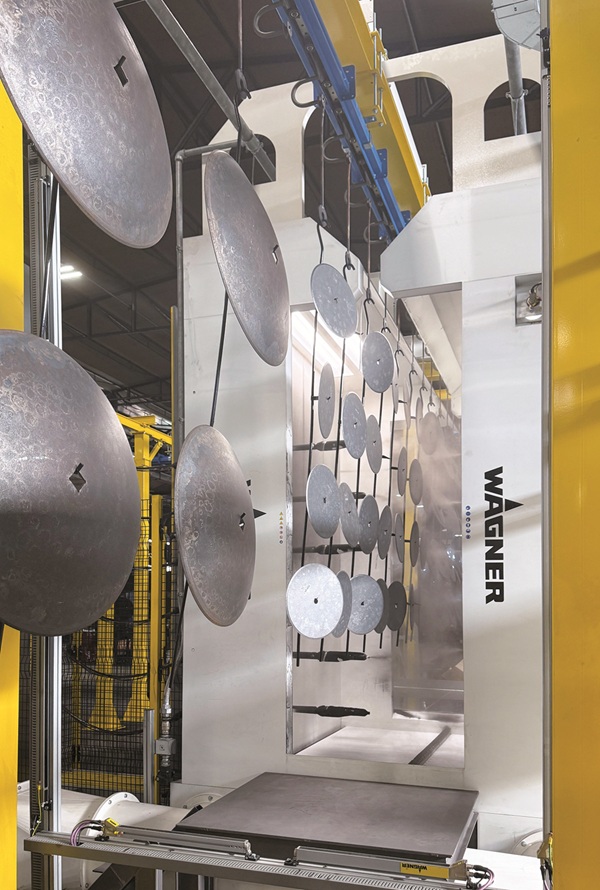 Components entering the Wagner coating booth. © ipcm
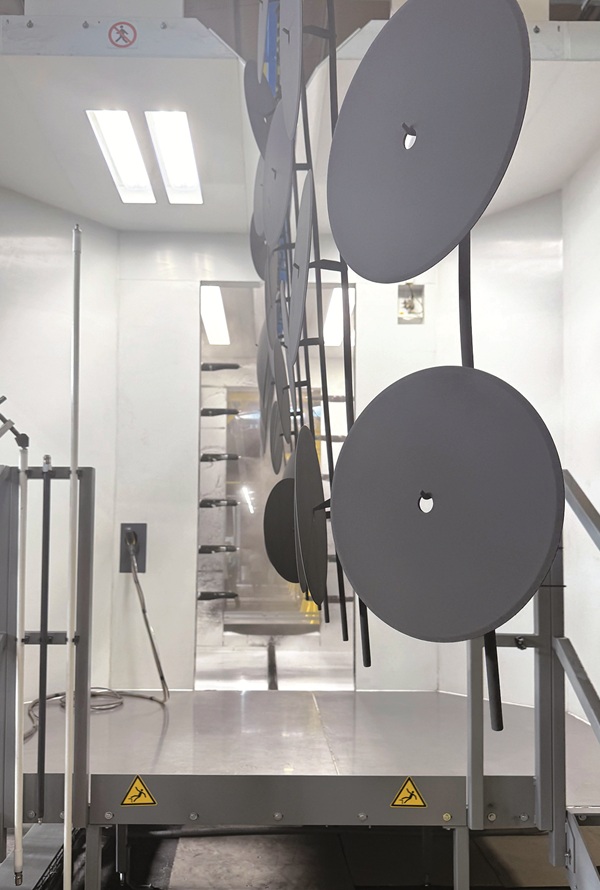 The new booth allows applying all colours requested by customers, from standard RAL hues such as black 9005 to custom shades. © ipcm
The characteristics of the curing oven designed to improve energy efficiency
The oven is a key plant component in achieving both energy efficiency and consistent coating quality. “We encountered significant problems with the previous system: the oven took up to 3 hours to reach the right temperature, insulation was inadequate, and there was significant energy waste,” explains Nicola Favero. The new oven, with 90 meters of conveyor track inside, is equipped with two burners with a total output of approximately 800 kW, which allow it to reach an operating temperature of about 180 °C in just 30 minutes. “We normally use powders that cure at 170-180 °C, but we can also work with products that require 150 °C,” says Nicola.
The oven is designed to ensure optimal air circulation thanks to fans at the top that push the air from top to bottom.
The slits and air curtains at the entrance prevent heat loss and ensure a uniform temperature throughout the oven. In addition, the 150-mm rock wool insulation and a construction design that eliminates thermal bridges between the interior and exterior ensure optimal energy management. “All these measures have enabled us to drastically reduce energy consumption and improve our final coating quality. Previously, we used an oven to polymerise both powder and liquid coatings, with inconsistent results and frequent defects. Now, thanks to the new system, the applied powders cure evenly and consistently, thus fully meeting the specifications of raw material suppliers, with whom OFAS has conducted extensive temperature tests, and ensuring high-quality finishes,” comments Verona Impianti’s owner, Pietro Tamellin.
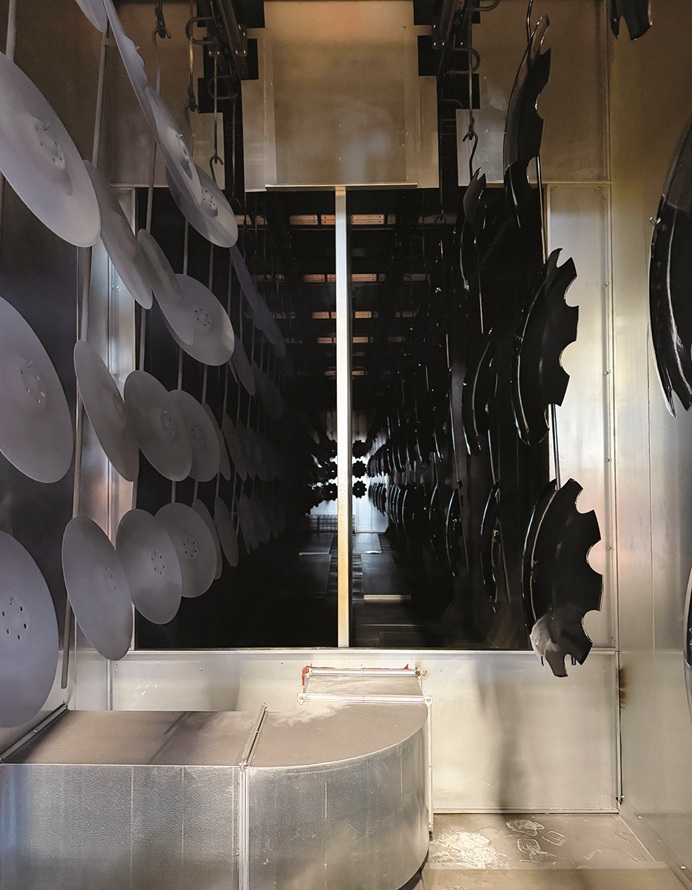 Verona Impianti has installed a partition wall in the oven to prevent colour contamination between incoming and outgoing components. © ipcm
In addition, the new oven has optimised the company’s productivity: what previously required three shifts can now be completed in one, resulting in significant time and energy savings. Finally, the new plant’s compactness has enabled the recovery of approximately 100 square metres of production area, freeing up valuable space within the factory.
Conclusions: the advantages of the new system
“When we first met with the Verona Impianti team, our initial request was to revamp our existing oven to improve insulation and optimise the air flow inside it,” recalls Nicola Favero. “We thoroughly evaluated this possibility, but it became clear that the most appropriate solution was to build a completely new plant, considering that the existing oven had been purchased second-hand and was about 40 years old. With the significant growth recorded over the last 15 years, we realised that, to further support our development, modernising our old plants was not enough: we needed to completely renew our line. So, after a constructive intergenerational dialogue, we decided to invest in the new plant.”
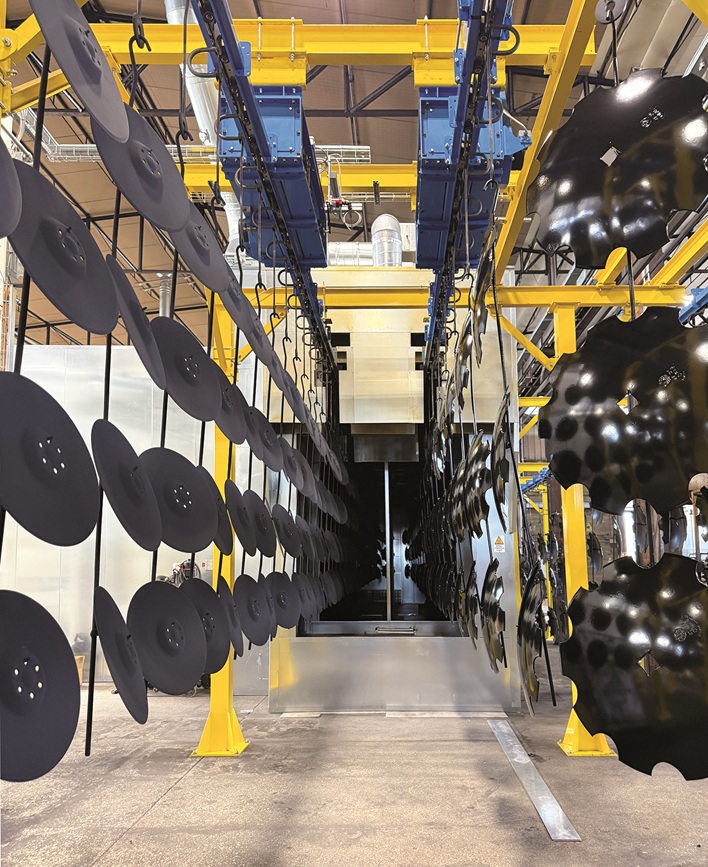 Left: components entering the curing oven. Right: components exiting it. © ipcm
“Although the system has only been operational since the end of August 2025, the results are already evident in the first 2.5 months since its start-up. From an energy perspective, methane and electricity consumption have halved, generating both economic and environmental benefits. The conditions for operators working in the area around the line have also improved thanks to better oven insulation. On the production side, the new system has also made it possible to reduce shifts to just one,” enumerates Martina Favero.
“Another significant challenge was to ensure production continuity during installation. Verona Impianti managed to dismantle our system and install the new one in less than five weeks, also taking care of scrapping the old plant components,” explains Nicola. “Our next steps will be to further optimise the loading and unloading phases to ensure greater ergonomics and safety, especially when handling large parts. We are looking into installing platforms to facilitate the manual hanging of parts onto the conveyor to reduce the physical effort required of operators.”
“Today we can say that we are fully satisfied with our choice to rely on a flexible and proactive company like ours, capable of fully understanding our needs, carefully analysing specific challenges, and proposing concrete, tailor-made solutions,” concludes Nicola Favero.