Adapta presented a new landmark building featuring ceramic finishes from its ENAMEL Collection for architecture and design: the Enterprise Research Campus (ERC) in the Allston neighbourhood. Redeveloped as part of the city of Boston’s inclusive and sustainable development policy, it features a ceramic-toned façade created with a three-layer powder system that meets AAMA 2605 certification requirements.
The Inclusionary Development Policy (IDP) adopted by the city of Boston (Massachusetts, USA), known for hosting Harvard University and the MIT Research Centre, aims to promote the construction of affordable housing within new private real estate projects. In practice, it requires property developers constructing new residential buildings of a given size to reserve a portion of the units within the project for families or individuals with low to moderate incomes (affordable housing), or to contribute financially to a city fund for the creation or maintenance of affordable housing in other areas of the city. The aim is to promote socio-economic diversity in neighbourhoods and combat gentrification, ensuring that even people on lower incomes can continue to live in areas undergoing rapid property development.
The adoption of the IDP by the city of Boston has been key to increasing the offer of affordable housing, but it has also led to a surge in projects redeveloping semi-abandoned, industrial, or unused areas, including green spaces, communal areas, and alternative transport links, as well as focusing on the use of sustainable, low-carbon construction technologies, materials, and finishes. One of them is the Enterprise Research Campus (ERC) project in the Allston-Brighton area, a hub of creativity, research, and culture that advocates for a sustainable future through eco-friendly, climate-resilient buildings constructed with low-carbon building techniques.
Boston’s Allston and Brighton neighbourhoods are culturally rich districts that thrive on their diversity, history, and cultural heritage. They are a melting pot of artists, immigrant families, long-time residents, young families, and students from different cultures and religions. Led jointly by Henning Larsen Architects in collaboration with Studio Gang, alongside landscape architect SCAPE and local planner Utile, this plan envisions a dynamic urban landscape with diverse scales of streets and urban spaces, designed to enrich the pedestrian experience.
A powder coating with glossy, textured ceramic tones reminiscent of enamel, in typical Boston colours, was selected for the façades of the 8-storey residential buildings and the 17-storey tower. Obtained with a coating system supplied by Adapta Color (Peñíscola, Spain), a leading manufacturer of powders for architecture and design and a pioneer in developing smart coatings, this finish consists of two layers of powder from the ENAMEL collection and a clear coat from the ETERNAL collection. The resulting three-layer system, with a total thickness of approximately 300 microns, meets the requirements of the American AAMA 2605 certification, which are similar to those of the European Qualicoat Class 3 certification, and complies with the ASTM E84 fire resistance standard.
Project overview
American real estate company Tishman Speyer is committed to unlocking human potential by building neighbourhoods that benefit the community, and it has done so with the Enterprise Research Campus project, too, in collaboration with Harvard-Allston Land Company. Adjacent to Harvard Business School and Harvard’s Science and Engineering Complex, the ERC is a dynamic mixed-use development in the heart of Boston’s Allston neighbourhood.
The first phase of the project included state-of-the-art laboratory space, rental residences (25% of which are affordable units), a hotel, the David Rubenstein Treehouse conference centre, and large public open spaces. The Enterprise Research Campus thus transforms a historically underutilised section of the Allston neighbourhood into an urban district designed to nurture and inspire creativity and exploration through local restaurants and shops, a vibrant Greenway, apartments, and R&D laboratories. The ERC’s office and laboratory buildings will be eligible for Fitwel certification, which ensures a healthier working environment that improves occupants’ well-being and productivity, with a particular focus on sustainability, resilience, and equity.
Designed to be a pedestrian- and cycle-friendly site, reducing carbon emissions and making a tangible contribution to the fight against climate change, the ERC will introduce significant improvements for all mobility users: new cycle paths, pavements, and areas that will easily connect pedestrians and cyclists, with a reduced number of parking spaces to discourage vehicular travel. The expected benefits of the ERC also include the creation of 2,000 jobs in the construction sector and 2,300 permanent on-site jobs across various fields, including life sciences, building management, commerce, and hospitality.
Phase A of the project has already been completed, with approximately 8,000 m² of green space landscaped around a Greenway that serves as the green backbone of a larger urban plan connecting the historic Allston neighbourhood to the Charles River. It includes two buildings for research and development, a residential building with 343 housing units (86 of which are affordable), a hotel, and a conference centre managed by Harvard University. The Greenway is the heart of the site, serving as a dynamic public space with events and activities open to all. Phase B will follow a separate approval process and include additional office and R&D laboratory space, new housing units, and additional green and open spaces to further expand the Greenway.
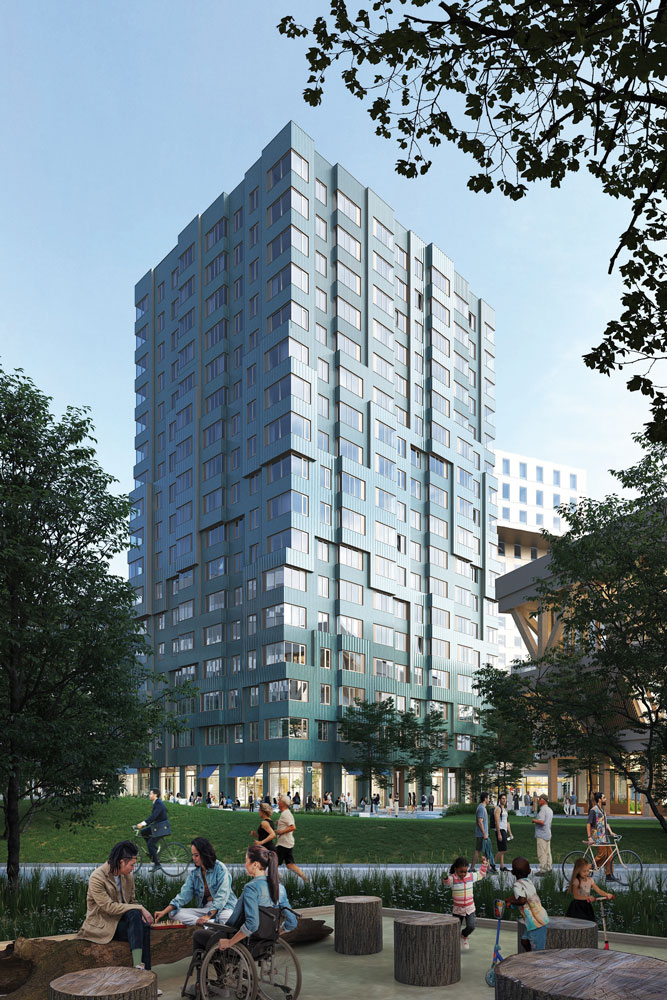 The 17-storey, 58 m-high tower clad with bright green panels that evoke the traditional copper-clad bay windows that are common in Boston. Ⓒ MVRDV
Aesthetics and finishes
Inspired by Boston’s typical architecture, the ERC’s residential buildings offer a contemporary reinterpretation of the city’s distinctive textured façades and materials. The project includes two residential blocks: an 8-storey mid-rise building and a 17-storey tower rising to 58 metres, both designed by MVRDV (Rotterdam, Netherlands). On their ground floor, these structures – as well as a neighbouring hotel designed by Marlon Blackwell Architects – are connected by a one-storey layer of amenities, including a co-working space, a gym, a game room, and meeting rooms for residents of the apartment complex.
The project provides a mix of studio, one-bedroom, and two-bedroom apartments. Each apartment type comes in three sizes, pushing the façade in and out to give the buildings a dynamic, textured appearance, while also allowing more apartments to have corner windows to maximise each resident’s views. Through refined materials and details, the design echoes local architecture while displaying an elegant, contemporary character. All of the buildings in the Enterprise Research Campus adopt a recognisably Bostonian colour palette; in the case of the residential buildings, the façades are clad in glossy green panels, a reference to the green copper-clad bay windows that are common in Boston.
Adapta’s ENAMEL collection was chosen for the panels, offering reflective, highly decorative surfaces that evoke enamelled finishes while maintaining all the sustainability characteristics of powder coatings, perfectly in line with the requirements of the ERC project. A double-layer finish in different shades of green was applied to all the panels, achieved with a beige base coat and a top coat in the Verde Sacramento and Verde Medio hues. To maximise outdoor resistance, an additional layer of glossy clear coat from Adapta’s ETERNAL collection was also applied, enabling the coating to meet AAMA 2605 requirements.
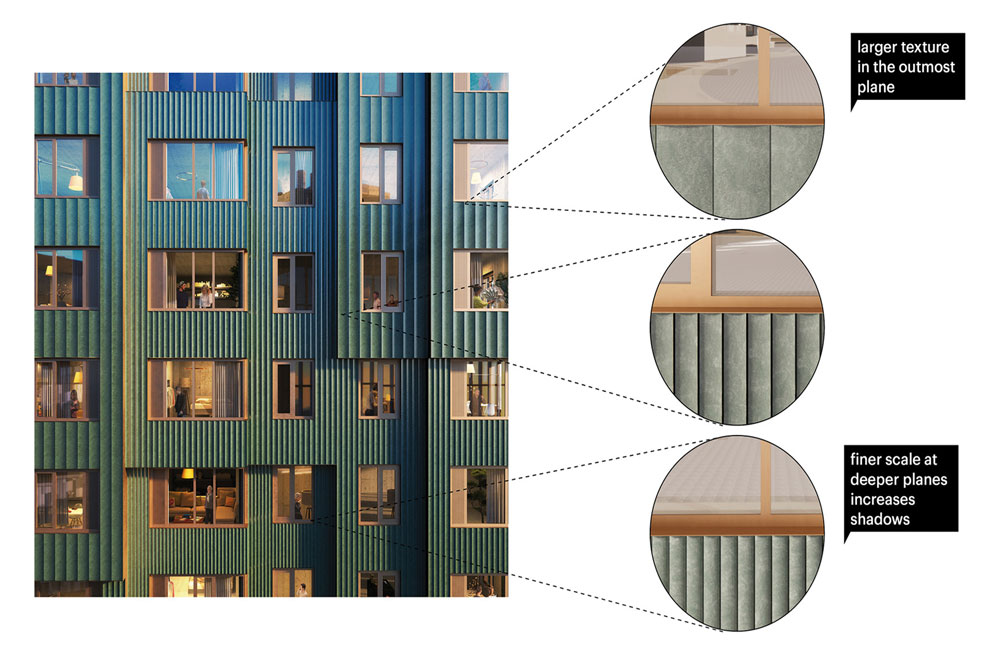 The façades of two residential blocks in the Enterprise Research Campus project in Boston are coated with powder paints from Adapta’s ENAMEL collection, which offers highly decorative, reflective surfaces. Ⓒ MVRDV
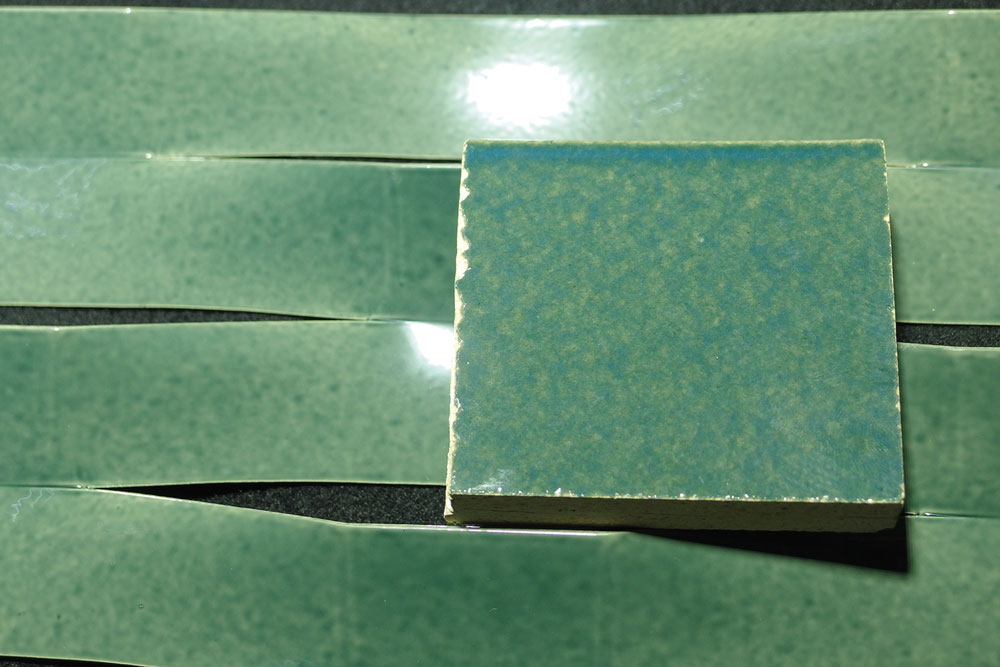 The product from the ENAMEL Collection applied on expanded metal sheet next to the actual ceramic pattern. Ⓒ Adapta
Features of the Vivendi SDS ENAMEL collection
The products in the Vivendi SDS ENAMEL collection are formulated with super-durable polyester resins and applied in two-coat systems. The base coats are in solid colours, whereas the top coats are pigmented transparent paints that mimic enamels and glaze finishes. These two-coat systems meet the highest international quality specifications for powders, such as Qualicoat Class 2, GSB Master, or AAMA-2604, and can be used for outdoor architectural applications.
They are available in smooth satin (30-80% gloss), matte (35-42% gloss), and glossy (80-95% gloss) versions.
The Vivendi SDS ENAMEL products are primarily designed for use on aluminium surfaces, such as: expanded and perforated panels; expanded and flattened mesh; sunshades and screens; façade cassettes.
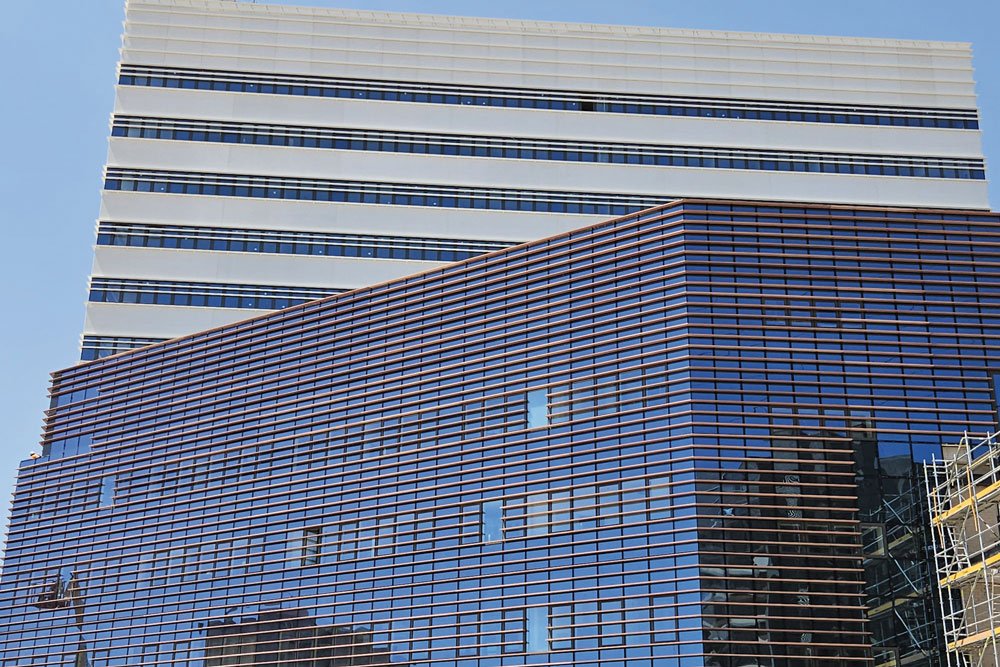 The Vithas Barcelona Hospital in Esplugues de Llobregat (Barcelona) is one of the most recent projects completed with Adapta paints. Ⓒ Adapta
The coatings formulated with the Vivendi SDS technology ensure excellent outdoor resistance, colour stability, and gloss retention after 36 months of exposure in Florida, thus meeting Qualicoat Class 2, GSB Master, and AAMA 2604 standards. With the application of a clear coat, the coating system also easily meets Qualicoat Class 3 and AAMA 2605 certification requirements. In the absence of natural exposure tests in Florida, Adapta’s technicians performed xenon arc (3,000 hours) and QUV B-313 (2,000 hours) tests, which showed a gloss retention of 50%. In addition, the three-coat system applied in Boston was tested for fire resistance in accordance with ASTM E84.
Asset protection and durability as prime indicators of sustainability
In sustainable architectural design, asset durability plays a key role. Using super-durable coatings with long-lasting outdoor aesthetic and functional performance reduces maintenance intervals, prevents premature material replacement, and eliminates the countless costs, including environmental ones, associated with the production of new components. After all, sustainability is not just about reducing environmental impact, limiting carbon footprint, and implementing circular economy principles, but above all about conserving and preserving what already exists.
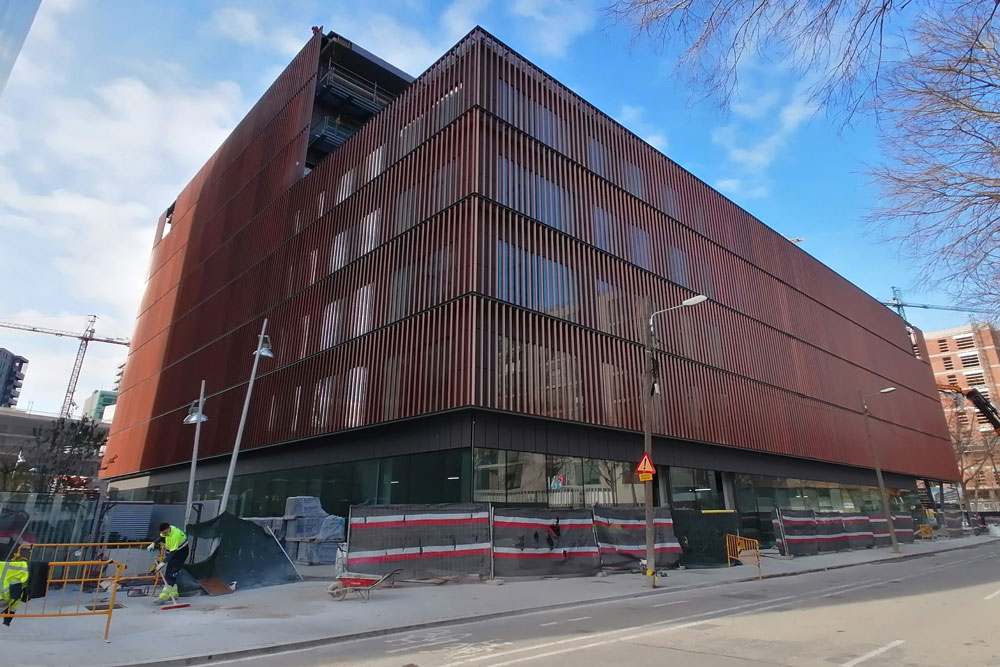 The state-of-the-art Tánger-Álaba office building, located in Barcelona’s 22@ district, has been clad with Adapta’s Enamel Terracotta DM-0073 system. Ⓒ Adapta
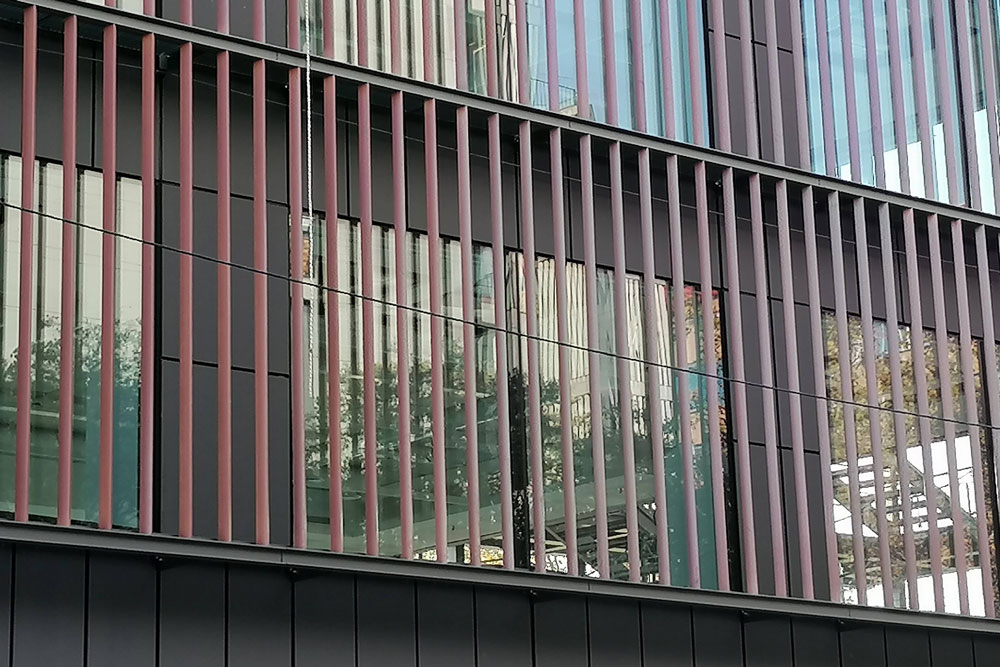 The double baguette façade features super-durable ceramic powder coating in clay tones DM-0073 over RM-9010, RM-9003, and RM-7038. Ⓒ Adapta